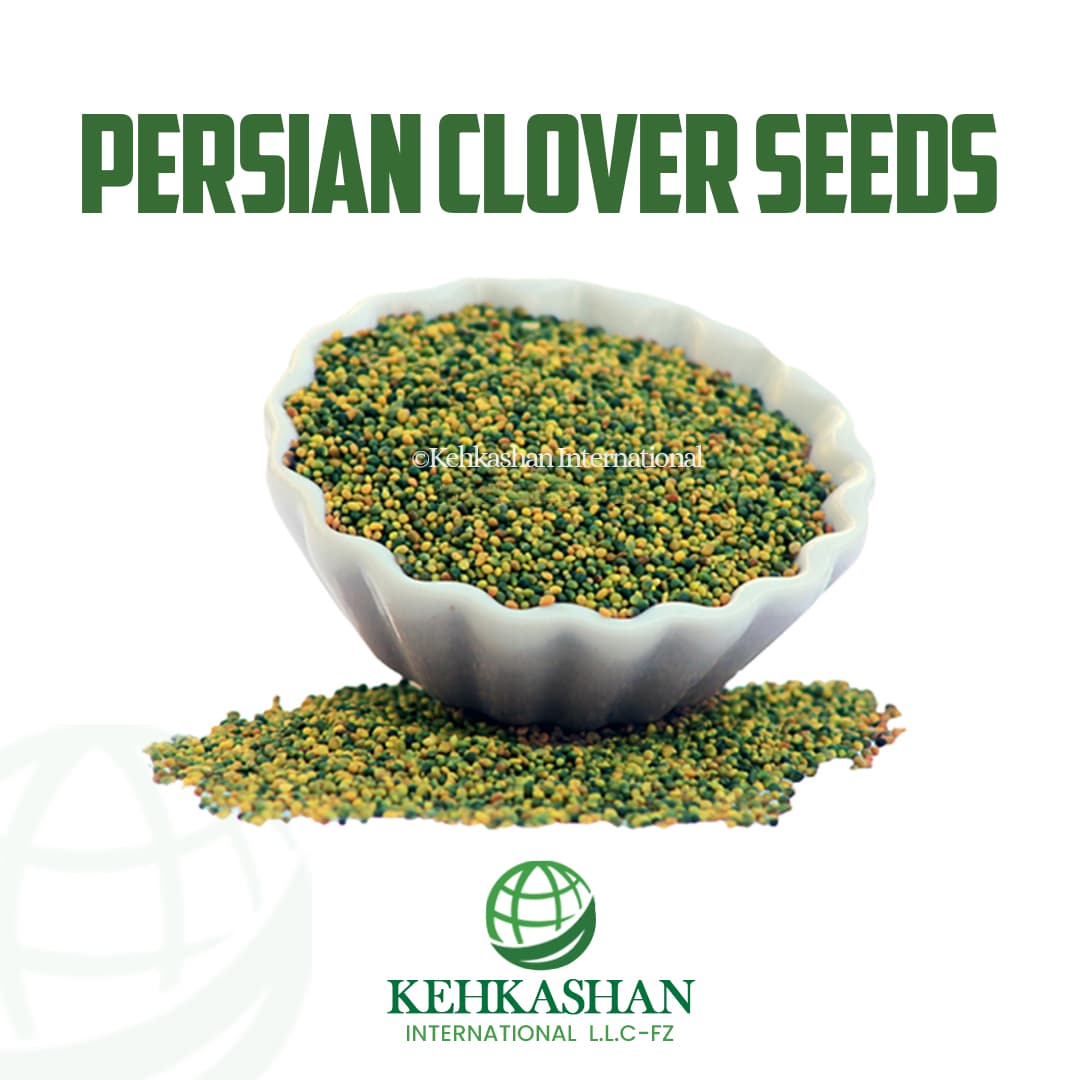
Commercial clover seed covers five Trifolium species — Persian (resupinatum), Berseem (alexandrinum), Red (pratense), White (repens), and Crimson (incarnatum). Buyers specify species, origin, ISTA purity 99 percent, germination 85 percent minimum, dodder-freedom certificate. MOQ is 1,000 kg LCL or 22 metric tons FCL. Lead times Karachi to Jeddah are 5 to 8 days.
Why the clover trade collapses on RFQs that don't name the species
Clover is the single most-confused category in the global forage seed trade. Buyers regularly write "20 tons clover" on the RFQ, expect a quote within an hour, and then spend three days arguing with the supplier about whether the offered material is the right species for their pasture, dairy, lawn or green-manure program. The five commercial Trifolium species are not interchangeable. They differ in growth habit (annual vs perennial), in agroclimatic zone (cool-temperate vs warm-temperate), in nitrogen-fixation rate, in livestock palatability, and in seeding rate per hectare. A Persian clover and a White clover are both "clover" only in the same sense that a wolf and a poodle are both "canine."
This guide walks through the five commercial species, the origin matrix (Pakistan, Egypt, USA, Italy, Australia, New Zealand), the ISTA grading vocabulary, and the documentation set we run on every Kehkashan container. The aim is to give your agronomy and procurement teams a common language to write RFQs that will actually return matched offers.
The five commercial species — what each does and where it grows
Trifolium resupinatum — Persian clover (Shaftal). Annual or biennial, 60 to 90 cm tall. Suited to mild-winter Mediterranean and subtropical zones. The dominant clover species in Pakistani Punjab cultivation, where it is grown as a winter forage rotation between two summer crops. Six to eight cuts possible during the November-to-April growing season. Strong nitrogen-fixation, high palatability for dairy cattle. Pakistan is the largest export-grade producer of Persian clover seed globally.
Trifolium alexandrinum — Berseem clover (Egyptian clover). Annual, 50 to 80 cm tall. Suited to mild-winter subtropical and Mediterranean zones with irrigation. The dominant winter forage in Egyptian Nile Delta cultivation, with substantial production in Pakistani Sindh and northwestern Indian Punjab as well. Three to five cuts during the November-to-April season, with heavier biomass-per-cut than Persian. Egyptian Mescavi, Saidi and Balady varieties dominate the export trade. Covered in our existing Berseem trader's brief — see related links.
Trifolium pratense — Red clover. Short-lived perennial (2 to 3 years), 30 to 80 cm tall. Suited to cool-temperate climates with summer rainfall. The dominant pasture and hay clover in Northern Europe, the US Midwest, the Pacific Northwest, New Zealand and Australia. Strong nitrogen-fixation, moderate palatability, used heavily in mixed pasture programs alongside ryegrass and timothy. Origin supply is dominated by USA (Pacific Northwest), Italy, France, Denmark, and New Zealand.
Trifolium repens — White clover. Long-lived perennial (5+ years), creeping habit, 10 to 30 cm tall. Suited to cool-temperate and high-altitude tropical climates with reliable rainfall per FAO Grassland Index profiles. The dominant pasture clover in Ireland, the United Kingdom, New Zealand, southern Australia and the US Pacific Northwest. Used in mixed pasture programs and as a turfgrass companion legume. Smaller seed size than red — about 0.6 grams per 1,000 seeds versus 1.7 grams for red.
Trifolium incarnatum — Crimson clover. Annual, 30 to 50 cm tall, deep crimson flower head. Suited to mild-winter zones with autumn rainfall. Used primarily as a winter cover crop and green-manure species in the US Southeast, France, Italy and northern Spain. Strong nitrogen-fixation in a short window (90 to 120 days), then terminated for the following spring crop. Origin supply is dominated by USA (Oregon Willamette Valley) and Italy (Veneto, Po Valley).
A sixth species, Trifolium subterraneum — Subterranean clover, has substantial Australian and Mediterranean cultivation but is a niche specialty rather than a mainstream commercial export crop. We can source on request through Australian and Italian partner channels — Trifolium species classifications follow the OECD Forage Seed Scheme variety lists.
Origin matrix — where each species comes from at export volume
| Species | Primary export origins | Pakistan-origin offer |
|---|---|---|
| Persian clover | Pakistan, Iran | Yes — primary Kehkashan offer |
| Berseem clover | Egypt, Pakistan, India | Yes — Pakistani Sindh + Egyptian re-export |
| Red clover | USA (Oregon, Idaho), Italy, Denmark, France, New Zealand | No — origin re-export through Free Zone |
| White clover | New Zealand, Ireland, USA (Oregon), Italy | No — origin re-export through Free Zone |
| Crimson clover | USA (Oregon Willamette Valley), Italy | No — origin re-export through Free Zone |
For the Persian and Berseem species, Kehkashan operates from the Pakistan supply base directly. For red, white and crimson clover, we consolidate origin material through Free Zone routing in the UAE, with proper documentation and Certificate-of-Origin chain for buyers requiring specific origins.
ISTA grading vocabulary on the Certificate of Analysis
A clean clover seed CoA carries seven fields beyond species declaration:
- Species and variety declaration — Trifolium species name, variety where applicable (Mescavi, Mantra, Aberdai, Ladino, etc.).
- Physical purity — ISTA standard, minimum 99 percent for export grade. Premium pasture-grade lots run 99.5 percent.
- Germination — minimum 85 percent for Persian, Berseem and Crimson. Minimum 80 percent for Red. Minimum 85 percent for White. Tested per ISTA at 20 degrees Celsius, 7-day count for most species.
- Hard seed percentage — Trifolium species naturally produce a percentage of hard (water-impermeable) seeds that germinate over multiple seasons. Declared on the CoA, typically 5 to 25 percent depending on species and lot.
- Other-crop seed — below 0.1 percent, with explicit declaration on prohibited weeds.
- Dodder freedom (Cuscuta spp.) — declared as "dodder-free" or with parts-per-million count if any. EU and US destinations require dodder-freedom certification under ISTA seed-purity rules, and lots failing dodder testing are routinely rejected at port.
- Inert matter — below 1 percent.
EU destinations add the OECD seed scheme certificate where applicable, plus additional pesticide-residue testing for organic-certified lots.
Container math, MOQ, and pricing
Clover seed is small and high-density — 1,000-seed weight ranges from 0.6 grams (White clover) to 1.7 grams (Red clover) to 2.0 grams (Berseem). Bulk density runs 750 to 800 kg per cubic meter. A 20-foot full-container load holds 22 to 24 metric tons in 25 kg multi-layer kraft bags or PP woven bags with food-grade liner.
MOQ tiers as we run them at Kehkashan:
- 100 kg starter — minimum order, fits LCL consolidation
- 1,000 kg — break-even on most LCL routes
- 5,000 kg — full LCL consolidation with shared 20-foot booking
- 22,000 kg+ — full 20-foot FCL of single-species, single-variety material
- 26,000 kg+ — full 40-foot FCL for high-volume forage and pasture program buyers
Pricing tiers (FOB Karachi or Free Zone consolidation, indicative, 2026):
- Persian clover (Trifolium resupinatum), Pakistani-origin: 2.20-2.80 USD/kg
- Berseem clover (Trifolium alexandrinum), Egyptian Mescavi: 2.40-3.00 USD/kg
- Berseem clover, Pakistani Sindh: 2.10-2.60 USD/kg
- Red clover (Trifolium pratense), Pacific Northwest USA: 5.50-7.50 USD/kg
- Red clover, Italian: 4.80-6.50 USD/kg
- White clover (Trifolium repens), New Zealand: 7.00-10.00 USD/kg
- White clover, Pacific Northwest USA: 6.50-9.00 USD/kg
- Crimson clover (Trifolium incarnatum), Oregon Willamette: 4.50-6.00 USD/kg
- Coated and Rhizobium-inoculated seed: add 0.40-0.80 USD/kg over uncoated tier
Documentation set on every shipment
Every clover seed container leaves Karachi or Free Zone consolidation with the standard export pack:
- Bill of lading
- Commercial invoice and packing list
- Certificate of Origin (Pakistan Chamber of Commerce, Egyptian Chamber for Berseem re-export, or Free Zone CoO for consolidated origins)
- Phytosanitary certificate with explicit dodder-freedom declaration
- ISTA Certificate of Analysis (species, variety, purity, germination, hard seed, other-crop seed, inert matter)
- OECD seed scheme certificate (where applicable)
- Variety registration / Certificate of Variety
- Seed treatment declaration (active ingredient, rate) where seed is treated, coated, or Rhizobium-inoculated
- Form A or EUR.1 origin certificate where preferential tariff applies
- Fumigation certificate (mandatory for EU and US destinations)
EU organic-certified buyers add the EU-organic transaction certificate per shipment plus the lot-level traceability chain back to the multiplication block.
Lead times by destination port
| Destination port | Country | Ocean transit | Typical Incoterm |
|---|---|---|---|
| Jeddah | Saudi Arabia | 5-8 days | CFR / CIF |
| Hamad | Qatar | 3-5 days | CIF |
| Sohar | Oman | 2-4 days | CIF |
| Mombasa | Kenya | 12-18 days | CIF |
| Dar es Salaam | Tanzania | 14-20 days | CIF |
| Hamburg | Germany | 21-28 days | CIF / DAP |
| Rotterdam | Netherlands | 21-28 days | CIF / DAP |
| Marseille | France | 22-28 days | CIF |
| Genoa | Italy | 22-28 days | CIF |
| New York | United States | 28-35 days | CIF |
| Sydney | Australia | 24-30 days | CFR |
| Auckland | New Zealand | 26-32 days | CFR |
| Mumbai | India | 7-10 days | CFR |
Most clover shipments move at standard ambient with humidity-controlled stowage requirements. Coated and Rhizobium-inoculated seed has a stricter humidity and temperature envelope on the booking note — Rhizobium viability is sensitive to moisture and heat over 35 degrees Celsius for extended periods.
Demand-side pulls — who buyers actually are
Five end-use segments drive global clover seed demand, each with distinct species, origin and pricing tolerances:
Gulf and Middle Eastern dairy and feedlot operations. Saudi Arabia, UAE, Egypt, Sudan, Jordan, Oman. Spec emphasis on Persian clover and Berseem clover for irrigated winter forage rotation. Buyers run 200 to 5,000 ton annual programs. The Gulf is the single largest export market for Pakistani Persian clover.
East African dairy and pasture operations. Kenya, Tanzania, Ethiopia, Rwanda, Uganda, South Africa. Spec emphasis on Red and White clover for high-altitude pasture, plus Berseem for irrigated lowland forage. Buyers run 100 to 1,000 ton annual programs.
European pasture and silage operations. UK, Ireland, Netherlands, Denmark, Germany, France, Italy. Spec emphasis on Red and White clover for mixed pasture programs, plus Crimson clover for cover-crop and green-manure programs. Buyers run 200 to 2,000 ton annual programs, often through national farm-input cooperatives.
North American cover-crop and pasture operations. USA Midwest, Pacific Northwest, Southeast plus Canadian Prairie. Spec emphasis on Crimson clover (cover-crop), Red clover (mixed pasture), and White clover (intensive grazing). Buyers run 100 to 5,000 ton annual programs through farm-input distribution chains.
Lawn, turf and amenity-grass operations. Globally distributed segment serving golf courses, sports turf, and amenity-grass installations. Spec emphasis on White clover (creeping, low-cut tolerant) and Microclover (compact White clover variety) blended with turf-grass species. Volumes are smaller but premium pricing applies.
Competition map — who buyers usually go to
The clover seed export trade is fragmented within each species but with named players at the top of each segment.
For Persian clover: Pakistani exporters dominate, with Kehkashan, Hyseed and Saeed Ahmad Seed Corporation among the larger players.
For Berseem: Egyptian exporters Misr Hytech, El Sayyad, and Daltex dominate the high-volume Mescavi trade. Pakistani Sindh material consolidates through Karachi and serves the price-sensitive segment.
For Red and White clover: DLF Seeds (Danish, world's largest forage and turf seed company), Barenbrug (Dutch), PGG Wrightson (New Zealand), Smith Seed Services (Oregon), and Pacific Seeds dominate the premium origin trade.
For Crimson clover: Smith Seed Services, Saddle Butte Ag, Allied Seed (all Oregon Willamette Valley), plus Italian regional cooperatives serve the bulk of global supply.
For buyers running diligence, the differentiators between credible suppliers and marketplace listings are:
- Species and variety transparency — a credible exporter can produce the formal Certificate of Variety, the breeder's release notes, and the multiplication chain back to the original parental lines.
- Lab certification of germination, hard seed percentage, and dodder freedom from an ISTA-accredited lab.
- Origin transparency — for re-exported red, white, and crimson clover, the original origin (USA, New Zealand, Italy, etc.) must trace through the documentation chain. Marketplace listings that obscure origin should be treated cautiously.
- Rhizobium inoculant compatibility — for buyers needing inoculated or coated seed, the Rhizobium strain (R. leguminosarum biovar trifolii) and inoculation date must be documented for viability assessment.
We document each of these on every Kehkashan clover shipment. Sample lots of 1 to 5 kg are couriered free of freight to qualified buyers worldwide; the sample fee credits against the first PO on acceptance.
When to buy ahead vs spot
Persian and Berseem clover multiplication in Pakistan and Egypt runs the November-to-April winter season. Quality assessment finishes by late May, and the year's pricing band stabilizes by July. Annual contracts booked in July at fixed prices typically secure 8 to 12 percent better pricing than spot purchases through the year, plus guaranteed availability of the specified species.
Red, White and Crimson clover multiplication in Pacific Northwest USA, Italy and New Zealand runs the spring-summer growing season, with harvest July to September. Quality assessment finishes by late October, and the year's pricing band stabilizes by December. Annual contracts booked in December secure pricing-stability premiums for buyers running multi-year pasture or cover-crop programs.
For Gulf and East African winter forage program buyers — annual contracts are essentially mandatory for spec consistency. For European and North American cover-crop and pasture buyers running smaller spot programs, mid-year purchases of 1 to 5 ton lots through the year work reliably.
Trade desk closing note
Clover is one of those crops where the supplier needs to know the agronomy as well as the buyer's procurement team does. The wrong species at the wrong seeding rate in the wrong climate is a season-killing mistake — and most "clover" seed sold on B2B marketplaces does not match the spec the buyer's downstream agronomy team intended. We work with multiplication partners in the Faisalabad and Multan corridors of Punjab for Persian and Berseem, plus consolidator partnerships into Egyptian Mescavi, Pacific Northwest Red, New Zealand White, and Oregon Crimson supply for buyers needing those origins specifically.
For a quote, send the five RFQ specs (species, variety, origin preference, treatment yes/no, quantity) to [email protected]. The trade desk replies within one working day with FOB Karachi or Free Zone consolidation, CFR your-destination-port, CIF, and DAP options.


