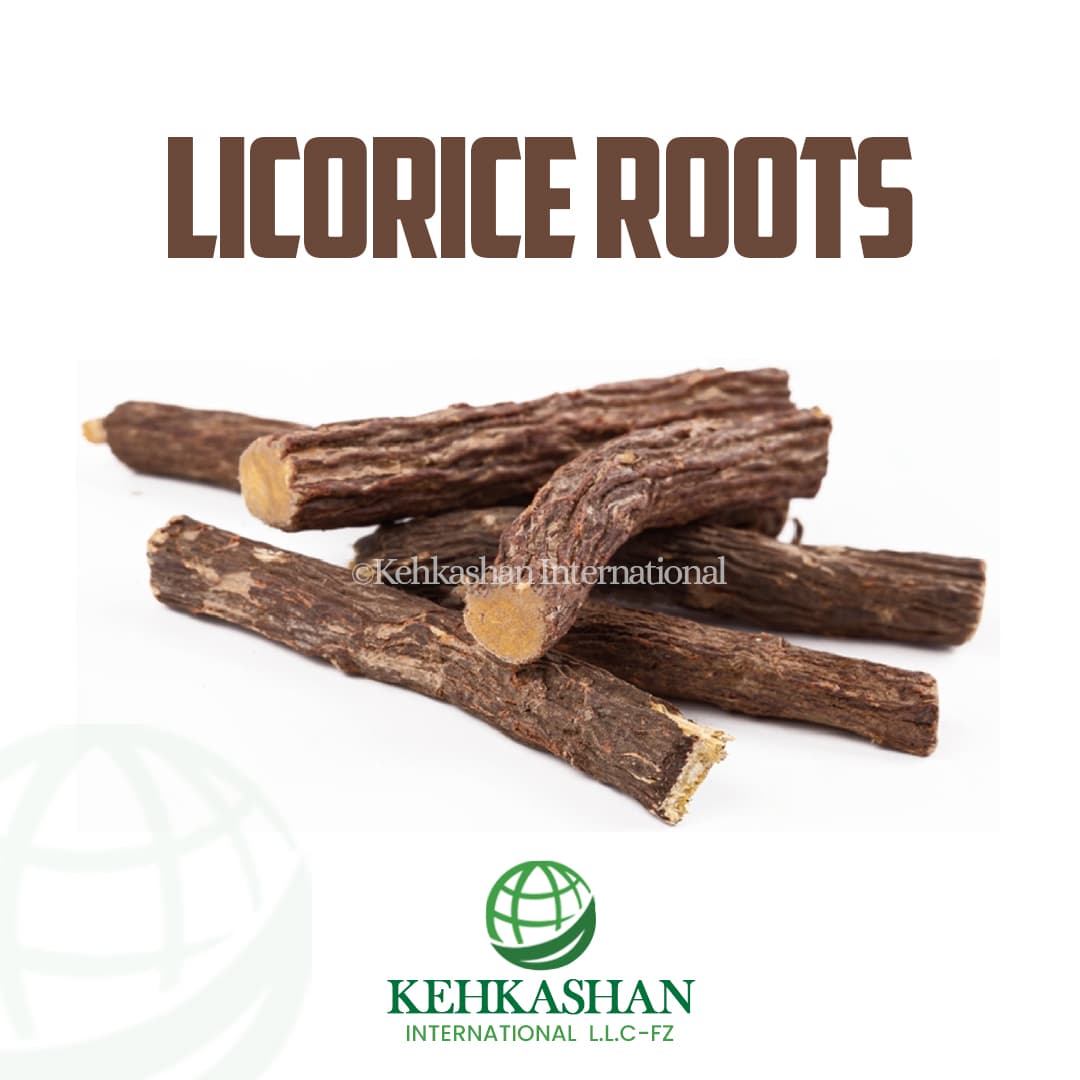
Licorice roots (Glycyrrhiza glabra) come primarily from Pakistan, Afghanistan, Uzbekistan, Turkmenistan and Azerbaijan. Buyers specify glycyrrhizin content of 8 to 12 percent, moisture below 12 percent, peeled or unpeeled grade, and EU heavy-metal compliance. Standard MOQ is one 20-foot full-container load at 18 to 22 metric tons. Lead times from Karachi to Jeddah are 5 to 8 days.
Where commercial licorice roots come from
Glycyrrhiza glabra is a perennial legume that thrives in arid and semi-arid climates with calcareous, alkaline soils. Wild-harvested licorice from the Greater Khorasan and Central Asian belt accounts for the bulk of global supply tracked under ITC HS-1211.90. Five origin countries cover roughly 85 percent of the export trade.
Pakistan. Wild licorice is harvested across Sindh, Balochistan, and southern Punjab, with smaller volumes from Khyber-Pakhtunkhwa river valleys. Pakistani licorice ships out of Karachi and Gwadar; the Department of Plant Protection issues phytosanitary certificates. Glycyrrhizin content runs 7 to 11 percent on Pakistani-harvest lots — the bulk-export workhorse.
Afghanistan. Concentrated in the Mazar-i-Sharif region (Balkh province), Kunduz, and the Hari River valley near Herat. Higher glycyrrhizin titrations of 9 to 13 percent are common in Afghan-origin material because of the older, deeper-root harvest tradition. Most Afghan licorice transits through Pakistan ports under mixed-origin documentation.
Uzbekistan and Turkmenistan. Premium origin for European confectionery and pharmaceutical buyers. Uzbek licorice from the Karakalpakstan and Khwarazm regions can reach 14 percent glycyrrhizin in carefully selected lots. Direct exports through the Caspian or via the trans-Caspian route are growing, but Karachi remains a fallback consolidation point for buyers wanting one-stop GCC dispatch.
Azerbaijan. Smaller supplier, mostly serving Iranian and Turkish markets. Lots ship through Baku-Aktau-Aktau-Bandar Abbas or the Baku-Tbilisi-Kars rail corridor. Glycyrrhizin titration averages 10 to 12 percent.
The five countries together produce roughly 50,000 to 80,000 metric tons of harvest-weight wild licorice annually, with maybe half that reaching international export markets after domestic confectionery and pharmaceutical absorption.
Glycyrrhizin titration is the price driver
Buyers paying for licorice roots are paying for glycyrrhizin — the sweet, anti-inflammatory glycoside that dominates end-use applications. The European Pharmacopoeia monograph for liquorice root (Liquiritiae radix) requires not less than 4 percent glycyrrhizic acid for pharmaceutical input. Higher percentages command higher prices, and the spec on the RFQ should always state the target glycyrrhizin band.
Typical bands and applications:
- 6 to 8 percent. Bulk feedstock for licorice extract producers who concentrate downstream. Lowest FOB pricing, highest tonnage per container. Indian gutka and tobacco-flavor industry is a major buyer at this band.
- 8 to 10 percent. Standard food-flavor and confectionery grade. Most European candy makers (Haribo, Fazer, Katjes) buy in this band.
- 10 to 12 percent. Pharmaceutical-grade input for traditional medicine preparations. South Korean, Japanese, and Chinese herbal pharma buyers spec this band.
- 12 percent and above. Premium nutraceutical and cosmetic-grade. Skincare brands using licorice as a tyrosinase inhibitor (skin-brightening, hyperpigmentation) pay a substantial premium for guaranteed-titration lots.
Custom titration is available — when a buyer needs a specific band, the supplier blends harvest lots to hit the target plus or minus 0.5 percentage points. This costs more in lab work and margin but is routinely done for buyers running standardized formulations.
Grade vocabulary on the Certificate of Analysis
A clean licorice CoA carries five fields beyond glycyrrhizin titration:
- Format — small-cut (1 to 3 cm pieces), sticks (10 to 25 cm), peeled, unpeeled, powder.
- Moisture — below 12 percent for shipped grade. Bulk lots above 12 percent risk fungal degradation in transit.
- Foreign matter — below 2 percent for food-grade, below 0.5 percent for pharma-grade.
- Aflatoxin — total below 4 micrograms per kilogram for EU-compliant lots, B1 below 2 micrograms per kilogram. Required test under EU Regulation 1881/2006.
- Heavy metals — lead below 3 mg/kg, cadmium below 1 mg/kg, mercury below 0.1 mg/kg, arsenic below 1 mg/kg. EU pharmacopoeia heavy-metal limits for herbal substances.
Pharmaceutical and cosmetic buyers add pesticide residue panels (Annex A and B in EU pharmacopoeia) and microbiological tests for total aerobic microbial count plus E. coli absence.
Container math, MOQ, and pricing
Licorice roots are higher density than seeds. A 20-foot full-container load holds 18 to 22 metric tons of small-cut licorice in 25 kilogram PP bags, or 16 to 20 metric tons of sticks in 50 kilogram jute bags, or 24 to 26 metric tons of compressed bales of raw roots.
MOQ tiers as we run them at Kehkashan:
- 500 kg starter — minimum order, fits LCL consolidation
- 5,000 kg — break-even on a 20-foot LCL with consolidated shipping
- 18,000 kg+ — full 20-foot FCL of single-grade material
- 22,000 kg+ — full 40-foot FCL for bulk extract producers
Pricing tiers (FOB Karachi, indicative, 2026):
- Small-cut bulk, 7 to 8 percent glycyrrhizin: 1.20-1.50 USD/kg
- Small-cut food-grade, 8 to 10 percent: 1.50-1.90 USD/kg
- Sticks unpeeled, 8 to 10 percent: 1.40-1.80 USD/kg
- Sticks peeled, 10 to 12 percent: 2.20-2.80 USD/kg
- Powder, 8 to 10 percent: 2.00-2.40 USD/kg
- Powder, pharma-grade 12 percent+: 3.50-5.00 USD/kg
Documentation set on every shipment
Every Glycyrrhiza glabra container leaves Karachi or Jebel Ali with the standard export pack:
- Bill of lading
- Commercial invoice and packing list
- Certificate of Origin (Pakistan Chamber of Commerce or Afghan Chamber)
- Phytosanitary certificate (Department of Plant Protection or Afghan equivalent)
- Certificate of Analysis (glycyrrhizin titration, moisture, aflatoxin, heavy metals)
- Health certificate (PSQCA or equivalent)
- Form A or EUR.1 origin certificate where preferential tariff applies
- Fumigation certificate (mandatory for EU, optional for GCC)
EU pharmaceutical-grade buyers add the Certificate of Suitability to the European Pharmacopoeia (CEP) on a per-lot basis when supplied; this requires a more rigorous lot record and is priced accordingly.
Lead times by destination port
| Destination port | Country | Ocean transit | Typical Incoterm |
|---|---|---|---|
| Jeddah | Saudi Arabia | 5-8 days | CFR / CIF |
| Hamad | Qatar | 3-5 days | CIF |
| Sohar | Oman | 2-4 days | CIF |
| Mombasa | Kenya | 12-18 days | CIF |
| Hamburg | Germany | 21-28 days | CIF / DAP |
| Rotterdam | Netherlands | 21-28 days | CIF / DAP |
| Felixstowe | United Kingdom | 21-28 days | CIF / DAP |
| New York | United States | 28-35 days | CIF |
| Mumbai | India | 7-10 days | CFR |
| Busan | South Korea | 21-28 days | CFR |
| Shanghai | China | 18-24 days | CFR |
| Yokohama | Japan | 24-30 days | CFR |
US-bound pharma-grade material specifies refrigerated container service for stability; the rest moves at standard ambient.
Competition map — who buyers usually go to
The licorice export trade is concentrated. Three names dominate global supply: Alfarid Corporation (Pakistan/UAE-based, US FDA registered, ISO 9001:2008), Shadian (French-Afghan with operations in Mazar-i-Sharif and consolidation through Karachi), and Norevo (German with Uzbek and Iranian sourcing). Below this top tier sit roughly 20 to 30 mid-volume Pakistani and Afghan exporters plus regional players in Iran and Azerbaijan.
For buyers running diligence, the differentiators between credible suppliers and marketplace listings are:
- Lot traceability to the harvest village or province — a credible exporter can produce GPS coordinates or named cooperative for the lot.
- Lab certification from an internationally recognized lab (SGS, Bureau Veritas, Intertek, Eurofins) on the glycyrrhizin titration. In-house anonymous certificates carry minimal weight.
- Stability of glycyrrhizin band across multiple shipments — a supplier who can deliver the same titration band across four annual shipments is the supplier you want for a standardized formulation.
We document each of these on every Kehkashan licorice shipment. Sample lots of 1 to 2 kilograms are couriered free of freight to qualified buyers worldwide; the sample fee credits against the first PO on acceptance.
When to buy ahead vs spot
Wild licorice harvest in Pakistan and Afghanistan runs September to November. Quality assessment finishes by late January, and the year's pricing band stabilizes by mid-February. Annual contracts booked in February at fixed prices typically secure 6 to 10 percent better pricing than spot purchases through the year.
For nutraceutical and cosmetic buyers running standardized formulations against a guaranteed glycyrrhizin band, the annual-contract route is the only practical option — spot supply rarely matches the spec consistency these buyers need.
For confectionery and tobacco-flavor industrial buyers with looser titration tolerance, spot purchases of 5 to 10 ton lots through the year work reliably.
Trade desk closing note
Licorice is one of those commodities where the supply chain compresses quickly above the village-collection level, and the right supplier is one who knows the harvest traders by name and can hold a glycyrrhizin band across multiple shipments. We work with cooperatives in Sindh, Balochistan, and the Mazar-i-Sharif region, plus consolidator partnerships into Uzbek and Turkmen sources for buyers needing those origins specifically.
For a quote, send the four RFQ specs (origin, glycyrrhizin band, format, quantity) to [email protected]. The trade desk replies within one working day with FOB Karachi, CFR your-destination-port, CIF, and DAP options.


