Saltar al contenido
Kehkashan

Sesame Seeds Exporter & Wholesale Supplier — 35+ Origins, 80+ Destinations

Kehkashan exports sesame (Sesamum indicum) seeds from origin partners in Sudan, Ethiopia, Nigeria, India, and Pakistan — supplied in bulk FCL or LCL with FOB Jebel Ali, CFR, or CIF terms to tahini, bakery, and oil-extraction buyers across 80+ destinations.
  • 35+ origins
  • 80+ destinations
  • ISTA / OECD certified
  • LC at sight (USD/EUR)
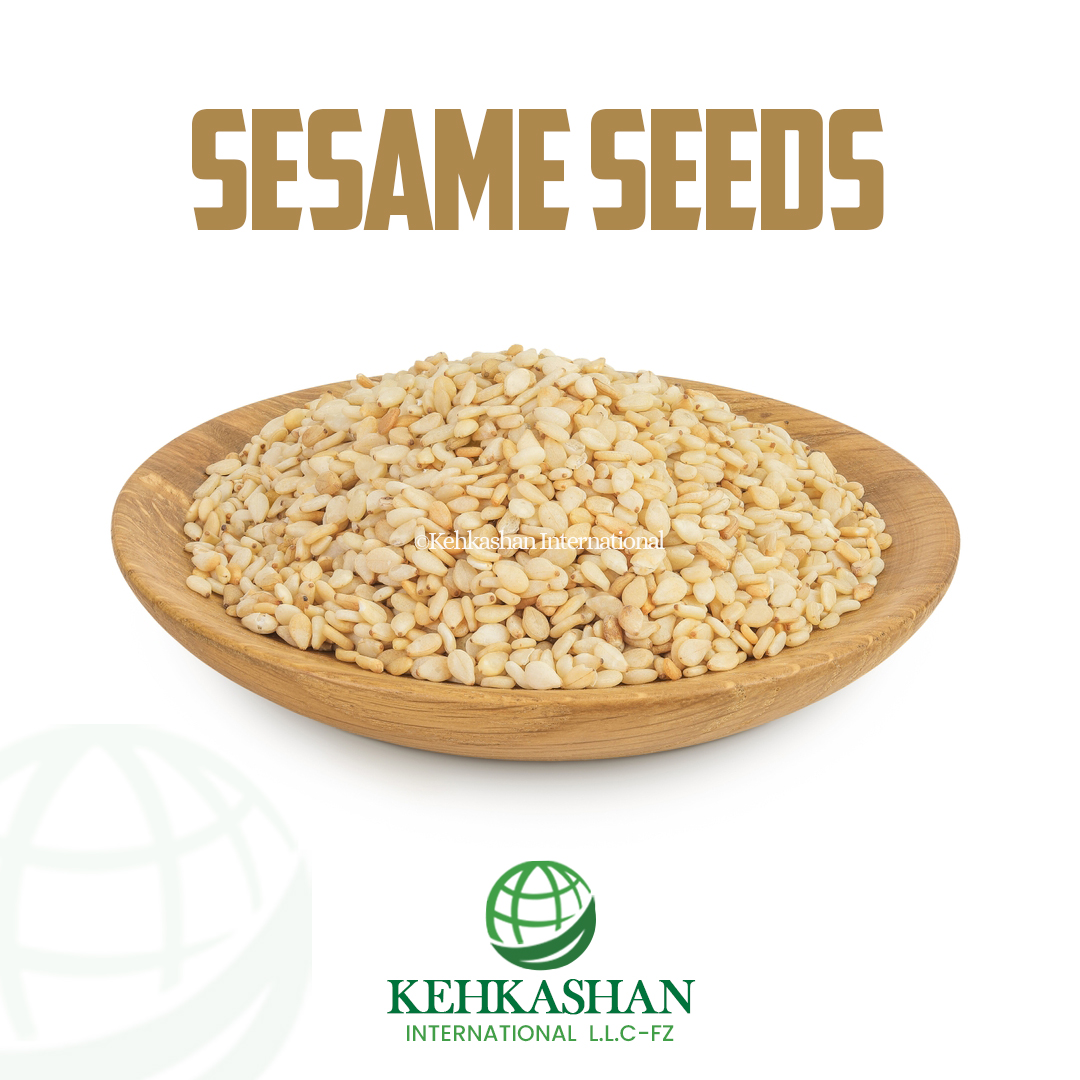
Sesame Seeds — foto del producto Kehkashan International

Reference image. Sample lots and product-specific photography available on RFQ.

Quick facts

Scientific name
Sesamum indicum
HS code
1207.40
Common varieties
Hulled white 99.95%, Natural white 99%, Black sesame, 99/1 Sortex
Origins available
India, Sudan, Ethiopia, Tanzania, Nigeria, Mali, Senegal, Uganda, DR Congo, Angola, Kenya, Iran, Bangladesh, Thailand, China, Mexico, Brazil, Kazakhstan, Russia, Argentina, Peru, Egypt, Iraq, Pakistan
MOQ
1 × 20'FCL
Pack sizes
25 kg PP bag, 50 kg jute bag, 1 MT FIBC
Specs
Sortex: 99 / 99.5 / 99.95%, Moisture: < 6%, FFA: < 2%, Admixture: < 0.5%
Lead time
14–21 days from PO confirmation
Incoterms
FOB Jebel Ali · CFR · CIF · DAP
Payment terms
LC at sight · TT · DP

Especificación y cálculo del contenedor

Niveles MOQ

NivelCantidadNota
Trial5 MT LCL
Standard FCL1 × 20'FCL ≈ 24 MT
Programme20–100 × 20'FCL / year

Bandas de precio FOB (a solicitud)

GradoRango indicativo
Sortex 99% white (commercial bakery)RFQ — entry tier
Sortex 99.5% white (premium tahini)RFQ — mid tier
Sortex 99.95% AA (Japan / Korea premium)RFQ — top tier
Hulled (oil-extraction grade)RFQ — variable

Plazos — destinos principales

Puerto de descargaTránsitoIncoterm
Karachi / Mundra (FOB)0 daysFOB
Jebel Ali (UAE)4–6 daysCFR / CIF
Mersin (Türkiye)14–18 daysCFR / CIF
Yokohama (Japan)28–35 daysCFR / CIF
Hamburg (Germany)21–28 daysCFR / CIF
Formatos de empaque
25 kg PP bag · 50 kg jute bag · 1 MT FIBC
Capacidad del contenedor
20'FCL: 24 MT (PP) · 22 MT (FIBC)

Set documental por embarque

Cada contenedor sale de la Zona Franca de EAU con el paquete documental indicado. Certificados adicionales (Halal, SASO, BRC, orgánico, FairWild, etc.) se agregan a solicitud antes del embarque.

  1. Bill of Lading (BL) — original 3/3 set
  2. Commercial Invoice — UAE Free Zone issued
  3. Packing List with lot codes
  4. Certificate of Origin (CoO) — Dubai Chamber attested
  5. Phytosanitary Certificate — origin NPPO
  6. SGS / Bureau Veritas weight + quality report
  7. Oil-content + FFA + moisture analysis (origin lab)
  8. GMO / Non-GMO declaration
  9. Fumigation Certificate
  10. Form A (GSP) where applicable

Origin × spec comparison

Sesame Seeds origin comparison: variety options, fall dormancy, purity, germination, lead time, FOB Jebel Ali price.
OriginVariety optionsFall dormancyPurity %Germination %Lead time to Jebel AliFOB Jebel Ali
India14–21 daysRFQ
Sudan14–21 daysRFQ
Ethiopia14–21 daysRFQ
Tanzania14–21 daysRFQ
Nigeria14–21 daysRFQ
Mali14–21 daysRFQ
Senegal14–21 daysRFQ

Indicative figures. Prices and lead times are confirmed at the time of RFQ.

What buyers ask us most

  • Do you supply HarvXtra alfalfa to Saudi Arabia?

    Yes — USA-origin AmeriStand 480 HarvXtra, fall-dormancy 4, ISTA-tested.

  • Can you mix Italian and Australian alfalfa on one PO?

    Yes — multi-origin consolidation at Jebel Ali is our default.

  • What's your germination guarantee?

    90 percent minimum, ISTA-tested COA per shipment.

  • Do you handle phytosanitary, COO, and fumigation?

    Yes — included in CFR, CIF, and DAP terms.

  • What's the MOQ for alfalfa seed versus alfalfa hay?

    Seed MOQ is 1 × 20'FCL (~25 MT). Hay is quoted on inquiry.

Origins we draw alfalfa from, and which buyer prefers which

Saudi Arabia dairy buyers tend to ask for USA-origin AmeriStand 480 HarvXtra and 455TQ Roundup Ready, fall-dormancy 4 to 5. Kenyan smallholder farmers and East African cooperatives prefer Italian and Argentinian fall-dormancy 6 to 8 lots. Russian feed mills source Pakistani and Argentinian alfalfa at lower entry pricing per metric tonne shipped.

What the variety codes actually mean for your field

AmeriStand 403T carries traffic-tolerance traits at fall-dormancy 4. AmeriStand 480 HarvXtra is the reduced-lignin Roundup Ready release for higher-quality dairy hay. WL 525HQ is a fall-dormancy 5 selection from the Forage Genetics International program. CW 5050 is a conventional dormancy-5 line widely used in Italy and Argentina across pivot fields.

Spec language on every alfalfa COA we ship

Every shipment carries an ISTA-format Certificate of Analysis with purity 99.0 to 99.9 percent, germination 90 percent minimum, and a dodder-free declaration. Origin lots from the United States and Australia are OECD-scheme tagged. Sortex cleaning is applied at the packing line where field admixture exceeds 0.5 percent. Hard-seed counts are reported on request.

Fall dormancy ratings 4 to 10 and how to pick the right one

Fall-dormancy 4 to 5 fits temperate Saudi central pivots, Algerian pivot circles, and southern European multi-cut systems. Fall-dormancy 6 to 7 suits Egyptian Delta rotations, Moroccan irrigated valleys, and most Kenyan smallholder programs. Fall-dormancy 8 to 10 is for year-round equatorial dairy operations in East Africa, Sudan, and tropical Latin America.

Use cases: dairy, beef, sheep, and equine forage

Saudi dairy and Gulf dairy operations use HarvXtra reduced-lignin alfalfa for higher relative-feed-value hay. Kenyan and Tanzanian smallholder beef and sheep programs run conventional fall-dormancy 6 to 8 alfalfa in mixed-rotation paddocks. Equestrian buyers in Qatar, Kuwait, and the UAE specify low-dust, double-cleaned WL series lots for stable feed.

Logistics from Jebel Ali to your discharge port

From Jebel Ali, transit to Jeddah and Dammam runs 5 to 8 days. To Mombasa via the Indian Ocean it is 12 to 18 days. Aqaba is 7 to 10 days. Doha and Kuwait are 3 to 5 days. Karachi is 4 to 6 days. Beirut is 10 to 14 days. We consolidate multi-origin alfalfa lots inside one 20 foot or 40 foot container at Jebel Ali before sailing.

Pricing structure: FOB versus CFR versus CIF deltas

We quote FOB Jebel Ali, CFR destination, CIF destination, and DAP door-step on the same RFQ. The FOB-to-CFR delta covers ocean freight only. The CFR-to-CIF delta adds marine insurance at roughly 0.15 percent of invoice plus 10 percent. DAP additionally covers destination port handling, inland trucking, and customs broker handover at your door.

Quality assurance: sample, COA, buyer approval, ship

We courier a one to two kilogram alfalfa sample with a draft Certificate of Analysis. The buyer runs lab confirmation or visual inspection. After signed approval we open the proforma invoice against an LC at sight or TT advance. Container loading happens under our supervisor. Documents are released through your bank.

Buying alfalfa in 20-foot FCL versus 40-foot HC versus LCL

One 20 foot full-container load fits about 24 to 25 metric tonnes of alfalfa seed packed in 25 kilogram PP bags or 50 kilogram jute bags. A 40 foot high-cube takes 26 to 28 metric tonnes. Less-than-container shipments are accepted for trial orders down to roughly 5 metric tonnes consolidated with our Jebel Ali warehouse partner before ocean dispatch.

Documentation set we release per alfalfa shipment

A standard alfalfa export pack includes the ISTA Certificate of Analysis, Certificate of Origin issued by the Dubai Chamber, a phytosanitary certificate from the UAE Ministry of Climate Change and Environment, the bill of lading, the commercial invoice and packing list, and where the destination requires it a fumigation certificate and Form A.

Sanctions, payment, and trade-finance from a UAE Free Zone

Russian feed mills and Iranian buyers benefit from neutral-jurisdiction USD or EUR LC at sight issued from our UAE Free Zone account. We screen each PO against UN, EU, US, and UK sanctions lists before confirming. TT advance and DP collection are accepted for repeat buyers. Saudi importers usually open LC through SABB or Riyad Bank.

Risk and rejection: how we handle a failed COA at destination

If a destination lab reports germination below 90 percent or purity below 99 percent, we accept a counter-sample drawn under SGS or Bureau Veritas supervision. Confirmed off-spec lots are replaced from a sister origin or refunded against the LC. We log every deviation and route the lot back through Sortex re-cleaning before any resale.

Saudi Arabia, Egypt, and Jordan import compliance for alfalfa

Saudi importers must clear SFDA and the Ministry of Environment, Water and Agriculture seed-import permit. Egypt requires phytosanitary inspection at Alexandria or Port Said and a CASC certificate. Jordan accepts ISTA-tagged lots through Aqaba with an MoA seed-quality clearance. We pre-stage compliance documents before container dispatch.

What changes when you order Roundup Ready alfalfa

Roundup Ready alfalfa carries a Monsanto-Forage-Genetics technology fee priced into the seed cost. Buyers sign a stewardship agreement governing replant rights and isolation distance. RR alfalfa is not permitted into the European Union or the GCC organic-certified channels. Conventional WL series and CW 5050 are the substitute lines for those buyers.

Preguntas de los equipos de compras

Respuestas a las preguntas más frecuentes que hacen los compradores durante la cotización y la evaluación de muestras.

What is the difference between Sortex 99, 99.5, and 99.95%?
Sortex grade is the optical-sorting purity benchmark — what fraction of the lot passes through optical-sort rejection of black, broken, or off-colour seed. Sortex 99% is bakery / commercial grade; 99.5% is premium tahini / halva grade demanded by Israeli, Lebanese, and Turkish processors; 99.95% is Japan-AA / Korea premium grade demanded by sushi-bun toppings, sesame-oil retail packers, and high-end confectionery.
Humera, Sudanese, Pakistani, or Indian sesame — which origin?
Humera (Ethiopian / Eritrean western lowland) is the global benchmark for premium white sesame — high oil content (53–55%), bright white seed, sweet flavour. Sudanese is comparable but variable. Pakistani Sindh / Punjab sesame is high-quality and nearer to Gulf markets. Indian Gujarat / Madhya Pradesh sesame is high-volume, slightly smaller seed, often blended. Match origin to end-use; we route Humera to Israeli tahini, Sudanese / Pakistani to Gulf retail, Indian to bulk oil-extraction.
What is the Salmonella test protocol?
Every shipment to EU, Japan, Korea, USA destinations carries a Salmonella-negative test report from an ILAC-accredited origin lab plus a destination retest at port-of-discharge if required. Sesame-Salmonella has been a recurring global issue (2018 EU recalls, 2021 Australian recalls); we run pre-loading and post-loading tests on every lot above 5 MT. Steam-pasteurised lots carry an additional certificate.
Hulled or natural — what changes?
Natural sesame retains the seed coat — used for tahini and halva manufacture (the coat carries flavour compounds). Hulled sesame has the coat mechanically removed — used in bakery toppings (sesame-bun seeds), oil extraction (higher oil yield), and confectionery. Hulled commands a 8–12% premium over natural for the same Sortex grade because of yield loss in hulling. Specify clearly on the PO.
How do you handle moisture and FFA on long-haul shipments?
Specify moisture < 6% and FFA < 2% on origin COA. Long-haul (Mundra to Yokohama 28–35 days) requires moisture < 5.5% pre-loading because container condensation can lift moisture 0.5% in transit. We ship sesame in unlined 25 kg PP bags (breathable) on long routes and add silica gel desiccant to FIBCs. Sortex re-cleaning at destination port is available for high-spec buyers.

Guías extensas redactadas por el equipo comercial Kehkashan para compradores y áreas de compras — comparativas de origen, códigos varietales y flujos documentales.

Quote a 20'FCL of alfalfa today

RFQ response within 24 hours. FOB Jebel Ali, CFR, CIF, or DAP. LC at sight, TT, or DP.

Dispatch from Jebel Ali. Lead time 14–21 days. RFQ within 24h.