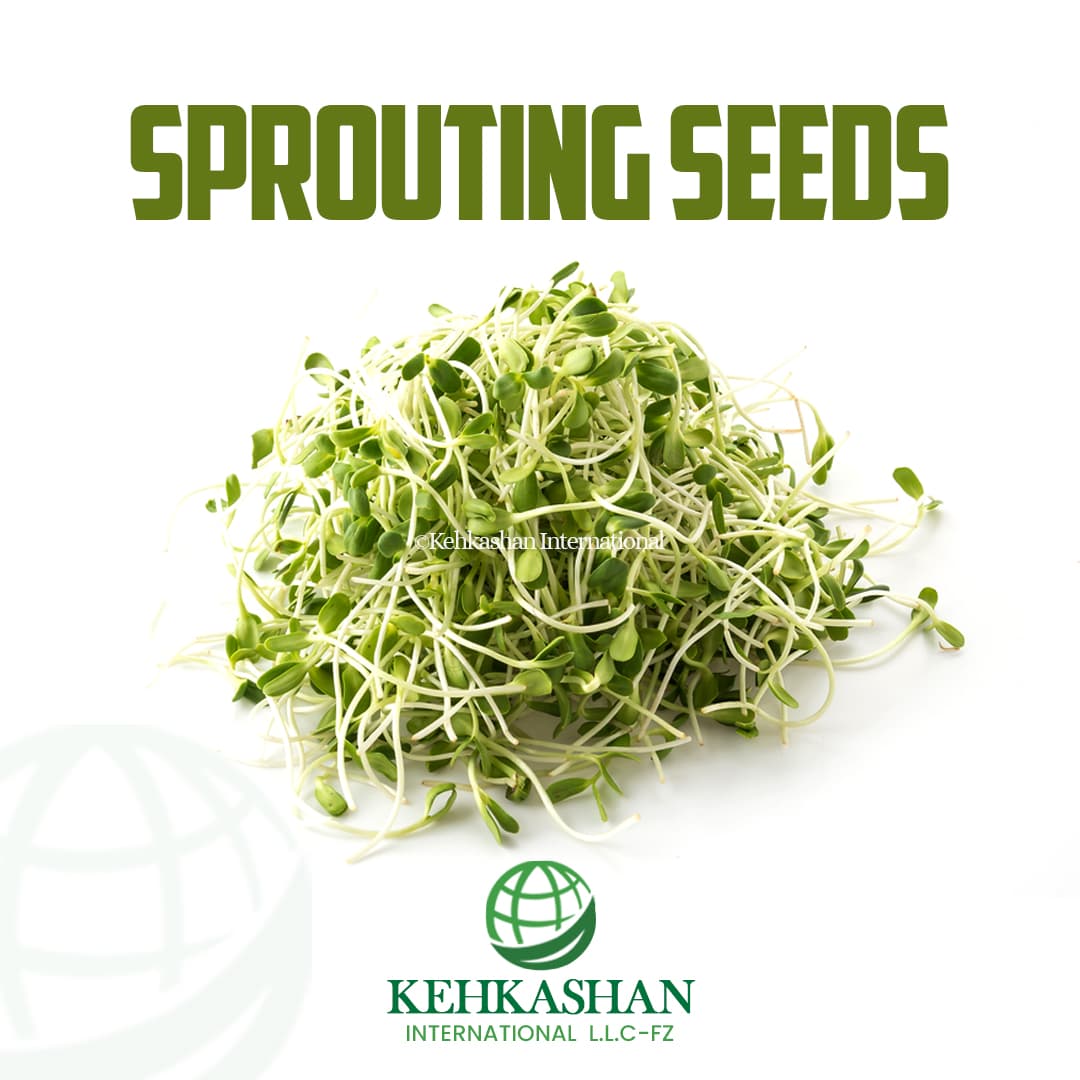
Sprouting seeds (alfalfa, broccoli, mung bean, lentil, radish, wheat, barley, sunflower) come primarily from Pakistan, USA, Canada, Italy and India. Buyers specify germination above 95 percent, salmonella absence, E. coli absence, EU and FDA pathogen-control compliance, and moisture below 12 percent. MOQ is 500 kg LCL or 22 metric tons FCL. Lead times Karachi to Hamburg are 21 to 28 days.
Why sprouting seeds are a different commercial category from the same plant species used as forage or food
Sprouting seeds and the same plant species used as forage seed or food seed are graded against different regulatory regimes, even when they look identical in the bag. The buyer who treats them as interchangeable creates a real food-safety and recall risk for the downstream sprouting operation.
Sprouting seeds are the input to a controlled-environment germination process that takes the seed from dormant to consumed (sprout, microgreen, or shoot) in 3 to 14 days. During that germination, any pathogen present on the seed surface (salmonella, E. coli O157:H7, listeria) multiplies rapidly in the warm, humid environment. The downstream consumer eats the resulting sprout raw or lightly cooked. The result: sprout-derived foodborne illness outbreaks have killed people, recalled millions of dollars of retail product, and triggered FDA Produce Safety Rule sprout-specific provisions and EU Implementing Regulation 208/2013 traceability rules for sprouts that classify sprouting seeds as a high-risk food-input category requiring specific pre-shipment pathogen testing and lot-level traceability.
Forage seed and food-grain seed of the same species do not face the same regulatory burden because the downstream process either kills pathogens (cooking) or does not produce the same pathogen-amplification environment (forage growth). A "Medicago sativa" lot can be sold as alfalfa forage seed at 1.40 USD/kg and as alfalfa sprouting seed at 7.50 USD/kg, and the difference is mostly in the pathogen-testing regime and the lot-traceability discipline.
This guide walks through the eight commercial sprouting species, the salmonella and E. coli specifications that drive the trade, the origin matrix, and the documentation set we run on every Kehkashan sprouting-seed container.
The eight commercial sprouting species
Alfalfa sprouts (Medicago sativa). The largest single species in the global sprouting-seed market. Used in salad-mix retail, sandwich and burger-topping foodservice, and clean-eating retail. Origin: USA (Idaho, Pacific Northwest) for premium tier; Pakistan, Australia and Italy for cost-competitive tier.
Broccoli sprouts (Brassica oleracea var. italica). Premium tier driven by sulforaphane content (a compound with documented anti-inflammatory and antioxidant properties — see the PubChem entry for sulforaphane). Used in nutraceutical-positioning retail and powder-supplement formulations. Origin: USA, Italy, Netherlands.
Mung bean sprouts (Vigna radiata). The largest single sprout by volume in Asian and global wok-cooking foodservice. Used in stir-fry, pho, banh mi, and pad thai. Origin: India, Pakistan, China, Australia, Argentina.
Lentil sprouts (Lens culinaris). Mid-tier salad-mix and Indian-cuisine retail input. Used in clean-eating retail and Indian-cuisine foodservice. Origin: Canada, India, Pakistan, Türkiye.
Radish sprouts (Raphanus sativus, including daikon var.). Spicy-bite salad and sushi garnish. Used in retail salad mix and Japanese foodservice. Origin: Italy, USA, Pakistan, China.
Wheat sprouts (Triticum aestivum). Wheatgrass-shoot juice retail and clean-beverage industry input. Origin: USA, Canada, Australia, Pakistan.
Barley sprouts (Hordeum vulgare). Barley-grass shoot juice and clean-beverage industry input. Origin: USA, Canada, Australia, Pakistan.
Sunflower sprouts (Helianthus annuus). Microgreen-segment shoot for salad, sandwich, and chef-foodservice. Origin: USA, Canada, Argentina, Pakistan.
A long tail of specialty sprouting species (mustard, cress, fenugreek, pea, chia, sesame, quinoa) accounts for the rest of the global trade.
Pakistan-origin commercial story
Pakistan is a competitive origin for sprouting seeds in five of the eight major species — alfalfa, mung bean, lentil, radish, wheat and sunflower — and the commercial story rests on three differentiators against Chinese sourcing (the largest competitor at the cost-tier end of the market):
- Lower pesticide-residue baseline. Pakistani agricultural pesticide consumption per hectare is materially lower than Chinese commercial-vegetable production, which means lot-level pesticide residue panels typically fail less frequently. EU buyers running tight Annex-A residue compliance increasingly source out of Pakistani supply rather than discount-tier Chinese supply.
- Salmonella-control discipline at multiplication. Pakistani sprouting-seed multiplication has scaled with EU and US food-safety auditor discipline since 2018. Cooperatives in the Faisalabad and Multan corridors run pre-harvest salmonella surveillance and post-harvest seed treatment with FDA-approved sprouting-seed sanitizers (calcium hypochlorite at 20,000 ppm). Documented programs.
- Cost-competitive pricing. Pakistani sprouting-seed FOB pricing is typically 25 to 40 percent below US Pacific Northwest pricing for equivalent grade, enabling EU and Asian buyers to source at premium-grade quality without the US price premium.
We work with sprouting-seed multiplication cooperatives in the Faisalabad-Multan corridor, with separately-managed lots under audited pathogen-testing discipline.
Salmonella and E. coli specifications drive everything
For sprouting-seed buyers, the two specifications that drive accept/reject decisions at port are:
Salmonella absence in 25g — tested per ISO 6579-1 horizontal detection method. EU and FDA both require salmonella absence with no tolerance. Lots failing salmonella testing are rejected at port and either destroyed or returned at supplier expense.
E. coli O157:H7 absence in 25g — tested per ISO/TS 13136 method or equivalent. Same zero-tolerance standard.
Additional microbiological parameters frequently specified:
- Total aerobic mesophilic count — typically below 10^5 CFU/g
- Coliforms — typically below 10^3 CFU/g
- Yeasts and molds — typically below 10^3 CFU/g
- Listeria monocytogenes absence — for some EU buyers
A clean sprouting-seed CoA carries these microbiological fields plus the standard seed-spec fields:
- Species and variety declaration
- Germination minimum 95 percent (premium tier 98 percent)
- ISTA physical purity 99 percent
- Moisture below 12 percent
- Other-crop seed below 0.1 percent
- Treatment status and method (pre-shipment sanitizer if applied)
- Heavy metals and pesticide residue (EU Annex A and B compliance)
- The four microbiological tests above
EU organic-certified sprouting seeds add the EU-organic transaction certificate per shipment.
Container math, MOQ, and pricing
Sprouting seed densities vary by species. A 20-foot full-container load holds:
- 22 to 24 metric tons of alfalfa, broccoli, radish, or wheat sprouting seed in 25 kg multi-layer kraft bags
- 20 to 22 metric tons of mung bean or lentil sprouting seed
- 18 to 20 metric tons of sunflower sprouting seed (lower density due to seed shape)
MOQ tiers as we run them at Kehkashan:
- 100 kg starter — minimum order, fits LCL consolidation
- 500 kg — break-even on most LCL routes
- 5,000 kg — full LCL consolidation with shared 20-foot booking
- 22,000 kg+ — full 20-foot FCL of single-species, single-lot material
Pricing tiers (FOB Karachi, indicative, 2026):
- Alfalfa sprouting seed (Medicago sativa), Pakistani-origin: 6.50-9.00 USD/kg
- Alfalfa sprouting seed, US Pacific Northwest: 9.50-13.00 USD/kg
- Broccoli sprouting seed (Brassica oleracea), USA-origin re-export: 18-26 USD/kg
- Mung bean sprouting seed (Vigna radiata), Pakistani-origin: 1.80-2.60 USD/kg
- Lentil sprouting seed (Lens culinaris), Pakistani-origin: 2.20-3.00 USD/kg
- Radish sprouting seed (Raphanus sativus), Italian-origin re-export: 8.50-12.00 USD/kg
- Wheat sprouting seed (Triticum aestivum), Pakistani-origin: 1.40-2.00 USD/kg
- Barley sprouting seed (Hordeum vulgare), Pakistani-origin: 1.40-2.00 USD/kg
- Sunflower sprouting seed (Helianthus annuus), Pakistani-origin: 2.40-3.20 USD/kg
- Pre-shipment sanitizer treatment: add 0.30-0.60 USD/kg over untreated tier
- Organic certification: add 0.80-1.50 USD/kg over standard tier
Documentation set on every shipment
Every sprouting-seed container leaves Karachi with the standard export pack:
- Bill of lading
- Commercial invoice and packing list
- Certificate of Origin (Pakistan Chamber of Commerce)
- Phytosanitary certificate (Department of Plant Protection)
- ISTA Certificate of Analysis (purity, germination, moisture, other-crop seed)
- Microbiological Certificate of Analysis from accredited lab — explicit declarations on salmonella absence, E. coli O157:H7 absence, total aerobic count, coliforms, yeasts and molds, listeria where applicable
- Pesticide-residue panel (EU Annex A and B compliance)
- Heavy metals certificate (lead, cadmium, mercury, arsenic)
- Treatment declaration (sanitizer chemistry, rate, application date) where pre-shipment sanitizer is applied
- Variety registration / Certificate of Variety (where applicable)
- Form A or EUR.1 origin certificate where preferential tariff applies
- Fumigation certificate (mandatory for EU and US)
- Lot traceability statement back to multiplication block
EU and FDA-regulated buyers add a Certificate of Suitability for the destination market's sprouting-seed regulatory regime, where applicable. EU organic-certified buyers add the EU-organic transaction certificate per shipment.
Lead times by destination port
| Destination port | Country | Ocean transit | Typical Incoterm |
|---|---|---|---|
| Hamburg | Germany | 21-28 days | CIF / DAP |
| Rotterdam | Netherlands | 21-28 days | CIF / DAP |
| Felixstowe | United Kingdom | 21-28 days | CIF / DAP |
| Antwerp | Belgium | 22-28 days | CIF / DAP |
| Marseille | France | 22-28 days | CIF |
| Genoa | Italy | 22-28 days | CIF |
| Jeddah | Saudi Arabia | 5-8 days | CFR / CIF |
| New York | United States | 28-35 days | CIF |
| Long Beach | United States | 32-40 days | CIF |
| Vancouver | Canada | 30-37 days | CIF |
| Tokyo | Japan | 24-30 days | CFR |
| Busan | South Korea | 21-28 days | CFR |
| Sydney | Australia | 24-30 days | CFR |
Most sprouting-seed shipments move at standard ambient. Pre-treated material moves with stricter humidity controls (below 65 percent ambient relative humidity at warehouse and during transit) to preserve the sanitizer effectiveness. Cold-chain is not typically required for whole-seed sprouting product but humidity-controlled stowage is.
Demand-side pulls — who buyers actually are
Five end-use segments drive global sprouting-seed demand:
EU and North American clean-eating retail. US natural-grocery chains (Whole Foods, Sprouts Farmers Market, Erewhon), EU organic-retail (Bio Company, La Vie Claire, Naturalia), Canadian (Whole Foods Canada, Save On Foods organic). Salad-mix retail SKUs containing sprouts. Buyers are typically downstream sprouting operations (Cal-Organic, Earthbound Farm, German sprout houses) buying sprouting-seed input from importers. Volumes 500 to 5,000 ton annual programs.
Asian foodservice and retail. Japanese (kaiware daikon and bean-sprout retail), Korean (kongnamul and sukju namul retail and foodservice), Vietnamese (banh mi and pho foodservice), Thai (pad thai foodservice). Mung bean is the dominant species. Buyers are downstream sprouting operations and direct-import foodservice chains. Volumes 200 to 2,000 ton annual programs.
Premium nutraceutical and supplement-powder brands. EU and US supplement brands using broccoli sprouts (sulforaphane positioning), wheatgrass and barleygrass (chlorophyll positioning), and microgreen powder formulations. Spec emphasis on organic certification, glucosinolate or sulforaphane titration on broccoli, and clean pesticide-residue panels. Volumes 20 to 200 ton annual programs.
Indian-diaspora retail. UK, USA, Canada, Australia retail of mung bean, lentil, and chickpea sprouting-grade seed for home-sprouting consumer market. Volumes 50 to 500 ton annual programs.
Microgreen and chef-foodservice direct. Specialty microgreen growers serving high-end restaurants and direct-to-consumer microgreen subscription services. Smaller per-buyer volumes (10 to 100 kg per order) but premium pricing applies.
Competition map — who buyers usually go to
The sprouting-seed export trade splits between premium-tier US, Italian, and Dutch suppliers and cost-tier Chinese, Pakistani, and Indian suppliers. Notable players:
- Caudill Seed (US Kentucky, large vertical from seed to retail brand)
- Sprout People (US California, retail-brand vertical and B2B supply)
- Sproutman (US, retail brand and B2B premium tier)
- La Semiola (Italian, premium European supply for radish and broccoli sprouts)
- De Bolster (Dutch, organic-certified premium tier)
- Mumm's Sprouting Seeds (Canadian, organic alfalfa specialty)
- East Asian aggregators for mung bean and Asian-cuisine sprouts
Below this top tier sit Pakistani, Indian, Chinese, and Argentine multipliers, plus a long tail of regional consolidators.
For buyers running diligence, the differentiators between credible suppliers and marketplace listings are:
- Lot-level pathogen testing documentation — a credible exporter can produce salmonella, E. coli, and total-microbiological test results on the lot being offered, from an internationally recognized lab (SGS, Eurofins, Bureau Veritas, Intertek).
- Pre-shipment sanitizer treatment records — for buyers requiring sanitized seed, the supplier needs documented treatment records (sanitizer chemistry, concentration, contact time, post-treatment microbiological re-test).
- Lot traceability back to multiplication block — sprout-derived foodborne-illness investigations require lot-level traceability for product-recall management. Suppliers without traceability discipline are not viable for premium-tier buyers.
- Audit-trail compliance — premium buyers (EU and US natural-grocery downstream sprouters) audit suppliers against their own food-safety programs (BRC, SQF, FSSC 22000). The supplier needs to maintain documented program compliance.
We document each of these on every Kehkashan sprouting-seed shipment. Sample lots of 1 to 5 kg are couriered free of freight to qualified buyers worldwide; the sample fee credits against the first PO on acceptance.
When to buy ahead vs spot
Pakistani sprouting-seed multiplication runs the November-to-April winter season for cool-season species (alfalfa, lentil, radish, wheat, barley) and the April-to-September warm-season for warm-season species (mung bean, sunflower). Quality assessment finishes 60 to 90 days post-harvest, and the year's pricing band stabilizes accordingly.
Annual contracts booked at the start of the supplier's marketing year (typically May for cool-season and October for warm-season) at fixed prices typically secure 8 to 12 percent better pricing than spot purchases through the year, plus guaranteed availability and microbiological-spec consistency.
For EU and North American downstream sprouting operations running standardized retail product against guaranteed pathogen-spec consistency, the annual-contract route is essentially mandatory — spot supply rarely matches the spec consistency these buyers need.
For Asian foodservice and Indian-diaspora retail with looser tolerance, spot purchases of 1 to 10 ton lots through the year work reliably.
Trade desk closing note
Sprouting seeds are a category where the supplier's pathogen-control discipline is the primary differentiator from cost-tier marketplace listings — the difference between a supplier that documents salmonella absence on every lot and one that does not is the difference between a viable EU and US buyer relationship and a recall waiting to happen. We work with sprouting-seed multiplication partners in the Faisalabad and Multan corridors of Punjab who run audited pathogen-testing discipline, plus consolidator partnerships into US Pacific Northwest, Italian, and Dutch supply for buyers needing those origins specifically.
For a quote, send the six RFQ specs (species, variety, organic certification yes/no, pre-shipment sanitizer yes/no, microbiological spec preferences, quantity) to [email protected]. The trade desk replies within one working day with FOB Karachi, CFR your-destination-port, CIF, and DAP options.


