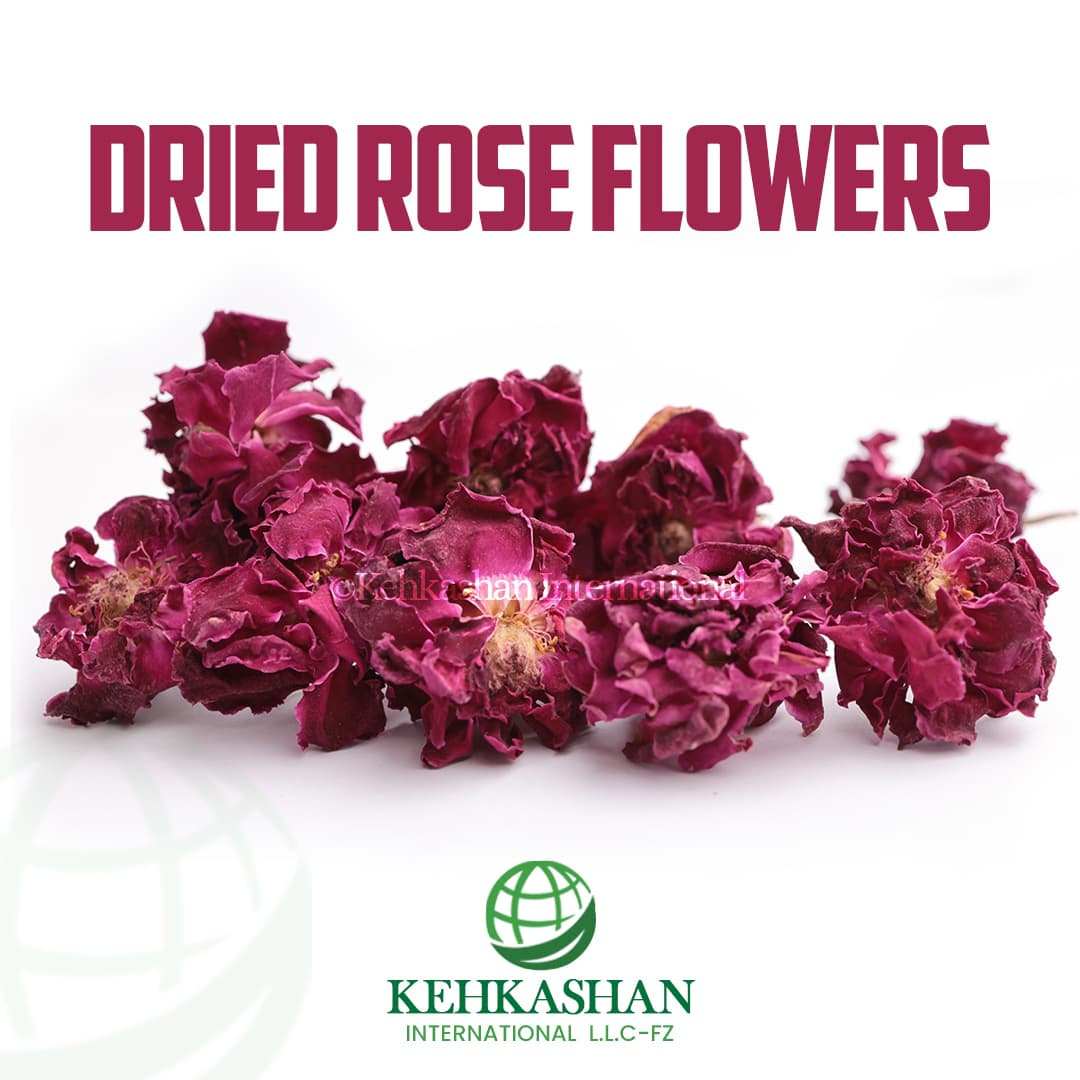
Bulgarian damask rose from the Kazanlak Valley delivers higher essential-oil yield at 0.03 to 0.04 percent and uniform drying. Iranian damask rose from Ispahan and Kashan offers larger volume and lower price for culinary and tea grades. Free Zone routing handles compliance for sanctioned-jurisdiction buyers.
Origin geography
Damask rose (Rosa damascena) is the cultivated species used for rose oil, rose water, dried petals, and rose absolute. Two origins dominate the global trade: Bulgaria and Iran.
Bulgaria — the Kazanlak Valley. Roughly 90 percent of Bulgarian damask rose grows in the "Valley of Roses" — a 95-kilometre band between the Stara Planina range to the north and the Sredna Gora range to the south, centred on the towns of Kazanlak, Karlovo, and Pavel Banya, recognised as the registered PGI zone for "Bulgarsko rozovo maslo". Altitude is 350 to 500 metres. Soils are well-drained alluvial loams. The Bulgarian harvest window is short — late May through mid-June, roughly four weeks — and harvesting is dawn-only, typically 04:00 to 09:00 before the rising air temperature volatilises essential oil.
Iran — Ispahan and Kashan provinces. Iranian damask rose centres on Ispahan Province (Kashan, Niasar, Qamsar) at 1,500 to 2,200 metres altitude, with a smaller production zone in Fars Province. Iranian harvest is later than Bulgarian — roughly mid-May through early July depending on altitude — and the area planted is several times larger than Bulgaria's. Iranian production volume substantially exceeds Bulgarian production, but a higher share of Iranian output goes to domestic rose-water consumption rather than international rose-oil distillation.
Spec differences
The two origins differ on three measurable axes that buyers care about: essential-oil yield per kilogram of fresh petal, dried-petal water-activity stability, and color retention through the drying chain.
Essential-oil yield. Bulgarian Kazanlak Valley material yields 0.030 to 0.040 percent essential oil from fresh petal — the international benchmark. Iranian Kashan material typically tests at 0.025 to 0.035 percent. The 25-to-30-percent yield differential is the structural reason cosmetic-grade buyers historically pay a premium for Bulgarian over Iranian rose oil.
Drying methods. Bulgarian dried petals are usually shade-dried in vented timber drying houses, with airflow tightly controlled to keep petals at 20 to 28 degrees Celsius until water activity falls below 0.55. The Bulgarian drying houses are inherited infrastructure — many in continuous use since the 19th century — and produce a consistent pale-pink finish. Iranian drying is more mixed: some material is shade-dried to Bulgarian-equivalent standard, but a substantial share is sun-dried, producing a darker red-brown petal that is preferred for culinary and herbal-tea use but unsuitable for cosmetic-grade supply.
Color retention. For dried-petal export, Bulgarian shade-dried material holds its pale-pink color through the supply chain to typically 12 months at correct storage humidity. Sun-dried Iranian material continues to oxidise more visibly over the same window but is acceptable for buyers whose end use is herbal infusion or culinary garnish, where the deeper color is a positive.
Pricing premium per origin
Bulgarian damask rose petals trade at roughly a 35 to 60 percent FOB premium over Iranian equivalent, with the precise differential moving year-to-year on harvest size. The Bulgarian premium reflects three factors: higher essential-oil yield, EU Geographical Indication protection on "Bulgarian Rose Oil" and "Rose of Damascus from Kazanlak Valley", and the smaller available production volume.
Iranian dried petals trade at a discount that opens substantial volume capacity for tea-blender, herbal-infusion, and culinary buyers who do not require the cosmetic-grade specification. Many large herbal-tea blenders run a dual-source program: Bulgarian top-grade for premium SKUs, Iranian middle-grade for bulk SKUs.
Use cases — cosmetic, culinary, tea
Cosmetic grade. Bulgarian top-grade dried petal, water activity below 0.55, color uniformly pale pink, no visible browning. Used in luxury skincare, soap manufacture, and as a base for steam-distilled hydrosol products. Buyers usually require a Bulgarian Rose Oil Producers' Association (BRPA) certificate and a residue analysis (no detected pesticide residue at 0.01 mg/kg LOD across a 200-substance multi-residue scan).
Culinary grade. Either origin acceptable; spec is food-safe-handling chain rather than oil yield. Common end use is Middle Eastern desserts, baklava and ma'amoul garnish, and rose-flavored sugar. Iranian sun-dried material is often preferred for the deeper red color it carries into the finished product.
Herbal-tea grade. Iranian product dominates this segment by volume. Spec is sub-3 percent foreign matter, sub-12 percent moisture, intact petal form (not crushed), and consistent color tone. Tea-blender buyers usually request whole-petal material rather than petal-flake.
Rose oil and rose absolute. Distillation-grade material is typically shipped as fresh petal directly to the distillery rather than as dried petal. Dried-petal sales for oil extraction are rare and only economic at the lowest-grade Iranian material.
Sanctions context — the Free Zone routing solution
Iran is subject to layered international sanctions that complicate direct payment from European, North American, and most Gulf buyers. Iranian rose petal itself is not a sanctioned good — it is an agricultural commodity outside the scope of the principal sanctions instruments — but the payment path and the financial-correspondent chain are constrained.
Compliant buyers route Iranian rose through a UAE Free Zone trader. Kehkashan's Meydan Free Zone licence allows the firm to purchase from Iranian exporters under a UAE-resident commercial invoice, settle in USD or EUR through a UAE-based bank, and re-issue the goods to the European or Gulf end buyer under a fresh UAE-origin commercial invoice and re-export endorsement. The end buyer receives the petals with original Iranian phyto and quality certificates accompanying — full chain visibility — but settles via a neutral-jurisdiction LC that satisfies their compliance team's correspondent-bank requirements.
This is not sanctions evasion. It is documented re-export under UAE Federal Customs supervision, with the Iranian-origin chain visible end-to-end. The Free Zone structure simply moves the payment and the seller-of-record into a jurisdiction that the buyer's bank can transact with directly.
For buyers in jurisdictions with secondary-sanctions exposure (US persons, US-bank correspondents, EU banks with US-Treasury overlap), an additional sanctions-screening declaration is normally required at the time of LC opening. Kehkashan provides a standard declaration template on request.
FAQ
Why is Bulgarian rose oil more expensive than Iranian rose oil?
Bulgarian Kazanlak Valley material yields 0.030 to 0.040 percent essential oil from fresh petal versus 0.025 to 0.035 percent from Iranian Kashan material — a roughly 25-to-30 percent yield differential — combined with EU Geographical Indication protection and smaller available production volume.
Is Iranian rose petal subject to international sanctions?
Iranian rose petal is an agricultural commodity outside the scope of the principal sanctions instruments. The complication is the payment chain rather than the goods. Compliant buyers route through a UAE Free Zone trader to settle in USD or EUR via a UAE-resident bank.
Which origin is preferred for culinary and herbal-tea use?
Iranian product dominates the herbal-tea and culinary segment by volume and price. The deeper red color from sun-drying is often a positive in these end uses, and the price discount versus Bulgarian opens substantial volume capacity for blenders and food manufacturers.
What's the export season for damask rose petals?
Bulgarian harvest is late May through mid-June; Iranian harvest is mid-May through early July depending on altitude. Cleaning, drying, and lot formation runs through August. Export containers ship August through April of the following year.
What documents accompany an Iranian rose re-export from Jebel Ali?
Original Iranian phytosanitary certificate, original Iranian quality and ISO 9001 facility documentation, UAE re-export endorsement from Federal Customs, UAE Free Zone commercial invoice, packing list, multimodal bill of lading, and on request a sanctions-screening declaration for the buyer's compliance file.
Storage, packaging, and shelf-life considerations
Dried damask rose petal is hygroscopic and oxidatively reactive. Storage humidity above 65 percent relative humidity will pull water back into the petal mass and start the browning reaction within weeks; storage temperature above 25 degrees Celsius accelerates color loss in both Bulgarian and Iranian material. The petal is also light-sensitive — direct sunlight bleaches the pink in Bulgarian material and dulls the red in Iranian sun-dried material.
Standard export packaging is multi-walled paper bags with a polyethylene inner liner, 5 kg or 10 kg bag, palletised in cartons. For higher-value Bulgarian cosmetic-grade material the packaging often steps up to nitrogen-flushed sealed pouches inside lined cartons, extending shelf life from 12 to 24 months at correct storage conditions. Bulk Iranian tea-grade material is more often shipped in 25 kg multi-wall paper bags without the nitrogen flush, on the understanding that the buyer's blending operation will turn over the inventory within 6 to 9 months.
Container shipping requires desiccant pouches and ventilated container service; reefer containers at controlled temperature are used for premium Bulgarian cosmetic-grade material on long ocean transits where transit-time humidity exposure exceeds 15 days.
Authenticating origin — what buyers can verify
Origin fraud is a documented issue in the dried-rose petal trade, particularly where Iranian sun-dried material is presented as Bulgarian shade-dried. The visual difference is real but subtle: Bulgarian shade-dried petals typically retain more uniform pale-pink color with petal-flat structure; Iranian sun-dried petals show deeper red tones with petal-curl from rapid drying. A trained buyer can distinguish the two on visual inspection, but a less experienced buyer will not.
The defensible authentication path is documentary plus laboratory. Documentary: the Bulgarian National Association of Essential Oils, Perfumery and Cosmetics (BNAEOPC) certificate names the registered drying facility and the harvest cooperative; an Iranian shipment will not carry that document. Laboratory: GC-MS analysis of an essential-oil distillate from a representative sample shows distinct compositional fingerprints between Kazanlak Valley and Kashan material — citronellol-to-geraniol ratios differ measurably, and methyl eugenol fractions vary. A buyer paying a Bulgarian premium should commission a GC-MS analysis on a sample drawn at loading, not just at receipt.
For a buyer running a regular dual-source program, the operational practice is to maintain a reference sample from a verified Bulgarian shipment and a verified Iranian shipment in cold storage, and benchmark every new shipment against both references at receipt.


