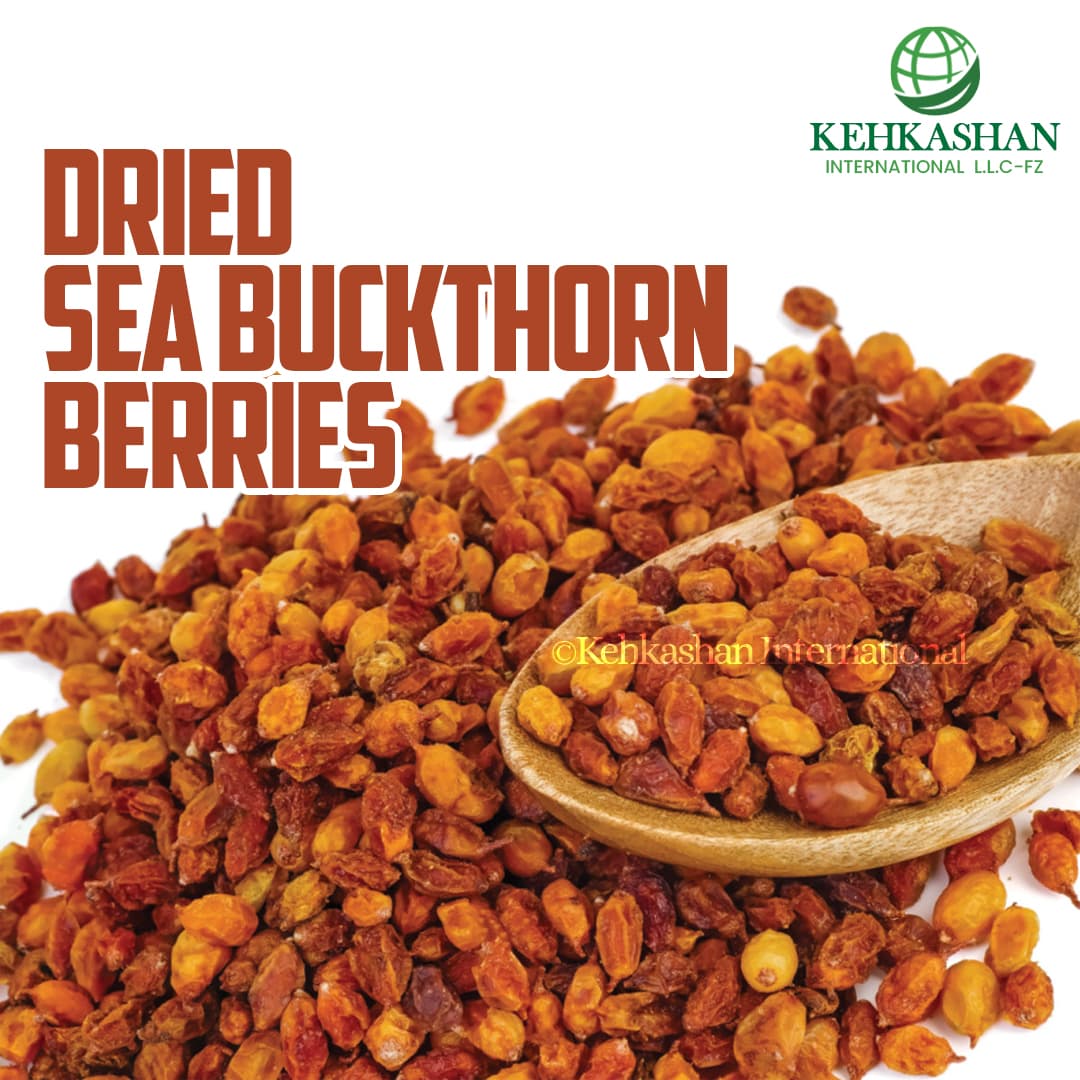
Sea buckthorn berries (Hippophae rhamnoides) come primarily from Pakistan-Ladakh, Mongolia, Russia, China and Germany. Buyers specify vitamin C content of 500 to 1500 mg per 100g, omega-7 oil yield 8 to 12 percent, EU pesticide and heavy-metal compliance. MOQ is one 20-foot full-container load at 14 to 16 metric tons frozen or 18 to 20 metric tons dried. Lead times Karachi to Hamburg are 21 to 28 days.
Why sea buckthorn is the highest-margin berry in our 2026 export book
Sea buckthorn is the only commercial berry that simultaneously ranks in the top 1 percent for vitamin C density as documented in the FAO ecocrop database for Hippophae rhamnoides, carries omega-7 (palmitoleic acid) at concentrations that no other plant matches at industrial scale, and grows in arid mountain belts where competing crops fail. The result is a berry with structurally limited supply, accelerating European nutraceutical demand, and FOB pricing that rewards origin discipline more than tonnage.
European nutraceutical and cosmetic buyers paid between 4.20 and 11.00 USD per kilogram FOB-equivalent for dried sea buckthorn in 2025, with seed-oil and pulp-oil buyers paying more for guaranteed-titration material. That spread is two to three times what a confectionery-grade dried berry like cranberry or blueberry commands, and the spread is widening as omega-7 supplementation moves from niche to mainstream.
This guide walks through the five origin countries currently supplying the export trade, the titration bands that drive pricing, the format choices (frozen, dried, oil, juice concentrate, powder), and the documentation set we run on every Kehkashan container.
Where commercial sea buckthorn comes from
Hippophae rhamnoides is a hardy, nitrogen-fixing shrub native to the cold-temperate belt running from the Himalayas through Central Asia into Northern Europe. Five origin countries cover roughly 90 percent of the global export trade.
Pakistan (Gilgit-Baltistan and Hunza valleys). Wild and semi-cultivated sea buckthorn at altitudes of 2,400 to 3,800 meters. Vitamin C titration on Pakistani-Hunza material runs 800 to 1,400 mg per 100g — the upper-mid band of the global supply. Berries ship out of Karachi after collection, sorting and IQF-freezing or sun-and-tunnel drying in Gilgit cooperatives. This is Kehkashan's primary origin — direct cooperative relationships in the Hunza valley plus the Skardu collection corridor.
Mongolia. Cultivated plantations in the Khovd, Selenge and Bulgan provinces, plus wild collection in the Altai range. Mongolian production has scaled aggressively since 2018 with state-backed plantation programs. Vitamin C titration is mid-band at 500 to 900 mg per 100g, but seed-oil yield is typically higher at 11 to 13 percent. Most Mongolian export ships through Tianjin port (China) or via the Trans-Siberian rail to European consolidators.
Russia (Altai Krai and Siberia). The largest single-origin producer by volume, with cultivated plantations dating back to Soviet-era horticultural programs catalogued by the N.I. Vavilov Research Institute of Plant Industry. Russian-Altai material runs 600 to 1,100 mg per 100g vitamin C, with carotenoid (beta-carotene) levels notably higher than other origins. Logistical complications since 2022 have shifted European buyers toward Mongolian, Chinese and Pakistani sources.
China (Inner Mongolia, Shaanxi, Gansu). Largest commercial cultivation footprint with substantial extraction infrastructure. Chinese material is competitively priced, but EU pesticide-residue compliance varies — buyers running tight pharma specs typically pay a premium for third-party-lab-certified Chinese lots or shift origin entirely.
Germany (Mecklenburg-Vorpommern, Brandenburg). Small but premium organic-certified cultivation in northeastern Germany. Vitamin C titration is moderate at 400 to 700 mg per 100g, but EU-organic certification and zero-mile EU origin command a substantial price premium for clean-label retail brands. Volumes are limited — German production is supplementary to imported Asian material.
The five origins together produce roughly 30,000 to 45,000 metric tons of fresh-berry equivalent annually for export, with a much smaller share reaching processed-form export markets after domestic juice and supplement absorption.
Vitamin C and omega-7 titration are the price drivers
Sea buckthorn pricing tracks two compositional levers more than any other variable. Buyers paying premium prices are paying for vitamin C density (relevant for nutraceutical capsules, immune-support powders, and clean-label functional drinks) and for omega-7 oil yield (relevant for skincare, joint-health supplements, and cardiovascular nutraceuticals).
Vitamin C titration bands and applications:
- 300 to 500 mg per 100g. Beverage-grade and food-flavor industrial input. Lowest FOB pricing. Suitable for juice concentrate buyers and confectionery flavor houses.
- 500 to 800 mg per 100g. Standard nutraceutical input grade. European supplement brands buy in this band for capsule and powder formulations.
- 800 to 1,200 mg per 100g. Premium nutraceutical and clinical-trial-grade material. Pakistan-Hunza and Russian-Altai material typically lands here.
- 1,200 mg per 100g and above. Specialty pharmaceutical and clean-label retail premium. Carries 30 to 50 percent FOB premium over standard nutraceutical band.
Omega-7 (palmitoleic acid) yield in seed and pulp oil:
- 6 to 8 percent. Standard cosmetic-grade pulp oil. Good for skincare emulsions and topical formulations.
- 8 to 11 percent. Premium cosmetic and nutraceutical-oil grade. Joint-health and cardiovascular supplement brands buy here.
- 11 to 14 percent. Clinical-grade omega-7 concentrate. Pharmaceutical-trial input pricing applies.
Custom titration is available — when a buyer needs a specific band, the supplier blends harvest lots and selects micro-origins to hit the target. This costs more in lab work and lot management but is routinely done for buyers running standardized formulations against a guaranteed compositional spec.
Format choices on the RFQ
Sea buckthorn is sold in five primary formats, and the format choice changes both the freight envelope and the price-per-kg of berry equivalent.
Frozen IQF whole berries. The closest format to fresh, used by juice concentrate producers, freeze-dry processors, and high-end retail confectionery brands. Ships in 10 kg cardboard boxes inside a refrigerated 20-foot container at minus 18 degrees Celsius. FOB Karachi pricing 4.50-6.50 USD/kg.
Dried whole berries (sun-and-tunnel or freeze-dried). Shelf-stable format, lighter and cheaper to ship, but with some degradation of vitamin C. Tunnel-dried 8.0-10.0 USD/kg, freeze-dried 18.0-26.0 USD/kg FOB Karachi. Freeze-dried preserves 85 to 95 percent of vitamin C versus 50 to 70 percent for tunnel-dried.
Berry powder. Spray-dried or freeze-dried powder for direct supplement and clean-label food formulation. FOB Karachi 14.0-30.0 USD/kg depending on drying method and titration band.
Seed oil (cold-pressed). Premium nutraceutical and cosmetic format. Yields roughly 8 to 12 percent of the seed weight. FOB Karachi 70-150 USD/kg for clinical grade.
Pulp oil (CO2 or solvent extracted). Higher omega-7 concentration than seed oil. FOB Karachi 90-200 USD/kg for clinical grade.
Juice concentrate (4x to 6x concentration). Beverage and food-industrial input. FOB Karachi 7.0-12.0 USD/kg.
Grade vocabulary on the Certificate of Analysis
A clean sea buckthorn CoA carries seven fields beyond vitamin C and omega-7 titration:
- Format — frozen IQF, dried whole, powder, oil, juice concentrate, with mesh size for powders.
- Moisture — below 14 percent for shelf-stable dried, below 5 percent for powders, below 0.5 percent for oils.
- Foreign matter — below 1 percent for food-grade, below 0.2 percent for nutraceutical-grade.
- Carotenoid content — beta-carotene typically reported 80 to 200 mg per 100g for dried whole berries.
- Aflatoxin and ochratoxin A — below EU regulatory limits per Regulation 1881/2006 on food contaminants.
- Heavy metals — lead below 3 mg/kg, cadmium below 1 mg/kg, mercury below 0.1 mg/kg, arsenic below 1 mg/kg.
- Pesticide residue panel — EU Annex A and B compliance, with full LC-MS scan for high-spec buyers.
Pharmaceutical and cosmetic buyers add microbiological tests for total aerobic count, yeasts and molds, E. coli absence, and salmonella absence. Organic-certified buyers require valid EU-organic, USDA-NOP, or JAS-organic certificates with the lot-level traceability tail.
Container math, MOQ, and freight envelope
Sea buckthorn is unusually freight-sensitive because of the format spread. A 20-foot full-container load holds:
- 14 to 16 metric tons of frozen IQF berries in 10 kg boxes (refrigerated container required)
- 18 to 20 metric tons of dried whole berries in 25 kg multi-layer kraft bags
- 14 to 16 metric tons of berry powder in 25 kg multi-layer kraft bags with food-grade liner
- 18 to 22 metric tons of cold-pressed oil in 200 kg HDPE drums
- 20 to 24 metric tons of juice concentrate in 250 kg HDPE drums
MOQ tiers as we run them at Kehkashan:
- 100 kg starter — minimum order for sample-to-trial transition, fits LCL consolidation
- 500 kg — break-even on most LCL routes
- 14,000 kg+ — full 20-foot reefer FCL of frozen IQF
- 18,000 kg+ — full 20-foot FCL of dried whole or powder
- 22,000 kg+ — full 40-foot FCL for high-volume nutraceutical buyers
Documentation set on every shipment
Every Hippophae rhamnoides container leaves Karachi with the standard export pack:
- Bill of lading
- Commercial invoice and packing list
- Certificate of Origin (Pakistan Chamber of Commerce)
- Phytosanitary certificate (Department of Plant Protection)
- Certificate of Analysis (vitamin C, omega-7 yield, moisture, aflatoxin, heavy metals, pesticide residue)
- Health certificate (PSQCA equivalent)
- Form A or EUR.1 origin certificate where preferential tariff applies
- Fumigation certificate (mandatory for EU dried product, optional for frozen)
- Cold-chain temperature logger record (mandatory for frozen IQF, oils, juice concentrate)
EU organic-certified buyers add the EU-organic transaction certificate per shipment. EU pharmaceutical and clean-label retail buyers may require a Certificate of Suitability to the European Pharmacopoeia (CEP) on the seed and pulp oil grades.
Lead times by destination port
| Destination port | Country | Ocean transit | Typical Incoterm |
|---|---|---|---|
| Hamburg | Germany | 21-28 days | CIF / DAP |
| Rotterdam | Netherlands | 21-28 days | CIF / DAP |
| Antwerp | Belgium | 22-28 days | CIF / DAP |
| Felixstowe | United Kingdom | 21-28 days | CIF / DAP |
| Gdansk | Poland | 24-30 days | CIF |
| Helsinki | Finland | 26-32 days | CIF |
| New York | United States | 28-35 days | CIF |
| Long Beach | United States | 32-40 days | CIF |
| Tokyo | Japan | 24-30 days | CFR |
| Busan | South Korea | 21-28 days | CFR |
| Sydney | Australia | 24-30 days | CFR |
| Jeddah | Saudi Arabia | 5-8 days | CFR / CIF |
Frozen IQF, oils, and juice concentrate move under refrigerated container service throughout. Dried whole berries and powders move at standard ambient with desiccant packs and humidity-controlled stowage requirements specified on the booking note.
Demand-side pulls — who buyers actually are
Five end-use segments drive global sea buckthorn demand, and each has different titration priorities and pricing tolerance:
Nutraceutical capsule and powder brands. Largest and fastest-growing segment. Brands like Weleda, Sibu Beauty, Genuine Health, and dozens of EU and North American direct-to-consumer supplement labels. Spec emphasis on vitamin C (800-1,200 mg per 100g band) and omega-7 oil yield. Willing to pay 30-50 percent premium for guaranteed-titration material.
Cosmetic and skincare formulators. Skincare brands using sea buckthorn pulp oil for its omega-7 and carotenoid loading — antioxidant, anti-inflammatory, and skin-regeneration claims. L'Occitane, Weleda, Pai Skincare, and a long tail of indie clean-beauty brands. Spec emphasis on omega-7 yield (10-14 percent band) and organic certification where applicable.
Functional beverage and clean-label food brands. Juice concentrate, smoothie powder, and immune-support drink formulations. EU and North American startup brands buy in 500-2,000 kg per quarter. Spec emphasis on vitamin C density and clean pesticide-residue panels.
Pharmaceutical and clinical research. Specialty pharma buyers running clinical trials on omega-7 cardiovascular benefits or vitamin C immune-support claims. Smallest segment by volume but highest pricing. Require CEP-grade documentation and lot traceability to harvest plot.
Pet and animal nutraceutical. Equine and canine joint-health and immune-support supplements. Growing segment in EU and North America. Lower titration tolerance, larger volumes per order.
Competition map — who buyers usually go to
The sea buckthorn export trade is more fragmented than licorice or pine nuts. No single supplier controls more than 10 percent of global export volume. Notable players include:
- SiberianHerbs and Sibu Inc. (US/Russia-Altai sourcing, retail-brand vertical)
- Zhonglian Hippophae (China-Inner Mongolia, processing and extraction)
- Mongolian Sea Buckthorn Association (Mongolian cooperative aggregator)
- Aronia Original (Germany, EU-organic certified)
- A long tail of 40+ regional Pakistani, Mongolian, Russian, Chinese, and EU exporters
For buyers running diligence, the differentiators between credible suppliers and marketplace listings are:
- Lot traceability to the harvest valley or plantation block — a credible exporter can produce GPS coordinates or named cooperative for the lot.
- Lab certification from an internationally recognized lab (SGS, Bureau Veritas, Intertek, Eurofins) on the vitamin C and omega-7 titration. In-house anonymous certificates carry minimal weight in the EU nutraceutical and cosmetic trade.
- Stability of titration band across multiple shipments — a supplier who can deliver the same compositional band across four annual shipments is the supplier you want for a standardized formulation.
- Cold-chain integrity record on frozen and oil shipments — the temperature logger record at destination is the proof point.
We document each of these on every Kehkashan sea buckthorn shipment. Sample lots of 250g to 1kg are couriered free of freight to qualified buyers worldwide; the sample fee credits against the first PO on acceptance.
When to buy ahead vs spot
Sea buckthorn harvest in Pakistan-Hunza, Mongolia, and Russia runs late August through October. Quality assessment finishes by late November, and the year's pricing band stabilizes by early December. Annual contracts booked in November-December at fixed prices typically secure 8 to 15 percent better pricing than spot purchases through the year.
For nutraceutical and cosmetic buyers running standardized formulations against a guaranteed vitamin C and omega-7 band, the annual-contract route is the only practical option — spot supply rarely matches the spec consistency these buyers need.
For functional beverage and food-industrial buyers with looser titration tolerance, spot purchases of 500 to 2,000 kg lots through the year work reliably.
Trade desk closing note
Sea buckthorn rewards buyers who get the origin discipline right — the difference between an 800 mg per 100g vitamin C lot and a 1,200 mg per 100g lot is real money in the formulated end-product, and the gap shows up at the consumer-facing claim level. We work with cooperatives in the Hunza valley and the Skardu collection corridor, plus consolidator partnerships into Mongolian and Russian-Altai sources for buyers needing those origins specifically.
For a quote, send the six RFQ specs (origin, format, vitamin C band, omega-7 yield band, organic certification yes/no, quantity) to [email protected]. The trade desk replies within one working day with FOB Karachi, CFR your-destination-port, CIF, and DAP options.


