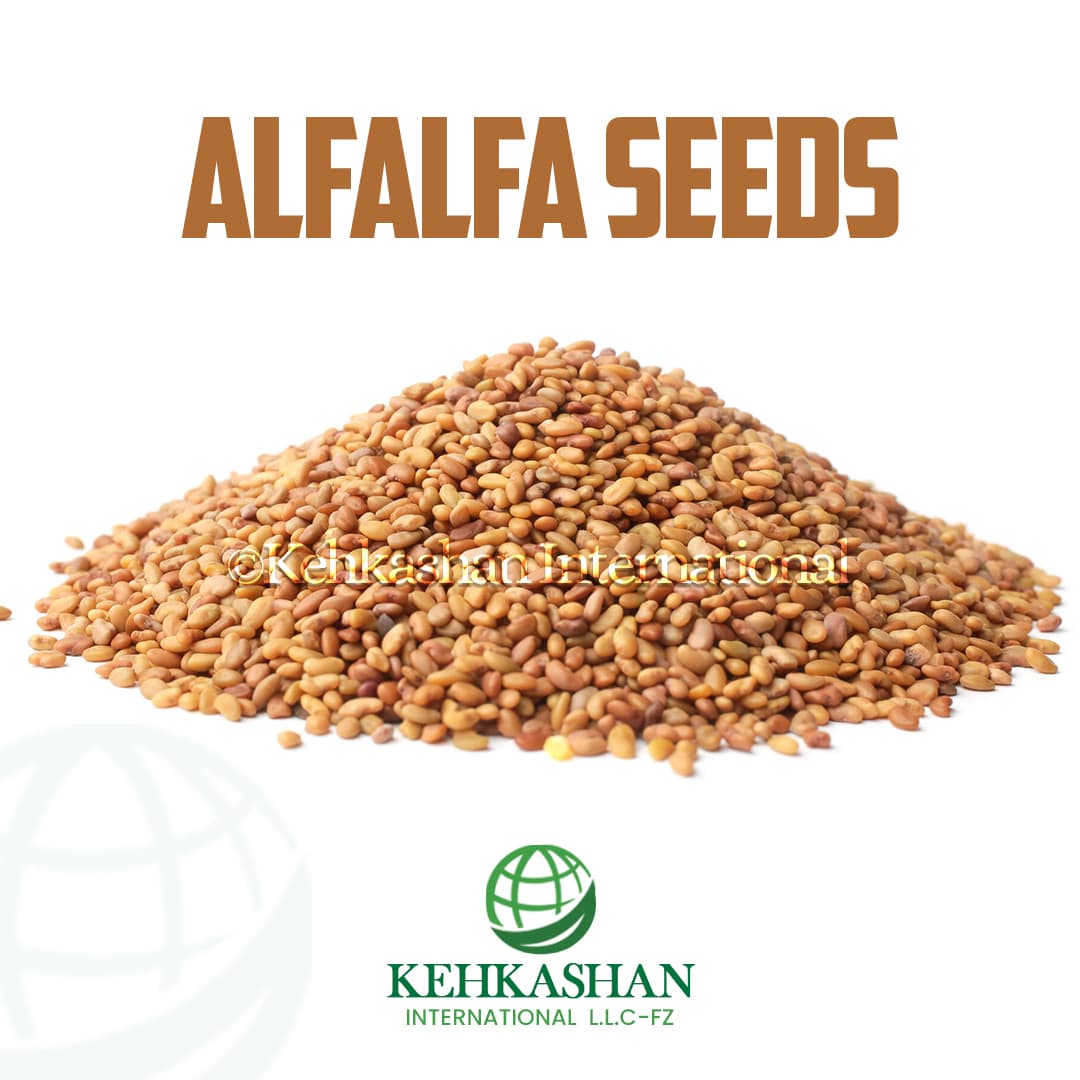
Alfalfa seeds (Medicago sativa) come primarily from USA, Australia, Italy, Argentina, France, Canada and Saudi Arabia. Buyers specify fall-dormancy rating 1 to 11, ISTA purity 99 percent, germination 85 percent, and dodder-freedom certification. MOQ is 1,000 kg LCL or 22 metric tons FCL. Lead times Jebel Ali to Jeddah are 5 to 8 days.
Why alfalfa is the largest forage seed trade in the world — and the most agroclimate-sensitive
Alfalfa (Medicago sativa, also called lucerne) is the largest single forage seed in the global export trade by both volume and value. Roughly 200,000 to 280,000 metric tons of alfalfa seed move across borders annually per UN Comtrade HS-1209.21 records, supporting dairy and beef forage operations from Saudi Arabian feedlots to Argentine pampas to Chinese and Mongolian dairy farms.
The single most important variable in matching alfalfa seed to a buyer's farm is fall dormancy rating — a 1-to-11 scale that measures how much winter dormancy each variety expresses. Fall-dormancy 2 varieties (very dormant) are matched to cold-winter zones like the US Northern Plains and Canadian Prairie, while fall-dormancy 9-11 varieties (non-dormant) are matched to subtropical and tropical zones like Saudi Arabia, the UAE, and southern Australia. Ordering the wrong dormancy rating into the wrong climate is a season-killing mistake — the variety either never establishes (too dormant for the climate) or winterkills (not dormant enough). This single specification, more than any other variable, drives the buyer-supplier conversation.
This guide walks through the seven origin countries that dominate the global trade, the fall-dormancy zone matrix, the ISTA grading vocabulary, and the documentation set we run on every Kehkashan container. For the specific Saudi Arabian buyer perspective, see our companion pillar at /insights/alfalfa-import-guide-saudi-arabia-2026.
Where commercial alfalfa seed comes from
United States. The premium-tier origin globally. Concentrated in California, Oregon, Idaho, Washington (Pacific Northwest), and Wisconsin (Northern Plains). US alfalfa seed includes both proprietary hybrid varieties (AmeriStand, WL, Pioneer, S&W Seed Co.) and public-release varieties. Fall-dormancy ratings 2 to 11 available, with the Pacific Northwest specializing in 4-9 ratings for dairy markets and California specializing in 8-11 ratings for hot-summer markets. US alfalfa ships out of Long Beach, Oakland, Seattle (Tacoma), and Portland.
Australia. Second-largest premium-origin globally. Concentrated in Western Australia, South Australia, and northern Victoria. Australian alfalfa breeding programs have specialized in fall-dormancy 7-11 varieties suited to Mediterranean and subtropical climates — particularly Saudi Arabia, the UAE, Egypt, Jordan, and southern China. Strong export pipeline through Fremantle, Adelaide, and Melbourne.
Italy. Concentrated in Emilia-Romagna, Veneto, Marche, and Tuscany. Italian alfalfa breeding includes both fall-dormancy 4-6 (suited to Mediterranean dairy markets) and 7-9 (suited to North African and Middle Eastern operations). Strong Italian heirloom variety library (Garisenda, Lodi, Costanza). Ships from Genoa and Trieste.
Argentina. Concentrated in Buenos Aires, La Pampa, Córdoba and Santa Fe provinces. Argentine alfalfa specializes in fall-dormancy 8-11 for the South American beef market plus export to Saudi Arabia and Chinese dairy. Ships from Buenos Aires (Puerto de la Plata).
France. Concentrated in the Champagne-Ardenne, Bourgogne, and Pays de la Loire regions. French alfalfa is mostly fall-dormancy 3-5 for European dairy markets, with EU-organic certification often available. Strong public-research breeding program at INRAE. Ships from Le Havre and Marseille.
Canada. Concentrated in Saskatchewan, Manitoba, and Alberta. Canadian alfalfa specializes in fall-dormancy 1-3 (very dormant, cold-tolerant) for the Northern Plains market plus North Dakota, Montana, and Wyoming. Ships from Vancouver and Montreal.
Saudi Arabia. Smaller producer, mostly serving domestic dairy operations (Almarai, Nadec, Al Safi) plus regional UAE and Egyptian buyers. Fall-dormancy 9-11 specialist for the hot-desert irrigated dairy operations. Limited export volume but locally strategic.
The seven origins together produce roughly 220,000 to 280,000 metric tons of export-grade alfalfa seed annually.
Fall-dormancy zone matrix — the spec that drives everything
The fall-dormancy rating system is a 1-to-11 scale developed by the North American Alfalfa Improvement Conference and now embedded in the OECD Forage Seed Scheme variety lists. Lower numbers indicate stronger winter dormancy (the plant goes deeply quiescent when day length shortens and temperatures drop). Higher numbers indicate non-dormancy (the plant continues growing through mild winters). Each fall-dormancy band is matched to a climate zone:
FD 1-2 (very dormant). Cold-winter zones — Canadian Prairie, US Northern Plains, eastern European dairy belts (Poland, Russia, Ukraine, Belarus), high-altitude Inner Asia (northern Mongolia, Kazakhstan, Tibet). Survives -30 to -40°C winters. Slow spring green-up, single annual cut economically meaningful.
FD 3-4 (dormant). Cold-temperate zones — US Midwest, Great Lakes, southern Canada, northern Europe (Germany, Netherlands, Denmark, southern Poland), Hokkaido Japan. Survives -20 to -30°C winters. Two to three annual cuts.
FD 5-6 (semi-dormant). Cool-temperate dairy zones — California Central Valley, Italian Po Valley, French dairy regions, southern UK, New Zealand South Island, southern China dairy belt. Survives -10 to -20°C winters. Three to five annual cuts.
FD 7-8 (semi-non-dormant). Mediterranean and warm-temperate zones — California Imperial Valley, Italian South, Spain, Türkiye, Iran, Pakistan, Argentine Pampas, Australian wheat belt. Mild winters with occasional frost. Five to seven annual cuts.
FD 9-11 (non-dormant). Subtropical and hot-desert irrigated zones — Saudi Arabia, UAE, Egypt, Sudan, Jordan, southern Mexico, southern Argentina, Australian Northern Territory, southern Brazil. Year-round growth potential. Seven to ten annual cuts.
Buyers running multiple farms across climate zones typically need multiple varieties, not one. Suppliers offering "alfalfa seed FOB Karachi" without fall-dormancy specification are not viable for any serious dairy or forage buyer.
ISTA grading vocabulary on the Certificate of Analysis
A clean alfalfa CoA carries seven fields beyond fall-dormancy and variety declaration:
- Variety and fall-dormancy rating — explicit declaration with breeding source (proprietary hybrid name or public variety name).
- Physical purity — ISTA standard, minimum 99 percent. Premium tier 99.5 percent.
- Germination — minimum 85 percent for hybrid, 80 percent for public open-pollinated. Tested per ISTA International Rules for Seed Testing at 20°C, 7-day count.
- Hard seed percentage — alfalfa naturally produces a percentage of hard (water-impermeable) seeds. Declared on the CoA, typically 5 to 15 percent. Some buyers require de-hulled seed (mechanically scarified to break the hard-seed coat) — declared explicitly.
- Other-crop seed — below 0.1 percent.
- Dodder freedom (Cuscuta spp.) — declared as "dodder-free" or with parts-per-million count if any. EU, US, and Saudi (SASO) destinations require dodder-freedom certification, and lots failing dodder testing are routinely rejected at port.
- Treatment status — declaration of seed treatment chemistry (Apron, Cruiser, Vitavax, Rhizobium meliloti inoculant, fungicide coating) where seed has been treated, with full active-ingredient and rate disclosure.
EU and US destinations add OECD seed scheme certification where applicable. Saudi destinations add SASO (Saudi Standards) certification for the specific variety, with documented introduction approval where the variety is new to the kingdom. North American organic-certified buyers add USDA-NOP or Canadian-COR certification per shipment.
Container math, MOQ, and pricing
Alfalfa seed is small (1,000-seed weight ~2.0 to 2.5 grams) and high-density. A 20-foot full-container load holds 22 to 24 metric tons in 25 kg multi-layer kraft bags or PP woven bags with food-grade liner.
MOQ tiers as we run them at Kehkashan (consolidating from origin supply through Free Zone routing):
- 200 kg starter — minimum order, fits LCL consolidation
- 1,000 kg — break-even on most LCL routes
- 5,000 kg — full LCL consolidation with shared 20-foot booking
- 22,000 kg+ — full 20-foot FCL of single-variety material
- 26,000 kg+ — full 40-foot FCL for high-volume forage program buyers
Pricing tiers (FOB Free Zone consolidation or origin-port, indicative, 2026):
- Public open-pollinated alfalfa, FD 4-6, EU/US-origin: 4.50-6.50 USD/kg
- Public open-pollinated alfalfa, FD 7-9, Australia/Italy/Argentina: 4.20-5.80 USD/kg
- Hybrid alfalfa, FD 4-6, US Pacific Northwest: 7.00-10.00 USD/kg
- Hybrid alfalfa, FD 7-9, US/Australia premium tier: 8.50-12.00 USD/kg
- Hybrid alfalfa, FD 9-11, US/Australia/Argentina dairy-tier: 9.00-13.50 USD/kg
- HarvXtra and reduced-lignin trait hybrids: add 1.50-3.00 USD/kg over standard hybrid
- Roundup Ready (RR) trait hybrids: add 1.00-2.50 USD/kg over standard hybrid
- Coated and Rhizobium-inoculated seed: add 0.40-1.20 USD/kg over uncoated tier
Documentation set on every shipment
Every Medicago sativa container leaves origin or Free Zone consolidation with the standard export pack:
- Bill of lading
- Commercial invoice and packing list
- Certificate of Origin (origin chamber of commerce or Free Zone CoO for consolidated origins)
- Phytosanitary certificate with explicit dodder-freedom declaration
- ISTA Certificate of Analysis (variety, FD rating, purity, germination, hard seed, other-crop seed, inert matter)
- OECD seed scheme certificate (where applicable)
- Variety registration / Certificate of Variety
- Seed treatment declaration (active ingredient, rate, applicator) where seed is treated, coated, or Rhizobium-inoculated
- Form A or EUR.1 origin certificate where preferential tariff applies
- Fumigation certificate (mandatory for EU, US, and Saudi Arabian destinations)
- SASO certification (mandatory for Saudi Arabian destinations)
- Trait-event documentation (where Roundup Ready or HarvXtra trait varieties apply)
EU organic-certified buyers add the EU-organic transaction certificate per shipment plus the lot-level traceability chain back to the multiplication block.
Lead times by destination port
| Destination port | Country | Ocean transit | Typical Incoterm |
|---|---|---|---|
| Jeddah | Saudi Arabia | 5-8 days from Jebel Ali | CFR / CIF |
| Hamad | Qatar | 3-5 days from Jebel Ali | CIF |
| Sohar | Oman | 2-4 days from Jebel Ali | CIF |
| Mombasa | Kenya | 12-18 days | CIF |
| Hamburg | Germany | 21-28 days | CIF / DAP |
| Rotterdam | Netherlands | 21-28 days | CIF / DAP |
| New York | United States | 28-35 days | CIF |
| Long Beach | United States | 32-40 days | CIF |
| Vancouver | Canada | 30-37 days | CIF |
| Tokyo | Japan | 24-30 days | CFR |
| Busan | South Korea | 21-28 days | CFR |
| Sydney | Australia | 24-30 days | CFR |
| Auckland | New Zealand | 26-32 days | CFR |
| Buenos Aires | Argentina | 28-35 days | CIF |
| Shanghai | China | 18-24 days | CFR |
| Tianjin | China | 21-28 days | CFR |
Saudi Arabian dairy buyers (Almarai, Nadec, Al Safi, Saudi Dairy and Foodstuff) consolidate through Jebel Ali for the Jeddah Islamic Port leg. Other Gulf, African, and Asian destinations use Jebel Ali as the consolidation hub for buyers running multi-origin programs (US + Australian + Italian in a single shipment).
Demand-side pulls — who buyers actually are
Five end-use segments drive global alfalfa seed demand, each with distinct fall-dormancy, variety and pricing tolerances:
Saudi Arabian and Gulf hot-desert dairy. Almarai (the world's largest vertically integrated dairy operation), Nadec, Al Safi, plus Saudi Dairy and Foodstuff Company. Spec emphasis on fall-dormancy 9-11 hybrid varieties with demonstrated hot-desert adaptation. Buyers run 2,000 to 20,000 ton annual programs. The largest single demand pull globally for non-dormant alfalfa.
North American dairy and beef forage. US Midwest dairy belt, US Northern Plains beef, Canadian Prairie. Spec emphasis on fall-dormancy 1-5 hybrid varieties with HarvXtra reduced-lignin trait increasingly common. Buyers run 500 to 5,000 ton annual programs through farm-input distribution chains.
European dairy. Italy, France, Netherlands, Germany, Denmark, southern UK. Spec emphasis on fall-dormancy 3-6 varieties with EU-organic certification often required. Buyers run 200 to 2,000 ton annual programs.
East Asian dairy expansion. China, Japan, South Korea, Mongolia. Chinese dairy expansion (Yili, Mengniu) drives the largest single growth segment in the global alfalfa trade. Spec emphasis on fall-dormancy 4-8 varieties for the Chinese inner-Mongolia and northeast dairy belt, plus 9-11 for the southern China dairy expansion. Buyers run 1,000 to 10,000 ton annual programs.
South American forage and dairy. Argentine pampas dairy and beef, Brazilian dairy expansion, Uruguayan and Chilean forage. Spec emphasis on fall-dormancy 7-11 varieties. Buyers run 200 to 2,000 ton annual programs.
Competition map — who buyers usually go to
The alfalfa seed export trade is concentrated. Notable named players:
- S&W Seed Company (US, world's largest alfalfa breeding and seed company)
- Forage Genetics International (FGI) (US, owned by Land O'Lakes — HarvXtra reduced-lignin trait)
- Pioneer Hi-Bred / Corteva (US, premium hybrid pricing)
- Alforex Seeds (US, Pacific Northwest specialist)
- WL Alfalfa / Land O'Lakes (US, hybrid varieties)
- AmeriStand Seed Co. (US, premium hybrid breeding)
- Pacific Seeds (Australian-Indian joint venture)
- PGG Wrightson (New Zealand and Australia, large forage seed company)
- Barenbrug (Dutch, multi-origin forage seed)
- DLF Seeds (Danish, world's largest forage seed company)
For buyers running diligence, the differentiators between credible suppliers and marketplace listings are:
- Variety and fall-dormancy transparency — a credible exporter can produce the formal Certificate of Variety, the breeder's release notes, and the multiplication chain back to the original parental lines.
- ISTA-accredited lab certification of germination, purity, hard seed, and dodder freedom.
- SASO certification compliance for Saudi-destination shipments — not all suppliers maintain SASO documentation discipline; lots failing SASO at port are rejected.
- Trait-event compliance — for Roundup Ready, HarvXtra, and other GMO-trait varieties, the destination market's regulatory approval status must be documented. Some markets (EU, Australia, Saudi Arabia in some segments) restrict GMO-trait varieties.
We document each of these on every Kehkashan alfalfa shipment. Sample lots of 1 to 5 kg are couriered free of freight to qualified buyers worldwide; the sample fee credits against the first PO on acceptance.
When to buy ahead vs spot
Northern Hemisphere alfalfa multiplication runs the spring-summer growing season, with harvest July to October. Quality assessment finishes by December, and the year's pricing band stabilizes by February. Southern Hemisphere alfalfa multiplication runs October to April, with harvest February to May.
Annual contracts booked in February for Northern Hemisphere supply and June for Southern Hemisphere at fixed prices typically secure 8 to 15 percent better pricing than spot purchases through the year, plus guaranteed availability of the specified variety and fall-dormancy rating.
For Saudi dairy program buyers, North American dairy belt buyers, and East Asian dairy expansion buyers running standardized forage programs against a guaranteed variety spec, the annual-contract route is essentially mandatory — spot supply rarely matches the spec consistency these buyers need.
Trade desk closing note
Alfalfa is the largest single forage seed in the global export trade, and the supplier's variety-transparency and fall-dormancy-discipline are the primary differentiators between cost-tier marketplace listings and the supplier you want for a multi-year forage program. We work with consolidator partnerships into US Pacific Northwest hybrid supply, Australian Western Australia and South Australian fall-dormancy-9-11 supply, Italian Po Valley fall-dormancy-4-6 supply, Argentine pampas supply, and (for buyers needing it) Saudi Arabian domestic-supply variety lines.
For a quote, send the six RFQ specs (variety preference, fall-dormancy rating, origin preference, organic certification yes/no, trait-event preference, quantity) to [email protected]. The trade desk replies within one working day with FOB origin-port, CFR your-destination-port, CIF, and DAP options. For the deep dive on Saudi Arabian buyer specifications, see /insights/alfalfa-import-guide-saudi-arabia-2026.


