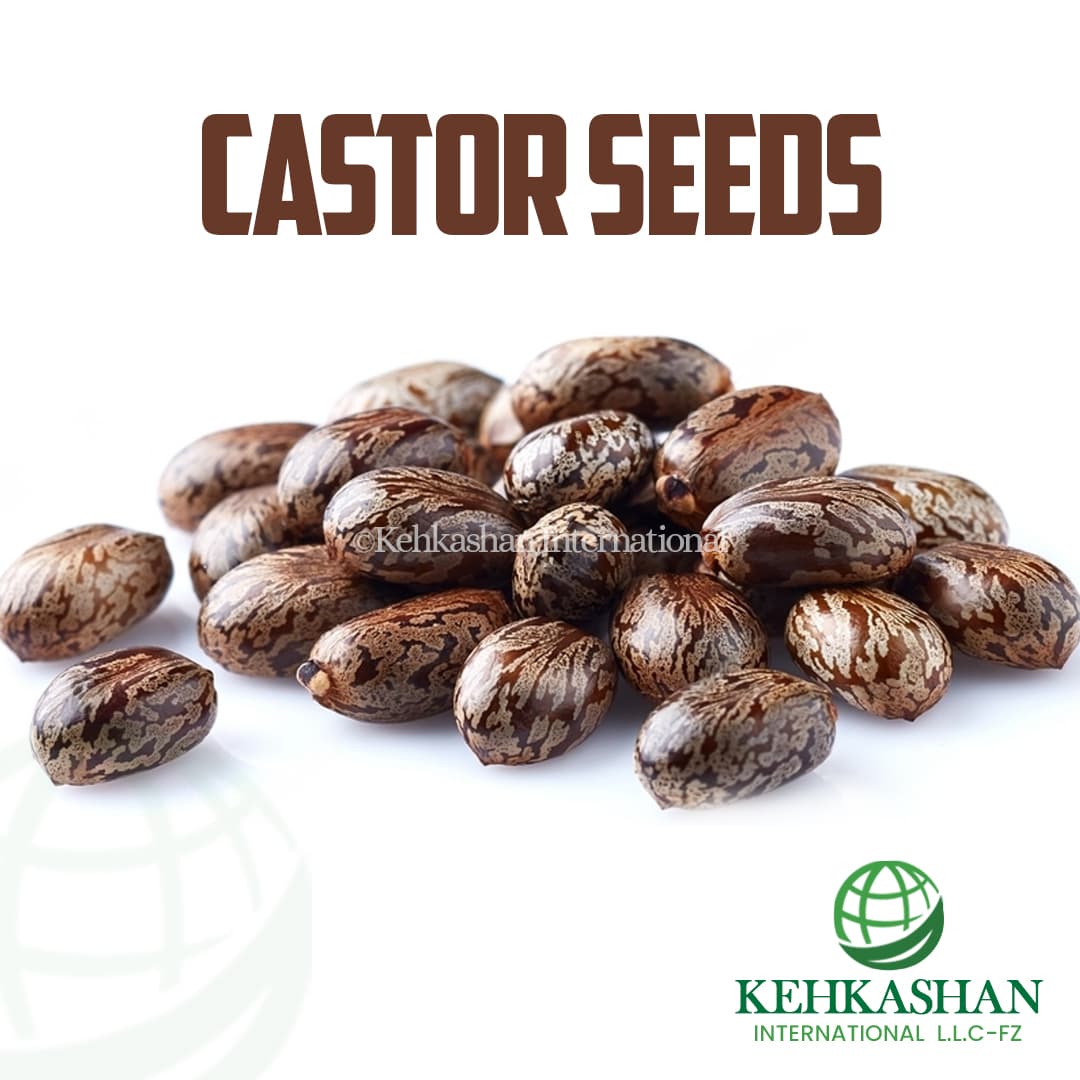
Indian castor variety codes are issued by three institutions: GCH (Gujarat Castor Hybrid) from Junagadh, DCH (Directorate of Oilseeds Castor Hybrid) from Hyderabad, and TMV (Tamil Nadu Manugu) from Coimbatore. Each release specifies oil-content range, yield-per-hectare, and HS-code 1207.30 export class.
Castor — the industrial oilseed
Castor (Ricinus communis) is an industrial oilseed grown principally for its fixed oil, which contains 85 to 90 percent ricinoleic acid — the only commercial source of this hydroxy fatty acid in international agriculture. Ricinoleic acid is the feedstock for sebacic acid, undecylenic acid, polyols for polyurethane, biodegradable lubricants, and a growing list of bio-derived industrial chemicals.
Castor is not a food crop. The seed contains ricin, a highly toxic protein concentrated in the seed coat, which is destroyed in the oil-extraction press cake by heat treatment. Castor meal after detoxification is used as nitrogen-rich organic fertiliser; in undetoxified form it is hazardous and trades only under controlled industrial-feedstock contracts.
India produces approximately 80 percent of the world's castor seed per FAOSTAT HS-1207.30 production data, with Gujarat State alone accounting for the bulk of that figure. China, Mozambique, Brazil, Ethiopia, and Paraguay are smaller-volume origins. The HS code for castor seed is 1207.30 (castor oil seeds, whether or not broken).
The Indian variety system — three institutions
Indian castor variety codes carry the institution prefix that bred them. Buyers reading a contract for "DCH-32 castor seed" should recognise that "DCH" tells them the breeding institution, and "-32" is the release sequence number from that institution.
GCH — Gujarat Castor Hybrid. Bred at the Junagadh Agricultural University Castor and Sesame Research Station in Junagadh, Gujarat. The GCH series is the dominant Indian castor pedigree by acreage. Notable releases:
- GCH-7 — released 2007. Oil content 48 to 50 percent. Yield potential 2,500 to 2,800 kg per hectare under irrigation. Wilt-tolerant, with moderate resistance to Fusarium oxysporum f. sp. ricini. Maturity 150 to 165 days.
- GCH-8 — released 2014. Higher oil content, 49 to 51 percent. Yield potential 2,700 to 3,100 kg per hectare. Improved wilt resistance over GCH-7.
- GCH-9 — most recent in commercial circulation. Oil content 50 to 52 percent.
DCH — Directorate of Oilseeds Research, Castor Hybrid. Bred at the Indian Council of Agricultural Research's Indian Institute of Oilseeds Research (ICAR-IIOR) in Hyderabad, Telangana. The DCH series targets central-Indian and southern-Indian growing conditions. Notable releases:
- DCH-32 — released 1992 and still in commercial use. Oil content 48 to 50 percent. Yield 2,400 to 2,700 kg per hectare. Suited to medium-heavy black-cotton soils of central India.
- DCH-177 — released 2003. Oil content 49 to 51 percent. Yield 2,500 to 2,800 kg per hectare under irrigation.
- DCH-519 — recent release with elevated wilt resistance and 50 to 52 percent oil content.
TMV — Tamil Nadu Manugu. Bred at Tamil Nadu Agricultural University, Coimbatore. The TMV series targets the lower-rainfall conditions of Tamil Nadu and Andhra Pradesh. "Manugu" is the Tamil word for castor.
- TMV-5 — long-standing TNAU release. Oil content 47 to 49 percent. Yield 1,800 to 2,200 kg per hectare under rainfed conditions, lower than GCH or DCH because of the rainfed agronomy. Matures earlier — 130 to 140 days.
- TMV-6 — improved release with marginally higher oil content. Used in mixed-cropping with red gram in Tamil Nadu.
Oil content per variety
The 47-to-52 percent oil-content band covers all current Indian castor releases. Within that band, genetics matter less than agronomy: a GCH-8 grown rainfed in marginal black-cotton soil will deliver 47 percent oil where the same variety grown irrigated in well-managed Banaskantha District alluvium will deliver 51 to 52 percent.
For an oil-pressing buyer the variety designation is a useful index of expected oil yield, but the contractual specification should always be on tested oil content per analyser report — not on variety designation alone. A clean contract reads "GCH-8, oil content not less than 49 percent on FOSS extraction" rather than "GCH-8" alone.
Yield per hectare and the supply curve
Yield-per-hectare differences between varieties shape the Indian production curve from year to year. GCH-8 and GCH-9 are pulling acreage in Banaskantha and Mehsana districts because their 2,700 to 3,100 kg/ha potential outperforms the legacy DCH-32 by 10 to 20 percent under the same input regime. Tamil Nadu rainfed acreage continues to use TMV-5 and TMV-6 because the agronomy in those districts cannot support the irrigation and input intensity that GCH varieties require to deliver their potential.
A castor trader who needs to commit forward volume in Q3 each year for the following March-April harvest reads the variety mix as a leading indicator: heavier GCH-8 and GCH-9 acreage signals higher production but slightly later maturity; heavier TMV acreage signals lower per-hectare yield but earlier harvest into the export window.
Origin notes — Gujarat dominance and alternatives
India — Gujarat (Banaskantha, Mehsana, Patan, Sabarkantha). Roughly 80 percent of global castor seed production. Banaskantha District alone is the single largest castor-producing district in the world. The export window from Mundra and Kandla is December through March. Pack form for export is 50 kg PP woven bag or bulk container with liner.
Brazil — Bahia. Second-largest origin. Bahia castor is principally rainfed; oil content runs 45 to 48 percent. Brazilian export is principally to North America.
China — Inner Mongolia, Hebei. Chinese castor is small-volume in the international export trade because most production is consumed by domestic chemical industry.
Mozambique — Manica, Tete. Re-emerging African origin. Lower oil content (44 to 47 percent) and yield, but proximity to European chemical buyers gives a freight advantage.
Ethiopia — Wollega. Small-volume rainfed producer. Oil content 45 to 47 percent.
HS code 1207.30 — what it covers
HS code 1207.30 is "castor oil seeds, whether or not broken" under Chapter 12 of the Harmonized System (oil seeds and oleaginous fruits). The code covers whole castor seeds and broken-castor lots; it does not cover castor oil (HS 1515.30) or castor meal/cake (HS 2306.49). Buyers writing import declarations should match the HS code to the physical good shipped: a contract for castor seed clears under 1207.30; a contract for crude castor oil clears under 1515.30.
EU and US import tariffs on castor seed under 1207.30 are zero or near-zero for most-favoured-nation status. The duty calculation is therefore straightforward, but the import buyer must hold a hazardous-material handling protocol because of ricin content in the unprocessed seed.
FAQ
What does "GCH" stand for in castor variety codes?
GCH stands for Gujarat Castor Hybrid. The series is bred at Junagadh Agricultural University in Gujarat, India, and includes commercial releases GCH-7, GCH-8, and GCH-9, with oil content ranging from 48 to 52 percent.
Which Indian castor variety has the highest oil content?
GCH-9 carries the highest commercial oil-content range at 50 to 52 percent under irrigated cultivation in well-managed Banaskantha District soils. Actual realised oil content depends heavily on agronomy.
What is the HS code for castor seed?
The HS code for castor seed is 1207.30. Castor oil is HS 1515.30, and castor meal/cake is HS 2306.49. Buyers should match the HS code to the physical good shipped.
Which country produces the most castor seed globally?
India produces approximately 80 percent of the world's castor seed. Gujarat State alone accounts for the bulk of Indian production, with Banaskantha District the single largest castor-producing district globally.
Is castor seed safe to handle?
Castor seed contains ricin, a highly toxic protein concentrated in the seed coat. Whole seed must be handled under appropriate occupational-safety protocols. Ricin is destroyed in the oil-extraction press cake by heat treatment, after which the meal is safe for use as nitrogen-rich organic fertiliser.
Procurement timing and the Indian export window
Indian castor seed is harvested between February and April depending on geography. Gujarat north (Banaskantha, Mehsana) harvests through March; Gujarat south (Bhavnagar) harvests slightly later. The cleaned, graded export-ready material starts moving from Mundra and Kandla ports in late March, and the heaviest export volume runs from April through August.
Buyers committing forward volume face a specific timing challenge: the Indian government Solvent Extractors' Association of India publishes monthly castor crop estimates, and those estimates move materially from January through April as actual harvest data lands. A buyer fixing a forward FOB price in November against an early December crop estimate can find the published estimate revised by 15 to 20 percent by the time the lot is loaded in May. For this reason, tonnage-only forward contracts are common in castor, with the price linked to a published index (NCDEX castor seed contract on the National Commodity & Derivatives Exchange) at the time of loading rather than at the time of contract signature.
International buyers who lack access to NCDEX index pricing typically negotiate FOB prices against a 30-day rolling average of the published NCDEX settlement price for the relevant delivery month. This is not a perfect hedge — the basis between NCDEX-traded grade and the buyer's specific specification can drift — but it removes the worst of the absolute-price exposure.
Castor oil versus castor seed — what the buyer actually wants
Many international "castor" enquiries are genuinely for castor oil rather than castor seed. The two trade under different HS codes (1207.30 for seed, 1515.30 for oil), have different storage and transport requirements (oil is typically shipped in flexitank or ISO tank; seed in containers), and have different downstream processing requirements at the buyer's plant.
A buyer asking for "castor oil first special grade" wants the oil. A buyer asking for "GCH-7 seed" wants the seed for their own pressing operation or onward trade. The two contracts look entirely different. Castor oil first special grade specifications commonly include acid value below 1.0, iodine value 82 to 90, hydroxyl value 160 to 168, saponification value 175 to 185, and color (Lovibond) below 1.0 yellow. None of these specifications apply to whole castor seed.
Buyers should confirm at enquiry-stage whether they need seed or oil. Trade desks that offer both will quote separately because the procurement chain, the storage, and the documentation are different.
Forward outlook for castor demand
Industrial demand for castor oil has expanded in three vectors over the past decade. The first is bio-derived polyols for polyurethane foam, where castor-based polyols replace petroleum-based polyether polyols in mattress, automotive seating, and footwear applications. The second is sebacic-acid production, principally in Chinese chemical plants, which is the precursor for nylon-6,10 polyamide. The third is the cosmetics and personal-care application, where hydrogenated castor oil and castor-derived emollients have grown share in formulation.
These industrial vectors give castor a structural demand floor that is less price-elastic than food oilseeds. A buyer committing forward volume for industrial-feedstock conversion is therefore less likely to walk away from a contract on a 5 to 10 percent price move than a food-oil buyer would be on the same move. This shapes the Indian export trade-desk's preference for repeat industrial buyers over spot speculative buyers, and it shapes the LC and payment terms — industrial buyers see longer LC tenors (60 to 90 day usance LC is not unusual) than spot buyers, who settle at sight.


