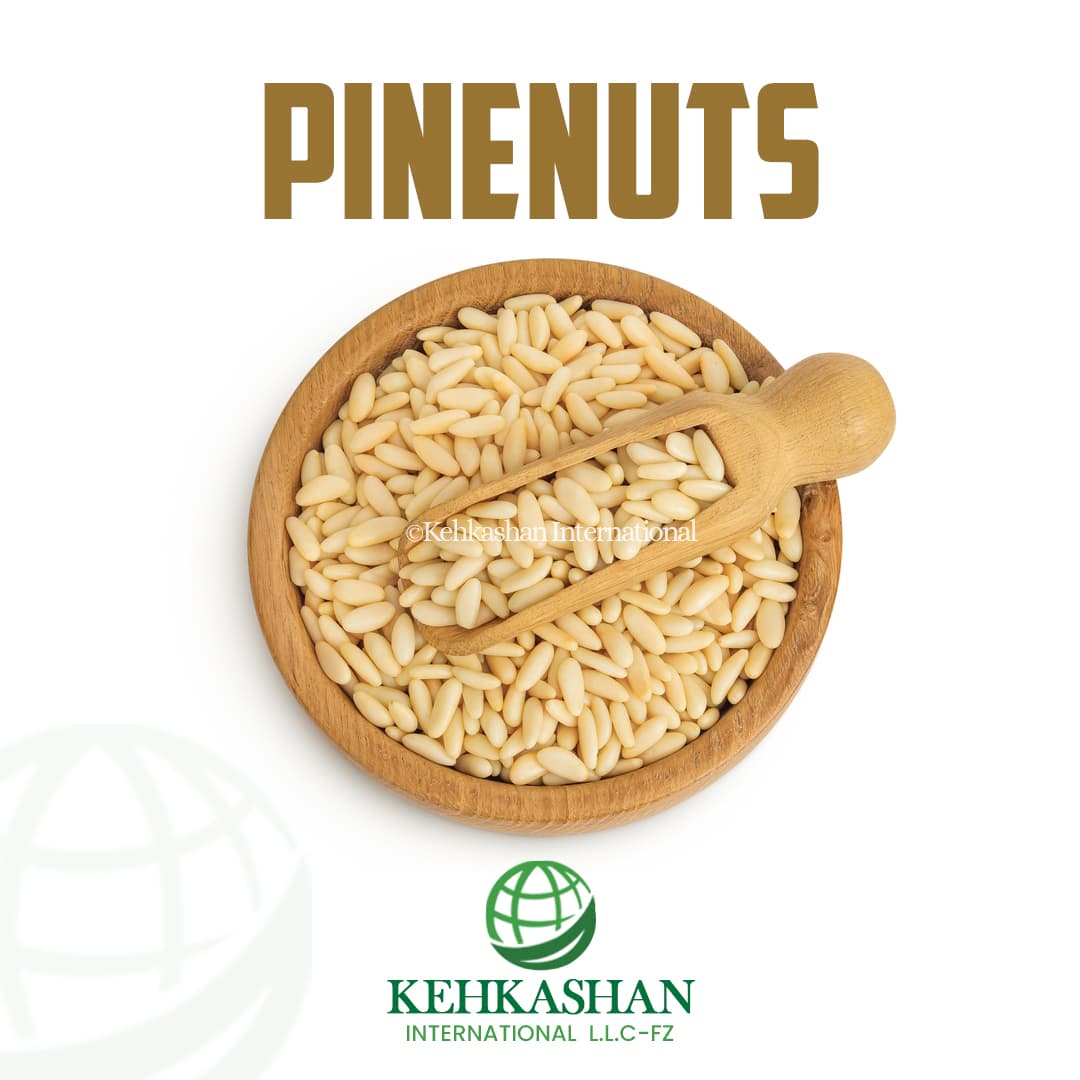
Pakistani pine nuts (Pinus gerardiana) come primarily from the Suleiman Range and Chitral region of Pakistan, plus eastern Afghanistan. Italian Pinus pinea and Korean Pinus koraiensis are alternative species with different shape and price. Buyers specify in-shell or white-kernel grade, moisture below 6 to 8 percent, EU aflatoxin compliance. Standard MOQ is 100 kg with FCL volumes available.
Why Pinus gerardiana commands a premium
Pinus gerardiana is the rarest commercially traded pine nut and is listed as Near Threatened on the IUCN Red List. The species grows only in the high-altitude dry temperate belt of the western Himalayas — Pakistan's Suleiman Range, Chitral district, parts of Khyber-Pakhtunkhwa, plus eastern Afghanistan. The trees mature in 25 to 30 years before producing economically viable cone yields, and harvest is done by hand from steep alpine slopes. Annual global production is small — estimates run between 800 and 2,400 metric tons of in-shell nuts depending on weather and pine moth pressure that year.
That scarcity sets the price floor. In-shell Pakistani pine nuts FOB Karachi run roughly 18 to 32 USD per kilogram in 2026 depending on grade and harvest yield, with white kernels (peeled and sorted) reaching 40 to 60 USD per kilogram for premium hand-sorted lots. Compare to Korean Pinus koraiensis kernel at 22 to 30 USD per kilogram or Italian Pinus pinea at 35 to 55 USD per kilogram and the buyer's choice is rarely about price alone — it is about which species the end market specifies.
The four pine nut species in trade
Buyers writing "pine nuts" on an RFQ typically mean one of four species, and the substitution rules between them are not symmetrical.
Pinus gerardiana. Long, narrow shells with a distinctive pointed tip. White kernel inside is sweeter, oilier, and softer than other pine nuts; kernel-to-shell ratio is about 35 to 40 percent. Origins: Pakistan and Afghanistan. Premium product, primarily sold into Middle Eastern, South Asian diaspora, and increasingly North American gourmet markets.
Pinus pinea — Italian or Mediterranean stone pine. Round, plump kernel with the classic pesto profile most European buyers recognize. Italy, Spain, Portugal, and Tunisia are the producing regions. Higher kernel-to-shell ratio (about 50 to 55 percent) but European supply is constrained by pine processionary moth and red palm weevil pressure on plantations.
Pinus koraiensis — Korean pine. Elongated kernel, mild flavor, the dominant species in global commercial pine-nut trade by volume. Korea, China (Heilongjiang and Jilin), and the Russian Far East. Kernel-to-shell ratio about 40 to 45 percent.
Pinus sibirica — Siberian pine. Smaller kernel, grown in Russian Siberia and Mongolia. Functional substitute for koraiensis at a discount.
For a buyer requesting Pakistani-origin pine nuts, the Latin name on the RFQ should be Pinus gerardiana. Substituting Pinus pinea or Pinus koraiensis without buyer consent is a recurring source of disputes — confirm the species before booking.
Grade vocabulary buyers use
The grading conversation has three layers and they all matter on the Certificate of Analysis.
Format. In-shell, kernel (peeled), or roasted kernel. In-shell preserves shelf life for up to 24 months in food-grade lined cartons; kernel runs 12 months sealed and refrigerated. Roasted is end-product oriented and ships in nitrogen-flushed pouches.
Sortation grade. Hand-sorted, machine-sorted (sortex), or unsorted bulk. Hand-sorted is the only grade that meets the cosmetic standard of high-end gourmet packers in Europe and the Gulf — broken kernels, hulls, and discoloration must be below 0.5 percent. Sortex is acceptable for mid-tier private-label retail. Unsorted bulk is for processors who will further sort downstream.
Moisture and aflatoxin. Kernel grade requires moisture below 6 percent for the food-grade shelf life claim; in-shell tolerates up to 8 percent. Aflatoxin testing is mandatory for any EU-bound shipment under EU Regulation 1881/2006 — total aflatoxins below 4 micrograms per kilogram, aflatoxin B1 below 2 micrograms per kilogram. Saudi Arabia's SFDA mirrors the EU limit. Indian FSSAI is more permissive at 15 micrograms per kilogram total but Indian re-exporters often spec to EU-tight to keep optionality on the lot.
A clean Certificate of Analysis on a Pakistani pine nut shipment carries: species (Latin binomial), origin region (Suleiman Range, Chitral, or specific Afghan province), harvest year, format, sortation grade, moisture percentage, aflatoxin total and B1 micrograms per kilogram, foreign matter percentage, and a phytosanitary declaration from Pakistan's Department of Plant Protection.
Pakistan vs Afghanistan — origin economics
Both countries produce true Pinus gerardiana, but the trade pathways differ.
Pakistan. Pakistani pine nuts move through Karachi or, increasingly, Gwadar port. Field collection is concentrated in the Suleiman Range (Balochistan side and Punjab side around Sherani and Sulemanki), Chitral, and pockets of South Waziristan. Pakistan's Department of Plant Protection issues the phytosanitary certificate; the Pakistan Standards and Quality Control Authority covers food-safety conformance. Karachi-FOB is the standard origin-trade incoterm. Pakistani in-shell typically runs 2 to 4 USD per kilogram cheaper than Afghan-origin equivalent at FOB level.
Afghanistan. Afghan Pinus gerardiana grows in Paktia, Khost, and Nangarhar provinces. Most Afghan supply moves overland to Pakistan first — through Torkham or Chaman border crossings — then ships out of Karachi or Jebel Ali. Direct Afghan exports through Bandar Abbas (Iran transit) or via the Wakhan corridor to Tajikistan are limited and irregular. Buyers paying for "Afghan-origin" should validate the chain-of-custody documentation; it is genuine when present but routinely conflated with Pakistani-origin lots in mixed-origin consolidation.
The trade desk recommendation: for buyers who do not have a strong end-customer preference between the two, source whichever has fresher harvest and tighter aflatoxin numbers in the year you are buying. The species, grade, and shelf-life math matter more than the country of origin sticker.
Container math, MOQ, and pricing tiers
Pakistani pine nuts are a low-density commodity by weight. A 20-foot full-container load of in-shell nuts in 25 kilogram cartons holds roughly 8 to 10 metric tons depending on packing density. Kernel grade in 10 kilogram vacuum-sealed cartons fits 14 to 18 metric tons per 20-foot container.
MOQ tiers as we run them at Kehkashan:
- 5 kg vacuum-sealed pouch — sample / boutique private label
- 100 kg cartons — minimum starter order, fits the LCL consolidation bracket
- 1,000 kg in cartons — break-even on a 20-foot LCL with consolidated shipping
- 5,000 kg+ — book a 20-foot FCL of mixed grades
- 10,000 kg+ — full 20-foot FCL of single-grade premium, customizable packaging
Pricing tiers (FOB Karachi, indicative, 2026):
- In-shell unsorted bulk: 18-22 USD/kg
- In-shell sortex: 22-28 USD/kg
- In-shell hand-sorted Premium: 28-32 USD/kg
- Kernel sortex: 38-46 USD/kg
- Kernel hand-sorted Premium: 48-60 USD/kg
- Roasted kernel (custom seasoning): +5-8 USD/kg over Premium
These bands move with the harvest. The pine cone biennial cycle plus moth-pressure variability means a single bad year can compress supply 30 percent and push every band up 25 percent. Buyers locking in annual contracts in October-November (post-harvest) typically secure 8-12 percent better pricing than buyers shopping the spot market in March-April.
Documentation set on every shipment
Every Pakistani pine nut container leaves Jebel Ali or Karachi with the standard export pack:
- Bill of lading
- Commercial invoice and packing list
- Certificate of Origin (Pakistan Chamber of Commerce)
- Phytosanitary certificate (Department of Plant Protection)
- Certificate of Analysis (lab name, ISO 17025 accreditation if applicable)
- Aflatoxin analysis report (separate or annexed to CoA)
- Health certificate (PSQCA or destination-equivalent)
- Form A or EUR.1 origin certificate (where preferential tariff applies)
- Fumigation certificate (mandatory for EU, optional for GCC)
For Saudi Arabia, the additional layer is an attested commercial invoice through the Pakistan Embassy in Riyadh or the Saudi Embassy in Islamabad, plus SASO conformity assessment. EU shipments add a CHED-D entry on the EU TRACES system and may trigger Border Control Post sampling in 8 to 12 percent of consignments.
Lead times by destination port
From Karachi or Jebel Ali, Pakistani pine nut shipments to the major destination ports run on these typical transit windows. Pre-vessel production lead time is 14 to 21 days from PO confirmation; ocean transit is on top.
| Destination port | Country | Ocean transit | Typical Incoterm |
|---|---|---|---|
| Jeddah | Saudi Arabia | 5-8 days | CFR / CIF |
| Hamad | Qatar | 3-5 days | CIF |
| Sohar | Oman | 2-4 days | CIF |
| Mombasa | Kenya | 12-18 days | CIF |
| Hamburg | Germany | 21-28 days | CIF / DAP |
| Rotterdam | Netherlands | 21-28 days | CIF / DAP |
| New York | United States | 28-35 days | CIF |
| Toronto via Halifax | Canada | 30-38 days | CIF |
| Mumbai | India | 7-10 days | CFR |
| Bangkok | Thailand | 18-22 days | CFR |
US-bound kernel-grade shipments specify nitrogen flushing in the cartons and refrigerated container service if the buyer is unwilling to bear shelf-life risk.
How buyers should run an RFQ
A clean RFQ to a Pakistani pine nut supplier specifies seven things. Every gap below the seven leads to a re-quote and a delayed PO.
- Species (Pinus gerardiana, pinea, or koraiensis — pick one)
- Format (in-shell, kernel white, kernel roasted)
- Sortation grade (hand-sorted, sortex, unsorted)
- Quantity in kilograms or metric tons
- Pack size and packaging (5 kg vacuum, 10 kg carton, 25 kg carton, etc.)
- Destination port
- Incoterm preference (FOB Karachi, CFR destination, CIF destination, DAP)
A complete RFQ gets a same-day quote. Incomplete RFQs add 2 to 5 working days as the trade desk clarifies specs.
When to buy ahead vs spot
Pinus gerardiana is a once-a-year cone harvest in Pakistan and Afghanistan, October to December depending on altitude and species. Quality assessment finishes by late January, and the year's pricing band is set by mid-February.
Buyers who need consistent year-round supply should book annual volume against an annual contract by January-February at fixed prices. This locks the lot, gives the supplier inventory certainty, and typically prices 8-12 percent under spot.
Buyers running smaller volume (under 5 tons annually) often do better on the spot market, picking up 100 to 500 kg lots as they need them through the year. The shelf-life math limits how far ahead they can usefully buy anyway.
What separates a good supplier from a marketplace listing
The Alibaba-style marketplace listings for "Pakistani pine nuts" include genuine Pakistani exporters mixed with Indian re-packagers and Chinese koraiensis-substituting traders. Three diligence checks separate the real from the deceptive:
- Lab origin on the CoA — accredited Pakistani or international labs (SGS Pakistan, Bureau Veritas, Intertek). Anonymous "in-house" certificates carry no weight.
- Photographic kernel evidence with reference to species shape — Pinus gerardiana kernels are long and pointed; Pinus pinea kernels are round and plump. A photo mismatch on the contracted species is the most common substitution scam.
- Sample sufficient for an end-buyer cupping or roast test — 200 to 500 grams is enough to verify aroma, kernel intactness, and roast performance before committing to a full container.
We courier 1 to 2 kilogram samples to qualified buyers worldwide free of freight; the sample fee credits against the first PO on acceptance.
Trade desk closing note
Pakistani pine nuts are one of those commodities where buying right means buying from someone who can name the village or valley the lot came from. The supply chain compresses across maybe 30 to 50 active wholesalers in Pakistan; below that level it is village-level cooperatives and individual collectors. Premium buyers — luxury gourmet packers in Riyadh, Mumbai, London, Frankfurt — increasingly require traceability to the harvest village level. We document this on request.
For a quote, send the seven RFQ specs above to [email protected]. The trade desk replies within one working day with FOB Karachi, CFR your-destination-port, CIF, and DAP options.


