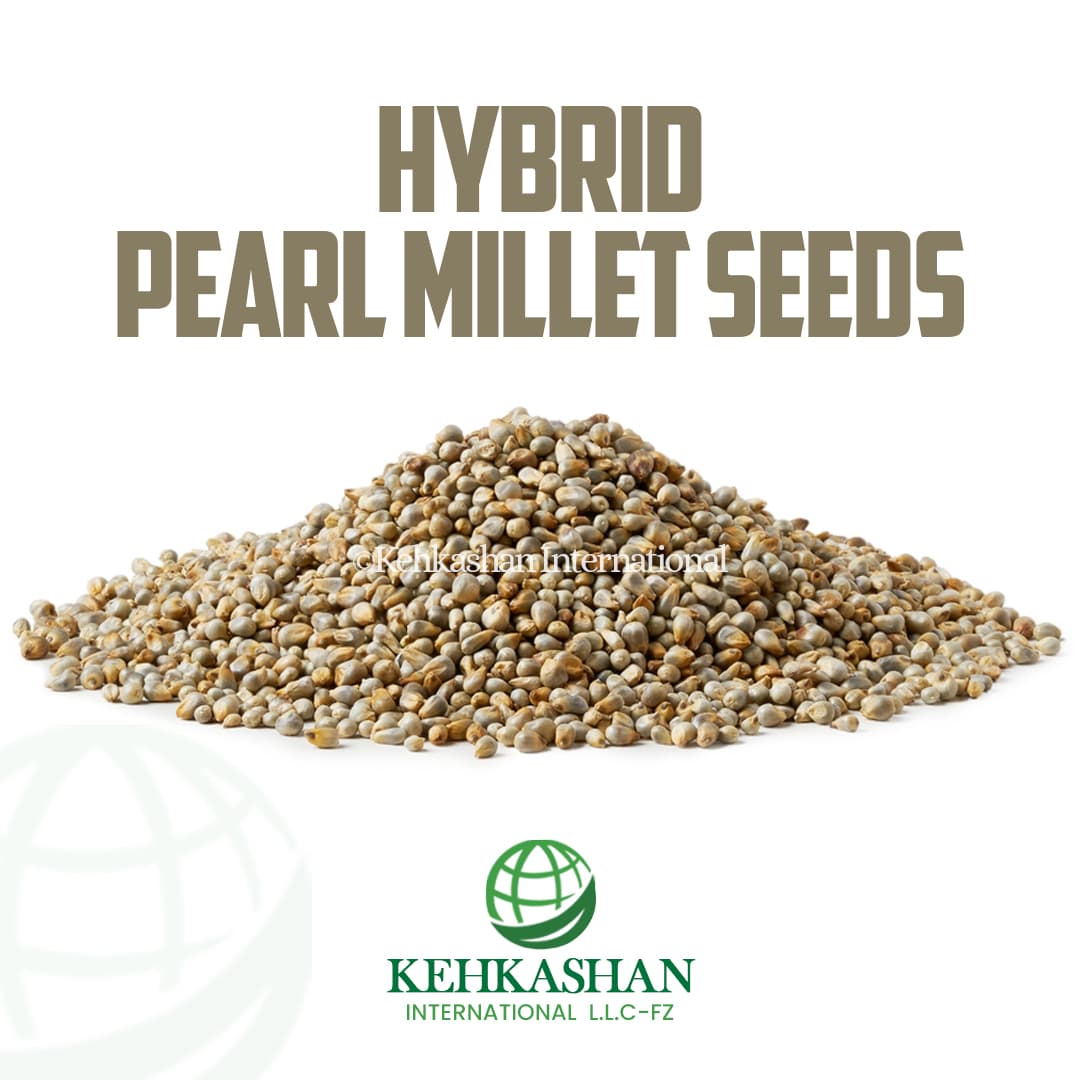
Hybrid pearl millet (Pennisetum glaucum) seed comes primarily from India and Pakistan. Buyers specify hybrid code (HHB-67, MH-179, Nandi-32, ICMH-356), purpose (forage, grain, dual), ISTA purity 99 percent, germination 85 percent minimum, moisture below 12 percent. MOQ is 1,000 kg LCL or 24 metric tons FCL. Lead times Karachi to Mombasa are 12 to 18 days.
Why hybrid pearl millet is the underrated forage SKU of 2026
Pearl millet sits at an unusual intersection of three concurrent demand pulls that few exporters have positioned themselves to serve in a single shipment. The first is the Sahelian and Saharan-belt food-security pull — Niger, Mali, Burkina Faso, Chad, and northern Nigeria where pearl millet grain is a primary calorie staple per FAO Sahel cereal balance sheets and seed-replacement demand runs into the tens of thousands of tons annually. The second is the East African and Gulf forage pull — Kenya, Tanzania, Ethiopia, and Saudi Arabia where dual-purpose hybrids deliver biomass for dairy and feedlot operations on lower-quality water than alfalfa requires. The third is the global drought-resilient-fodder R&D pull — Australian, Brazilian, and US-southern-tier breeders looking for parental lines to introduce into their proprietary hybrid programs.
Pakistan and India between them produce roughly 95 percent of the commercial hybrid pearl millet seed sold into export markets. The seed itself is small — about 8 to 10 grams per 1,000 seeds — which means a 24-ton FCL of hybrid pearl millet covers an unusually large planting footprint, often one to two million hectares of seedbed depending on seeding rate. That density is what makes the freight economics work even on long-haul routes to West Africa and South America.
This guide walks through the origin economics, the hybrid-code vocabulary, the dual-purpose forage-vs-grain specification choice, and the documentation set we run on every Kehkashan container.
Where commercial hybrid pearl millet seed comes from
India. The largest single-origin producer by volume, with multiplication zones across Rajasthan, Gujarat, Maharashtra, Karnataka, Andhra Pradesh and Tamil Nadu. Indian breeding programs at ICRISAT (International Crops Research Institute for the Semi-Arid Tropics, Hyderabad) and the All India Coordinated Pearl Millet Improvement Project (AICPMIP) have released the bulk of the commercial hybrid library now available. ICRISAT-derived public hybrids dominate the African export trade; private-sector hybrids from Pioneer, Bayer, Pacific Seeds and ProAgro dominate the Indian domestic market. Indian seed ships out of Mumbai (Nhava Sheva), Mundra and Kandla.
Pakistan. Multiplication zones across Punjab (Faisalabad, Multan, Bahawalpur) and Sindh (Mirpur Khas). Pakistan's pearl millet seed industry was built on Indian hybrid imports through the 1990s and 2000s, with progressive localization of multiplication and breeding from 2010 onwards. National hybrids from Ayub Agricultural Research Institute (AARI Faisalabad), Nuclear Institute for Agriculture and Biology (NIAB), and private-sector partners now cover the bulk of Pakistani commercial supply. Pakistani seed ships out of Karachi.
Niger and Senegal. Smaller but growing community-based seed system multiplication for African Sahelian markets, often supported by USAID, AGRA, and FAO seed-system programs. Volumes are modest relative to the South Asian supply but politically and logistically important for buyers serving the Sahel directly.
United States and Australia. Specialty production for dual-purpose forage hybrids in Texas, Kansas, Queensland and Western Australia. Volumes are limited and pricing is multiples of South Asian FOB. Used primarily by domestic forage operations and select premium-pricing export customers.
Hybrid code vocabulary — what each means on the Certificate of Variety
The hybrid code on the bag is a release identifier that compresses a substantial amount of breeding information. Understanding the code library is the difference between getting a 70-day-maturity grain hybrid when you needed a 100-day dual-purpose forage hybrid, and they look identical in the bag.
HHB-67 and HHB-67 Improved. Released by the All India Coordinated Pearl Millet Improvement Project. 65 to 70 days to maturity, downy mildew resistant, suited to drought-prone Rajasthan and northwestern Indian conditions. Grain-focused with moderate biomass. The most-multiplied public hybrid in the African Sahel export trade.
MH-179. Maharashtra Hybrid 179, released by Mahatma Phule Krishi Vidyapeeth. 80 to 85 days, dual-purpose grain and forage, suitable for medium-rainfall zones (350 to 600 mm seasonal rainfall). Common Pakistani commercial hybrid as well, often labelled differently for the Pakistani trade.
Nandi-32. Pakistani national hybrid released by AARI Faisalabad. 75 to 80 days, dual-purpose, downy mildew resistant, suited to Punjab and Sindh agroclimatic zones. Strong forage biomass with moderate grain yield.
ICMH-356 and ICMH-451. ICRISAT-released hybrids for the Sahelian and East African export trade. 75 to 85 days, primarily forage-biomass focused with moderate grain. Often the default specification on FAO and AGRA tenders.
ICTP-8203. ICRISAT open-pollinated variety (not technically a hybrid, but commonly grouped with the hybrid library on commercial RFQs). 80 days, dual-purpose, suited to community-based seed system multiplication.
Pusa Composite 612 and Pusa-23. Indian Council of Agricultural Research releases. Open-pollinated, mid-maturity, dual-purpose. Used where hybrid F1 vigor is unavailable or unaffordable.
Private-sector hybrids (Pioneer 86M88, Pacific MillSeeker, Bayer 9444). Proprietary hybrids released for specific Indian or Australian agroclimatic zones, with restricted licensing for export. Buyers wanting these specifically need to contract through the originator or licensed multiplier.
When the buyer's RFQ specifies "hybrid pearl millet 24 tons" without naming the hybrid code, the supplier's default is whichever hybrid is most cost-efficient at that moment in the multiplication cycle — which may not be the hybrid the buyer's downstream agronomy team specified. Always state the hybrid code (or two acceptable codes) on the RFQ.
Forage vs grain vs dual-purpose — the spec that drives everything
Pearl millet is sold under three end-use specifications, and the agronomic, packaging and pricing implications are different for each:
Grain-purpose hybrids. Targeted at human-food and poultry-feed grain production. Maturity 65 to 80 days, plant height 1.5 to 2.0 meters, grain yield priority over biomass. Rajasthan, northwestern India, and the African Sahel are primary markets. Seeding rate 3 to 5 kg per hectare, so a 24-ton FCL covers 5 to 8 million hectares of grain production.
Forage-purpose hybrids. Targeted at silage, hay, and direct-grazing dairy and feedlot operations. Maturity 90 to 110 days, plant height 2.5 to 4.0 meters, biomass priority over grain (or grain harvested as bonus). Multiple cuts possible during the season. Kenya, Tanzania, Ethiopia, Saudi Arabia, Egypt, and Sudan are primary markets. Seeding rate 8 to 12 kg per hectare, so a 24-ton FCL covers 2 to 3 million hectares of forage production.
Dual-purpose hybrids. The compromise tier — moderate maturity, moderate height, both grain and biomass yields balanced. Used by smallholder farmers across South Asia and Sub-Saharan Africa where the same crop serves family food, poultry, and livestock fodder. The bulk of community-based seed system demand sits in this tier.
The seeding rate difference (3 to 5 kg/ha for grain vs 8 to 12 kg/ha for forage) means that a forage-program buyer needs roughly 2 to 3 times the seed tonnage per hectare planted. RFQs that confuse the two end up with seed shortages or surpluses on the farm side.
Grade vocabulary on the Certificate of Analysis
A clean pearl millet seed CoA carries seven fields beyond hybrid code declaration:
- Genetic purity — minimum 95 percent for hybrid F1 seed (grow-out test required for export to EU and quality-conscious African markets), 90 percent acceptable for community-based seed system buyers.
- Physical purity — ISTA standard, minimum 99 percent.
- Germination — minimum 85 percent for hybrid F1, 80 percent for open-pollinated. Tested per ISTA International Rules for Seed Testing at 28 degrees Celsius, 7-day count.
- Moisture — below 12 percent for shipped grade. Bulk lots above 12 percent risk degradation in transit and shelf-life loss.
- Other-crop seed — below 0.1 percent, with explicit declaration on prohibited weeds (parthenium, striga).
- Inert matter — below 1 percent.
- Treatment status — declaration of seed treatment chemistry (Apron, Cruiser, Vitavax, etc.) where seed has been treated, with full active-ingredient and rate disclosure.
EU and quality-conscious African buyers add the OECD seed scheme certificate where applicable, plus a phytosanitary certificate explicitly clearing the lot for striga (Striga hermonthica and Striga asiatica) and downy mildew (Sclerospora graminicola) freedom.
Container math, MOQ, and pricing
Hybrid pearl millet seed is unusually high-density relative to its seed-count — about 8 to 10 grams per 1,000 seeds, with a bulk density of 700 to 800 kg per cubic meter. A 20-foot full-container load holds 22 to 24 metric tons in 25 kg multi-layer kraft bags or PP woven bags with food-grade liner.
MOQ tiers as we run them at Kehkashan:
- 100 kg starter — minimum order, fits LCL consolidation
- 1,000 kg — break-even on most LCL routes
- 5,000 kg — full LCL consolidation with shared 20-foot booking
- 22,000 kg+ — full 20-foot FCL of single-hybrid-code material
- 26,000 kg+ — full 40-foot FCL for high-volume forage program buyers
Pricing tiers (FOB Karachi, indicative, 2026):
- Open-pollinated grain (ICTP-8203, Pusa-23): 1.40-1.80 USD/kg
- Open-pollinated forage: 1.60-2.00 USD/kg
- Hybrid F1 grain (HHB-67, ICMH-356): 2.20-3.00 USD/kg
- Hybrid F1 forage (Nandi-32, MH-179 forage selection): 2.40-3.20 USD/kg
- Hybrid F1 dual-purpose (Nandi-32, MH-179): 2.30-3.10 USD/kg
- Treated hybrid F1 (with Apron / Vitavax / Cruiser): add 0.30-0.60 USD/kg over untreated tier
Documentation set on every shipment
Every Pennisetum glaucum container leaves Karachi with the standard export pack:
- Bill of lading
- Commercial invoice and packing list
- Certificate of Origin (Pakistan Chamber of Commerce)
- Phytosanitary certificate (Department of Plant Protection) — with explicit striga and downy mildew freedom declaration
- ISTA Certificate of Analysis (purity, germination, moisture, other-crop seed, inert matter)
- Genetic purity grow-out test certificate (where required)
- OECD seed scheme certificate (where applicable)
- Hybrid variety registration / Certificate of Variety
- Seed treatment declaration (active ingredient, rate, applicator)
- Form A or EUR.1 origin certificate where preferential tariff applies
- Fumigation certificate (mandatory for African and EU destinations)
African Sahelian buyers under FAO, AGRA, USAID or EU-development-program tenders add a third-party-verified pre-shipment inspection (PSI) certificate per shipment.
Lead times by destination port
| Destination port | Country | Ocean transit | Typical Incoterm |
|---|---|---|---|
| Mombasa | Kenya | 12-18 days | CIF |
| Dar es Salaam | Tanzania | 14-20 days | CIF |
| Djibouti | Djibouti | 10-14 days | CIF |
| Beira | Mozambique | 18-24 days | CIF |
| Lagos (Apapa) | Nigeria | 22-28 days | CIF |
| Tema | Ghana | 24-30 days | CIF |
| Cotonou | Benin | 24-30 days | CIF |
| Dakar | Senegal | 26-32 days | CIF |
| Jeddah | Saudi Arabia | 5-8 days | CFR / CIF |
| Sohar | Oman | 2-4 days | CIF |
| Hamburg | Germany | 21-28 days | CIF |
| Santos | Brazil | 28-35 days | CIF |
| Sydney | Australia | 24-30 days | CFR |
Sahelian inland buyers in Niger, Mali, Burkina Faso, and Chad use Lagos, Tema, Cotonou or Dakar as the entry port, with overland trucking or rail to inland destinations. Incoterm DAP (delivered at place) is available for these markets where the buyer wants the inland leg handled by the supplier.
Demand-side pulls — who buyers actually are
Five end-use segments drive global pearl millet seed demand, each with distinct hybrid, purity and pricing tolerances:
African Sahelian community-based seed systems. FAO, AGRA, USAID, EU-development-program tenders for smallholder grain seed in Niger, Mali, Burkina Faso, Chad, northern Nigeria, and Cameroon. Spec emphasis on open-pollinated and lower-cost hybrid F1 grain with downy mildew and striga resistance. Volumes 500 to 5,000 tons per program tender. Pricing tolerance is structurally limited.
East African dairy and forage operations. Kenya, Tanzania, Ethiopia, Uganda, Rwanda. Spec emphasis on dual-purpose and forage-priority hybrids with high biomass and multiple-cut potential. Buyers run 100 to 1,000 ton annual programs.
Gulf and Middle Eastern feedlot and dairy. Saudi Arabia, UAE, Egypt, Sudan, Jordan. Spec emphasis on irrigated-conditions forage hybrids with rapid biomass accumulation and tolerance to high salinity. Buyers run 200 to 2,000 ton annual programs, often as part of broader forage portfolios alongside alfalfa and sorghum-Sudan grass.
South Asian domestic and re-export. Indian and Pakistani domestic farm-input distributors plus re-export to Bangladesh and Nepal. Spec emphasis on grain hybrids with rust and downy mildew resistance, plus dual-purpose hybrids for smallholder agriculture. Volume large but pricing pressure intense.
Specialty research and breeding. Australian, Brazilian, US-southern-tier, and South African breeding programs purchasing parental lines, exotic germplasm, and trial seed. Volumes small (1 to 100 kg per shipment) but pricing is multiples of commercial FOB.
Competition map — who buyers usually go to
The hybrid pearl millet seed export trade is concentrated in India and fragmented within Pakistan. Notable players include Nuziveedu Seeds (Indian private-sector, large hybrid library), Kaveri Seed Company (Indian private-sector, ICRISAT-derived hybrid program), Mahyco (Indian private-sector, dual-purpose focus), Ankur Seeds, Pacific Seeds (Australian-Indian joint), Pioneer Hi-Bred (DuPont, premium hybrid pricing), and Bayer Crop Science. Within Pakistan, AARI Faisalabad, NIAB, plus private-sector multipliers like Hyseed, Saeed Ahmad Seed Corporation, and FB Genetics cover the commercial supply.
For buyers running diligence, the differentiators between credible suppliers and marketplace listings are:
- Hybrid code transparency — a credible exporter can produce the formal Certificate of Variety, the breeder's release notes, and the multiplication chain back to the original parental lines.
- Lab certification of germination and genetic purity from an ISTA-accredited lab, plus the grow-out test for hybrid F1 verification.
- Striga and downy mildew freedom certification for African destinations — not all phytosanitary certificates explicitly clear these pests, and buyers in striga-endemic zones will reject undocumented lots at port.
- Treatment chemistry transparency — full active-ingredient and rate declaration with regulatory clearance for the destination market (some EU-derivative African markets restrict specific neonicotinoid treatments).
We document each of these on every Kehkashan pearl millet shipment. Sample lots of 1 to 5 kg are couriered free of freight to qualified buyers worldwide; the sample fee credits against the first PO on acceptance.
When to buy ahead vs spot
Hybrid pearl millet multiplication in India and Pakistan runs in two cycles per year — kharif (June to October, monsoon-irrigated multiplication) and rabi (November to March, post-monsoon irrigated multiplication). The rabi-multiplied seed is typically higher purity and ships from February through May into the African and Gulf planting seasons. The kharif-multiplied seed ships from October through January.
For African Sahelian community-based seed system buyers, annual contracts booked in February at fixed prices typically secure 8 to 15 percent better pricing than spot purchases through the year, plus guaranteed availability of the specified hybrid code. For East African and Gulf forage-program buyers running multi-year contracts, the pricing-stability premium of an annual contract is typically the deciding factor over spot purchasing.
Trade desk closing note
Pearl millet is one of those crops where the supplier's relationship with the multiplication agronomist matters more than the supplier's brochure. We work with multiplication partners in the Faisalabad and Multan corridors of Punjab, plus consolidator partnerships into Indian Mahico, Kaveri and ICRISAT-derived public-hybrid supply for buyers needing those specific hybrid codes.
For a quote, send the five RFQ specs (hybrid code, end-use purpose, treatment yes/no, quantity, destination port) to [email protected]. The trade desk replies within one working day with FOB Karachi, CFR your-destination-port, CIF, and DAP options.


