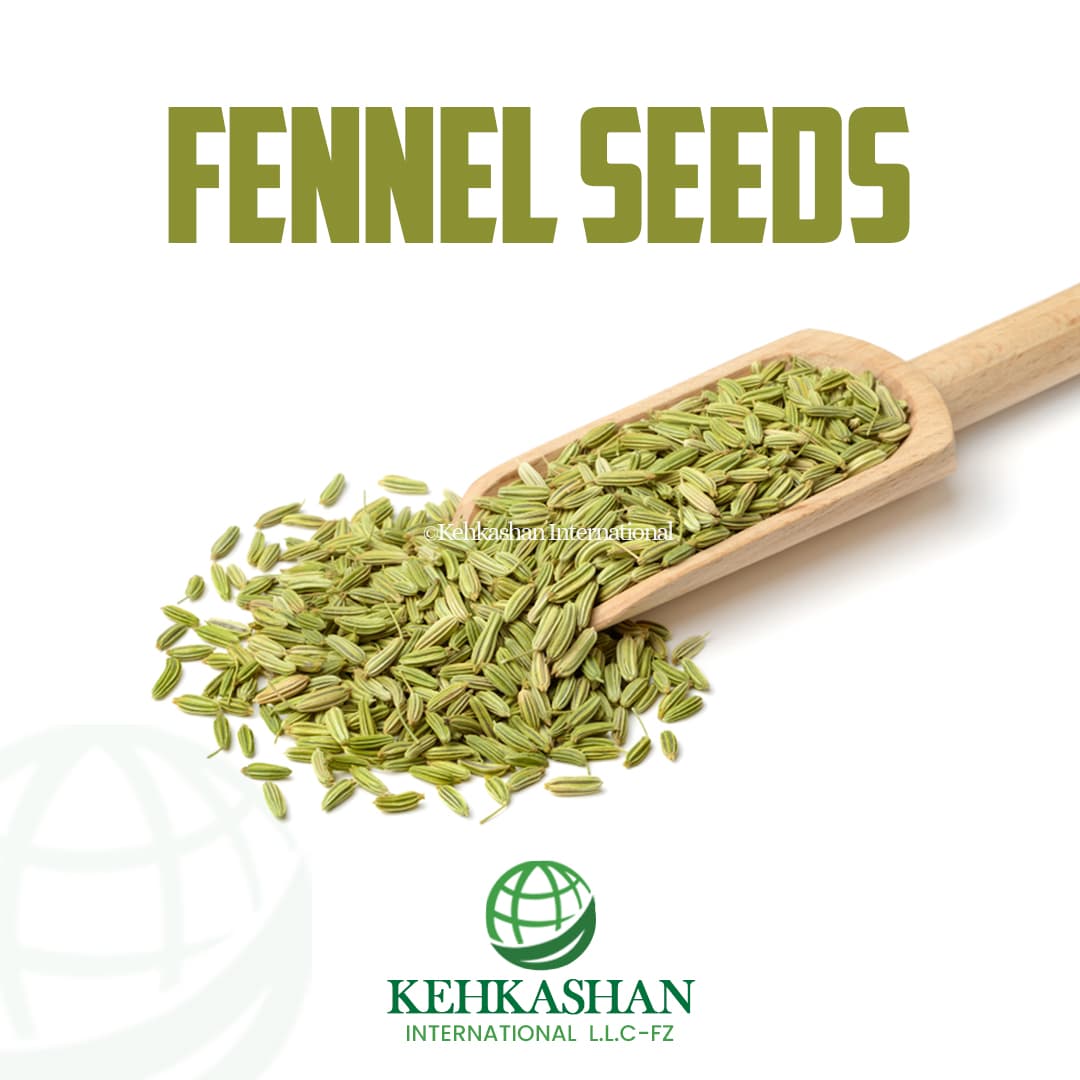
Fennel seeds (Foeniculum vulgare) come primarily from India, Egypt, Pakistan, Türkiye, Bulgaria and China. Buyers specify variety (sweet dulce or bitter vulgare), anethole content 1.5 to 4 percent, deep-green color retention, EU pesticide compliance, and moisture below 10 percent. MOQ is one 20-foot full-container load at 22 to 24 metric tons. Lead times Karachi to Jeddah are 5 to 8 days.
Why fennel is the easy spice trade that gets specified wrong
Fennel sits in an unusual sweet spot in the global spice trade. Demand is consistent across five distinct end-use channels (Gulf culinary, Indian-diaspora retail, European baking and confectionery, pharmaceutical digestive-aid formulations, and traditional medicine) and supply is concentrated in five export-grade origins. The pricing spread from bottom-grade industrial-extraction material to premium tea-grade green fennel is roughly 3x — a 3.20 USD/kg ceiling against a 1.40 USD/kg floor — which means buyers who specify the wrong grade often overpay, and buyers who don't specify the variety often get sweet fennel when their formulation needs bitter, or the other way around.
This guide walks through the variety separation that matters before you price the RFQ, the five origin countries, the anethole and color-retention bands that drive pricing, and the documentation set we run on every Kehkashan container.
Variety separation — sweet vs bitter is not a marketing distinction
Two botanical varieties dominate the export trade, and they are not interchangeable for end-use formulation.
Foeniculum vulgare var. dulce — sweet fennel. Anethole content 60 to 80 percent of essential oil, fenchone content low (5 to 10 percent of essential oil). Sweet, anise-like flavor. This is the variety used in Indian-diaspora retail, European baking and confectionery, GCC after-meal mukhwas blends, premium herbal teas, and sweet liqueurs. Origins: India dominant (Lucknow, Gujarat), with cultivation in Egypt, Bulgaria and Italy.
Foeniculum vulgare var. vulgare — bitter fennel. Anethole content 50 to 70 percent of essential oil, fenchone content higher (15 to 25 percent of essential oil), with monograph profiles described in the European Pharmacopoeia "Foeniculi amari fructus". Slightly bitter, more medicinal flavor. This is the variety used in pharmaceutical digestive-aid formulations, traditional medicine herbal blends, fennel essential oil distillation, and culinary spice mixes where the slight bitterness is desired (some Italian fennel-pollen products, Egyptian shorba blends). Origins: Egypt dominant, with Türkiye, Bulgaria, Hungary and Romania.
A third variant, Foeniculum vulgare var. azoricum — Florence fennel — is grown for its swollen bulb (consumed as a vegetable) rather than its seeds. It is not a commercial seed-trade variety, though confusion at the buyer-side does occur.
The price premium for confirmed sweet (var. dulce) over bitter (var. vulgare) at equivalent color and anethole grades is typically 15 to 25 percent. Indian Lucknow sweet fennel, the premium origin within sweet, runs another 20 to 35 percent above standard sweet.
Where commercial fennel comes from
India. The largest single-origin producer globally per FAOSTAT seed-spice production data, with cultivation across Gujarat (Mehsana, Banaskantha, Sabarkantha districts), Rajasthan (Sirohi, Jodhpur), Uttar Pradesh (Lucknow corridor), and Madhya Pradesh. Indian Lucknow sweet fennel commands the premium-tier of the global market — bright green, plump seeds, anethole content 70 to 80 percent of essential oil, intensely sweet flavor. Indian fennel ships out of Mumbai (Nhava Sheva), Mundra and Kandla. Roughly 60 to 65 percent of global export volume.
Egypt. Concentrated in the Beni Suef, Fayoum, and Asyut regions of the Nile Valley per Egyptian Ministry of Agriculture cultivation data. Egyptian fennel is mostly bitter (var. vulgare) with high fenchone content, suited to pharmaceutical and traditional-medicine end uses. Egyptian export ships from Alexandria and Port Said. Roughly 12 to 15 percent of global export volume.
Pakistan. Cultivation across Punjab (Faisalabad, Multan, Bahawalpur) and Sindh. Both sweet and bitter varieties grown; Pakistani-origin sweet fennel is competitively priced and serves a growing share of GCC after-meal mukhwas and Indian-diaspora retail demand. Pakistani fennel ships from Karachi. This is Kehkashan's primary origin — direct cooperative relationships in the Multan and Bahawalpur corridors.
Türkiye. Concentrated in the Çanakkale, Burdur, and Isparta provinces. Türkish fennel is mostly bitter, with strong essential-oil distillation industry. Ships from Mersin and Izmir.
Bulgaria. Smaller producer, mostly bitter (var. vulgare) for pharmaceutical and essential-oil markets. Ships from Varna and Burgas.
China. Cultivation across Gansu, Inner Mongolia and Xinjiang. Chinese fennel is mostly bitter, competitively priced, but EU pesticide-residue compliance varies — buyers running tight pharma specs typically pay a premium for third-party-lab-certified Chinese lots or shift origin entirely.
The six origins together produce roughly 200,000 to 250,000 metric tons of fennel annually, with maybe 60 to 70 percent reaching international export markets after domestic spice and pharmaceutical absorption.
Grade vocabulary on the Certificate of Analysis
A clean fennel CoA carries seven fields beyond variety declaration:
- Variety — Foeniculum vulgare var. dulce or var. vulgare (must be stated explicitly).
- Anethole content — by gas chromatography, expressed as percent of essential oil. Or the simpler spec: total essential-oil content (1.5 to 4.0 percent of dried-seed weight).
- Color grade — visual scale (deep green, light green, yellow-green, faded). Premium tea-grade lots are deep green; faded lots indicate older harvest or improper drying.
- Moisture — below 10 percent for shelf-stable shipped grade. Bulk lots above 10 percent risk fungal degradation and color fade in transit.
- Foreign matter — below 1 percent for tea-grade and culinary-grade, below 2 percent for industrial-extraction grade.
- Aflatoxin and ochratoxin A — below EU regulatory limits per Regulation 1881/2006 for tea-grade and food-grade.
- Heavy metals and pesticide residue — EU pesticide Annex A and B compliance, lead below 3 mg/kg, cadmium below 1 mg/kg.
Pharmaceutical buyers add microbiological tests (total aerobic count, yeasts and molds, E. coli absence, salmonella absence) plus a full LC-MS pesticide-residue scan. EU organic-certified buyers require valid EU-organic transaction certificate per shipment.
Container math, MOQ, and pricing
Fennel is high-density. A 20-foot full-container load holds 22 to 24 metric tons in 25 kg or 50 kg multi-layer kraft bags or PP woven bags with food-grade liner.
MOQ tiers as we run them at Kehkashan:
- 500 kg starter — minimum order, fits LCL consolidation
- 5,000 kg — break-even on a 20-foot LCL with consolidated shipping
- 22,000 kg+ — full 20-foot FCL of single-grade material
- 26,000 kg+ — full 40-foot FCL for high-volume retail or pharma buyers
Pricing tiers (FOB Karachi or Mumbai, indicative, 2026):
- Industrial-extraction grade fennel (faded, low-anethole): 1.40-1.70 USD/kg
- Standard culinary fennel (var. dulce, light green): 1.70-2.10 USD/kg
- Premium tea-grade fennel (var. dulce, deep green, Indian Lucknow): 2.30-3.20 USD/kg
- Bitter fennel pharmaceutical-grade (var. vulgare, Egyptian or Türkish): 1.80-2.40 USD/kg
- Organic-certified premium fennel: add 0.40-0.80 USD/kg over standard tier
- Steam-sterilized fennel (food-safety treated): add 0.20-0.40 USD/kg over untreated
Documentation set on every shipment
Every Foeniculum vulgare container leaves Karachi with the standard export pack:
- Bill of lading
- Commercial invoice and packing list
- Certificate of Origin (Pakistan Chamber of Commerce)
- Phytosanitary certificate (Department of Plant Protection)
- Certificate of Analysis (variety, anethole content, moisture, color grade, foreign matter, aflatoxin, heavy metals, pesticide residue)
- Health certificate (PSQCA equivalent)
- Form A or EUR.1 origin certificate where preferential tariff applies
- Fumigation certificate (mandatory for EU and US, optional for GCC)
- Steam-sterilization certificate (where the buyer has specified treated material for retail packaging)
EU organic-certified buyers add the EU-organic transaction certificate per shipment. EU pharmaceutical buyers may require a Certificate of Suitability to the European Pharmacopoeia (CEP) for var. vulgare lots being used in formulated digestive-aid products.
Lead times by destination port
| Destination port | Country | Ocean transit | Typical Incoterm |
|---|---|---|---|
| Jeddah | Saudi Arabia | 5-8 days | CFR / CIF |
| Hamad | Qatar | 3-5 days | CIF |
| Sohar | Oman | 2-4 days | CIF |
| Mombasa | Kenya | 12-18 days | CIF |
| Hamburg | Germany | 21-28 days | CIF / DAP |
| Rotterdam | Netherlands | 21-28 days | CIF / DAP |
| Felixstowe | United Kingdom | 21-28 days | CIF / DAP |
| Marseille | France | 22-28 days | CIF |
| Genoa | Italy | 22-28 days | CIF |
| New York | United States | 28-35 days | CIF |
| Toronto (via Montreal) | Canada | 30-37 days | CIF |
| Tokyo | Japan | 24-30 days | CFR |
| Sydney | Australia | 24-30 days | CFR |
Most fennel shipments move at standard ambient with desiccant packs and humidity-controlled stowage requirements specified on the booking note. Color-retention is the critical risk on long-haul routes — tea-grade green fennel needs nitrogen-flush packaging on the 28+ day routes for premium buyers paying for color insurance.
Demand-side pulls — who buyers actually are
Five end-use segments drive global fennel demand, each with distinct variety, color and pricing tolerances:
Gulf and Middle Eastern after-meal mukhwas industry. Saudi Arabia, UAE, Qatar, Kuwait, Bahrain, Oman, Egypt. Sweet fennel (var. dulce) is the primary input for after-meal digestive mukhwas blends sold in retail and food-service channels. Color and freshness are critical — faded fennel kills the retail product. Buyers run 200 to 5,000 ton annual programs.
Indian-diaspora retail. UK, USA (especially Bay Area, NJ, Texas Indian-diaspora corridors), Canada (Toronto, Vancouver), Australia (Sydney, Melbourne). Sweet fennel for retail sale as standalone seed and as ingredient in mukhwas and chai blends. Brand owners (Patanjali, MDH, MTR, Catch, Patel Brothers private-label) buy in 100 to 2,000 ton annual programs through North American and EU spice distribution chains.
European baking, confectionery and bakery industry. Germany, France, Italy, Netherlands, UK. Sweet fennel for bread, biscuits, sausage seasoning (fennel-pollen blends), liqueur production (sambuca, anisette), and confectionery. Buyers run 100 to 1,000 ton annual programs through national food-input distributors.
Pharmaceutical and digestive-aid formulators. Bitter fennel (var. vulgare) for digestive-aid tinctures, gripe water (infant colic remedy), and herbal-tea formulations. EU and Indian Ayurvedic pharma buyers run 50 to 500 ton annual programs with strict pesticide-residue and microbiological specs.
Premium tea and wellness brands. Pukka, Yogi Tea, Twinings, Celestial Seasonings, plus a long tail of EU and North American specialty herbal-tea brands. Sweet fennel as ingredient in digestive-blend, after-dinner, and bedtime herbal teas. Spec emphasis on premium tea-grade green fennel with clean pesticide-residue panels.
Competition map — who buyers usually go to
The fennel export trade is fragmented at the lower-grade tiers and concentrated at the premium end. Notable players: NedSpice (Dutch, premium spice trade vertical), Olam International (Singapore, large-volume commercial supply), McCormick (US, retail-brand vertical), Ramdev Food Products (Indian, Lucknow sweet fennel premium tier), Catch Foods (Indian, retail-brand), El Tahhan (Egyptian, pharmaceutical-grade vulgare), and Origins (Bulgarian, organic-certified premium). Below this top tier sit roughly 60 to 100 mid-volume Indian, Egyptian, Pakistani, Türkish, Bulgarian and Chinese exporters.
For buyers running diligence, the differentiators between credible suppliers and marketplace listings are:
- Variety transparency — a credible exporter can produce the formal botanical declaration (var. dulce or var. vulgare) with a third-party gas-chromatography test of the essential-oil profile.
- Lab certification of color, anethole content, pesticide residue, and aflatoxin from an internationally recognized lab (SGS, Bureau Veritas, Intertek, Eurofins).
- Color-retention stability across multiple shipments — a supplier who can deliver the same color grade across four annual shipments is the supplier you want for a standardized retail blend.
- Steam-sterilization capability — for buyers requiring food-safety-treated fennel for retail packaging, the supplier needs documented steam-sterilization process records and post-treatment microbiological testing.
We document each of these on every Kehkashan fennel shipment. Sample lots of 1 to 2 kg are couriered free of freight to qualified buyers worldwide; the sample fee credits against the first PO on acceptance.
When to buy ahead vs spot
Indian fennel harvest runs February through April. Pakistani harvest runs March through May. Egyptian harvest runs May through July. Turkish and Bulgarian harvests run July through September. Quality assessment finishes by September, and the year's pricing band stabilizes by October.
Annual contracts booked in October at fixed prices typically secure 6 to 10 percent better pricing than spot purchases through the year, plus guaranteed availability of the specified variety and grade. For Indian-diaspora retail, GCC mukhwas, and EU bakery brands running standardized retail product against a guaranteed color and anethole spec, the annual-contract route is essentially mandatory — spot supply rarely matches the spec consistency these buyers need.
For pharmaceutical, traditional-medicine and bulk industrial-extraction buyers with looser tolerance, spot purchases of 5 to 20 ton lots through the year work reliably.
Trade desk closing note
Fennel is one of those spice commodities where the supplier's relationship with the harvest and color-sorting line matters more than the supplier's brochure. The difference between a 1.70 USD/kg standard culinary lot and a 3.00 USD/kg premium tea-grade lot is mostly in the color-sorting and the cooperative discipline. We work with cooperatives in the Multan and Bahawalpur corridors of Punjab, plus consolidator partnerships into Indian Lucknow sweet fennel and Egyptian Beni Suef bitter fennel for buyers needing those origins specifically.
For a quote, send the five RFQ specs (variety, origin preference, color grade, organic certification yes/no, quantity) to [email protected]. The trade desk replies within one working day with FOB Karachi, CFR your-destination-port, CIF, and DAP options.


