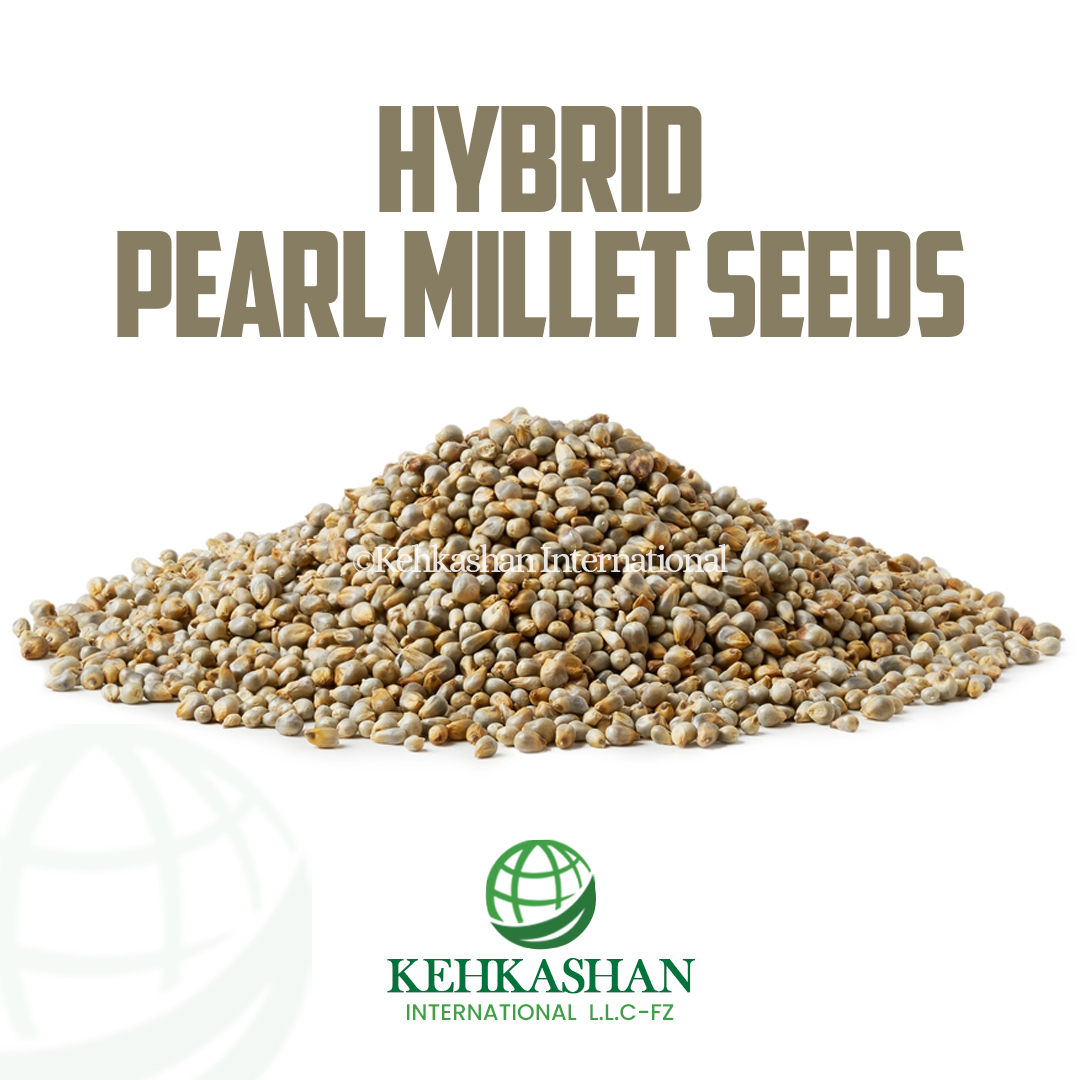
Kehkashan exports hybrid pearl millet (Pennisetum glaucum) seeds from origin partners in India and Pakistan — supplied in bulk FCL or LCL with FOB Karachi or Jebel Ali, CFR, or CIF terms to African Sahel growers and GCC dairy operations across 80+ destinations.
Reference image. Sample lots and product-specific photography available on RFQ.
Quick facts
Scientific name
Pennisetum glaucum
Also known as
Bajra, الدخن, просо африканское
HS code
—
Common varieties
Bajra hybrid, Tifleaf 3, Nutrifeed
Origins available
India, Pakistan
MOQ
1 × 20'FCL
Pack sizes
25 kg PP bag
Specs
Purity: 98%, Germination: 85% min
Lead time
14–21 days from PO confirmation
Incoterms
FOB Jebel Ali · CFR · CIF · DAP
Payment terms
LC at sight · TT · DP
Specification & container math
MOQ tiers
Tier
Quantity
Note
Trial
1,000 kg LCL
—
Standard FCL
1 × 20'FCL ≈ 22 MT
—
Programme
5–20 × 20'FCL / season
—
FOB pricing bands (RFQ)
Grade
Indicative range
Indian / Pakistani public hybrids (HHB, ICMH)
RFQ — entry tier
Private F1 hybrids (Pioneer, Nuziveedu)
RFQ — mid tier
Dual-purpose forage + grain hybrids
RFQ — premium tier
Lead times — top destinations
Discharge port
Transit
Incoterm
Karachi (Pakistan, FOB)
0 days
FOB
Jebel Ali (UAE)
4–6 days
CFR / CIF
Jeddah Islamic Port (KSA)
8–12 days
CFR / CIF
Dammam (KSA)
7–10 days
CFR / CIF
Mombasa (Kenya)
14–20 days
CFR / CIF
Packaging formats
25 kg PP bag · 5 kg foil pouch (premium hybrids)
Container capacity
20'FCL: 22 MT (PP)
Documentation set per shipment
Every container leaves UAE Free Zone with the document pack below. Additional certificates (Halal, SASO conformity, BRC, organic, FairWild, etc.) are added on request before vessel loading.
Bill of Lading (BL) — original 3/3 set
Commercial Invoice — UAE Free Zone issued
Packing List with lot codes per pallet
Certificate of Origin (CoO) — Dubai Chamber attested
Phytosanitary Certificate — origin NPPO
ISTA Certificate of Analysis (purity, germination, dodder)
OECD Seed Scheme tag (for OECD-eligible varieties)
Fall-dormancy declaration (alfalfa / clover only)
Fumigation Certificate
GMO / Non-GMO declaration
Form A (GSP) where applicable
Procurement-team questions
Answers to the questions buyers ask us most often during RFQ and trial-shipment evaluation.
Forage pearl millet versus grain pearl millet — same seed?
+
Different breeding objectives. Forage hybrids (HHB 67, BAIF Bajra 1) are bred for biomass — tall, leafy, late-flowering. Grain hybrids (HHB 226, ICMH 451) are short-statured, early-flowering, optimised for panicle yield. Dual-purpose hybrids (HHB 311, RHB 173) deliver moderate grain plus 6–8 MT/ha forage. Specify which trait you need; we ship the right hybrid.
Why pearl millet for the African Sahel?
+
Pearl millet is the most drought-tolerant cereal — productive on 350–400 mm rainfall where sorghum struggles below 500 mm and maize needs 600+ mm. Sahel programmes (Mali, Burkina Faso, Niger, Senegal) plant pearl millet as the staple. We export Indian and Pakistani hybrid seed into Senegalese and Malian seed multipliers and direct to East African Sahel buyers (Sudanese Kordofan, Ethiopian Tigray pre-2026 conflict pause).
What is downy mildew resistance level?
+
Downy mildew (Sclerospora graminicola) is the major pearl-millet disease in India and Pakistan. Modern hybrids (HHB 226, RHB 173) test 95%+ resistant in ICRISAT screening. Older landraces and 1990s hybrids (HHB 67) are susceptible. Specify post-2015 hybrid releases for high-pressure environments. Lot-specific resistance status is on the COA.
How does pearl millet fit GCC dairy rations?
+
GCC central-pivot dairies running summer rotations after alfalfa cycles plant pearl millet as a 60–75 day quick-turnaround forage. Yield 6–8 MT/ha dry matter at 14–16% crude protein. Drought tolerance lets operators reduce irrigation 30–40% versus alfalfa. We typically ship 2–3 FCLs of pearl millet to a single Saudi or UAE dairy per summer programme.
What seeding rate and depth?
+
4–6 kg per hectare for grain hybrids; 8–12 kg/ha for forage hybrids broadcast or drilled. Sowing depth 2–3 cm in moist soil. A 22 MT FCL covers 1,800–5,000 ha depending on rate. We pre-treat all hybrid seed with thiram + carbendazim against soil-borne pathogens at no additional charge.
Related buyer guides & trade briefs
Long-form guides written by the Kehkashan trade desk for buyers and procurement teams scoping origin trade-offs, variety codes, and documentation flows.
Trade-desk reference for hybrid pearl millet seed importers: India and Pakistan origin economics, HHB / MH / Nandi hybrid codes, forage vs grain specs, ISTA.