MOQ tiers
| Tier | Quantity | Note |
|---|---|---|
| Trial | 500 kg LCL | — |
| Standard FCL | 1 × 20'FCL ≈ 22 MT | — |
| Programme | 3–6 × 20'FCL / season | — |
Kehkashan exports white clover (Trifolium repens) seeds from origin partners in New Zealand, Ireland, the USA, and Italy — supplied in bulk FCL or LCL with FOB Jebel Ali, CFR, or CIF terms to intensive-grazing pasture and dairy operations in 80+ destinations.
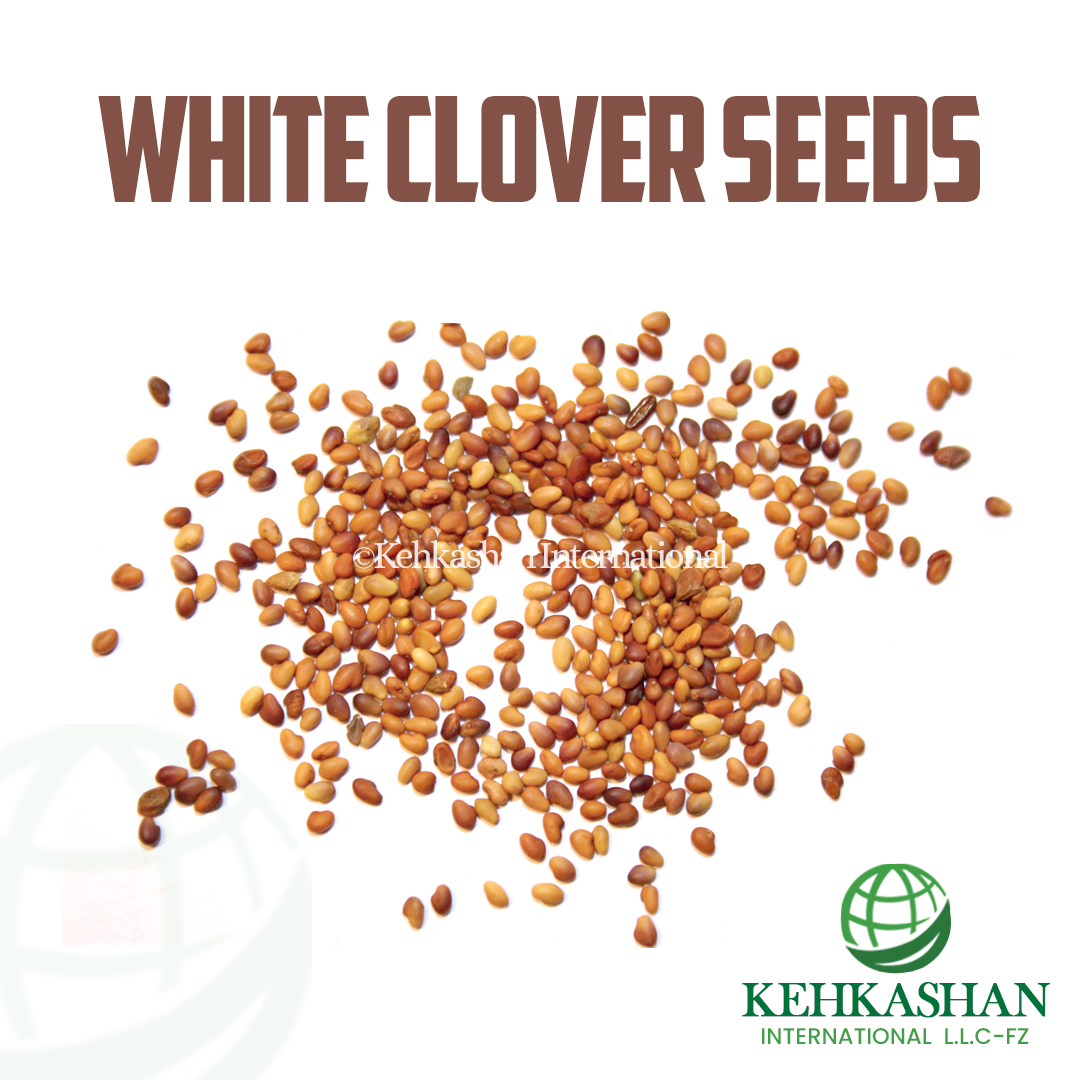
Reference image. Sample lots and product-specific photography available on RFQ.
| Tier | Quantity | Note |
|---|---|---|
| Trial | 500 kg LCL | — |
| Standard FCL | 1 × 20'FCL ≈ 22 MT | — |
| Programme | 3–6 × 20'FCL / season | — |
| Grade | Indicative range |
|---|---|
| European common | RFQ — entry tier |
| NZ Huia / Kopu II | RFQ — mid tier |
| USA Ladino / Regal | RFQ — premium tier |
| Discharge port | Transit | Incoterm |
|---|---|---|
| Auckland / Tauranga (FOB) | 0 days | FOB |
| Jebel Ali (UAE) | 28–35 days | CFR / CIF |
| Jeddah Islamic Port (KSA) | 32–40 days | CFR / CIF |
| Mombasa (Kenya) | 30–38 days | CFR / CIF |
| Hamburg (Germany) | 35–42 days | CFR / CIF |
Every container leaves UAE Free Zone with the document pack below. Additional certificates (Halal, SASO conformity, BRC, organic, FairWild, etc.) are added on request before vessel loading.
White clover seed is multiplied in New Zealand Canterbury, Oregon Willamette Valley, Ireland, southern Australia, and Germany. Kenyan Rift Valley and South African Drakensberg grazing dairies take New Zealand Huia and Demand. European seed distributors buy Irish and German common lots for pasture mixes. Turf and amenity blenders specify Oregon Ladino and microclover selections.
Ladino is the Italian-derived giant type multiplied in Oregon for hay and low-stocking dairies. Grasslands Huia is the 1960s New Zealand release still used as the medium-leaf benchmark in trials. Regal is a United States Ladino selection with better stolon survival. Kopu II and Demand are modern AgResearch lines bred for Friesian grazing.
White clover has a thousand-seed weight near 0.6 grams, so purity is tested on a working sample and reported at 99 percent minimum. Germination runs 85 percent minimum, with hard seed 10 to 25 percent. Coated seed is declared with coating percentage and Rhizobium inoculation date. New Zealand lots carry the IHS scheme tag.
Grazing dairies in Kenya, Rwanda, and the South African highveld oversow white clover into kikuyu and ryegrass paddocks for nitrogen and protein. Irish and Dutch seed distributors blend it at 2 to 4 kilograms per hectare into perennial ryegrass mixes. Golf courses, sports fields, and municipal amenity contractors use microclover in low-input turf.
New Zealand white clover loads at Tauranga or Auckland and reaches Jebel Ali in 28 to 35 days, Hamburg in 35 to 42 days. From Jebel Ali, onward legs run 5 to 8 days to Jeddah and 12 to 18 days to Mombasa. Coated seed is booked with humidity-controlled stowage below 35 degrees Celsius.
White clover is quoted against an RFQ as FOB Tauranga, FOB Jebel Ali, CFR, or CIF destination. Tiers are European common, New Zealand Huia and Kopu II, and Oregon Ladino and Regal. Coating and Rhizobium inoculation add a per-kilogram uplift. Container count, harvest timing after January-to-March threshing, and contract versus spot complete the quote.
A 500 gram to 1 kilogram sample with the origin ISTA report reaches the buyer. Coated lots include a bare-seed reference so the buyer can check germination independently of coating weight. After approval the proforma is issued against LC at sight or TT. Loading is photographed and seal numbers go on the packing list.
Bare white clover seed packs 22 metric tonnes into a 20-foot FCL in 25 kilogram PP bags and 26 tonnes into a 40-foot high-cube before road-weight limits apply. Coated seed doubles pack weight per hectare sown, so buyers plan volume by hectares rather than tonnes. LCL trials from 500 kilograms consolidate at Jebel Ali.
Kenya issues a KEPHIS plant import permit before shipment and inspects germination at Mombasa. Saudi Arabia requires a MEWA seed-import permit, SASO conformity, and an attested Certificate of Origin. European Union buyers need the cultivar on the EU Common Catalogue, an OECD certificate, and a fumigation certificate; treated seed carries an active-ingredient label.
Answers to the questions buyers ask us most often during RFQ and trial-shipment evaluation.
Long-form guides written by the Kehkashan trade desk for buyers and procurement teams scoping origin trade-offs, variety codes, and documentation flows.
trade brief
Trade-desk reference for clover seed importers: Persian, Berseem, Red, White, Crimson — Pakistani and European origin economics, ISTA bands, dodder-freedom.
Top origins
Related products
From the trade desk
RFQ response within 24 hours. FOB Jebel Ali, CFR, CIF, or DAP. LC at sight, TT, or DP.
Dispatch from Jebel Ali. Lead time 14–21 days. RFQ within 24h.