MOQ tiers
| Tier | Quantity | Note |
|---|---|---|
| Trial | 100 kg LCL | — |
| Commercial | 500 kg–2 MT LCL | — |
Kehkashan exports dried sea-buckthorn (Hippophae rhamnoides) berries from origin partners in Pakistan-Hunza, Mongolia, and Russia — supplied in bulk FCL or LCL with FOB Jebel Ali, CFR, or CIF terms to nutraceutical extractors and cosmetic formulators across 80+ destinations.
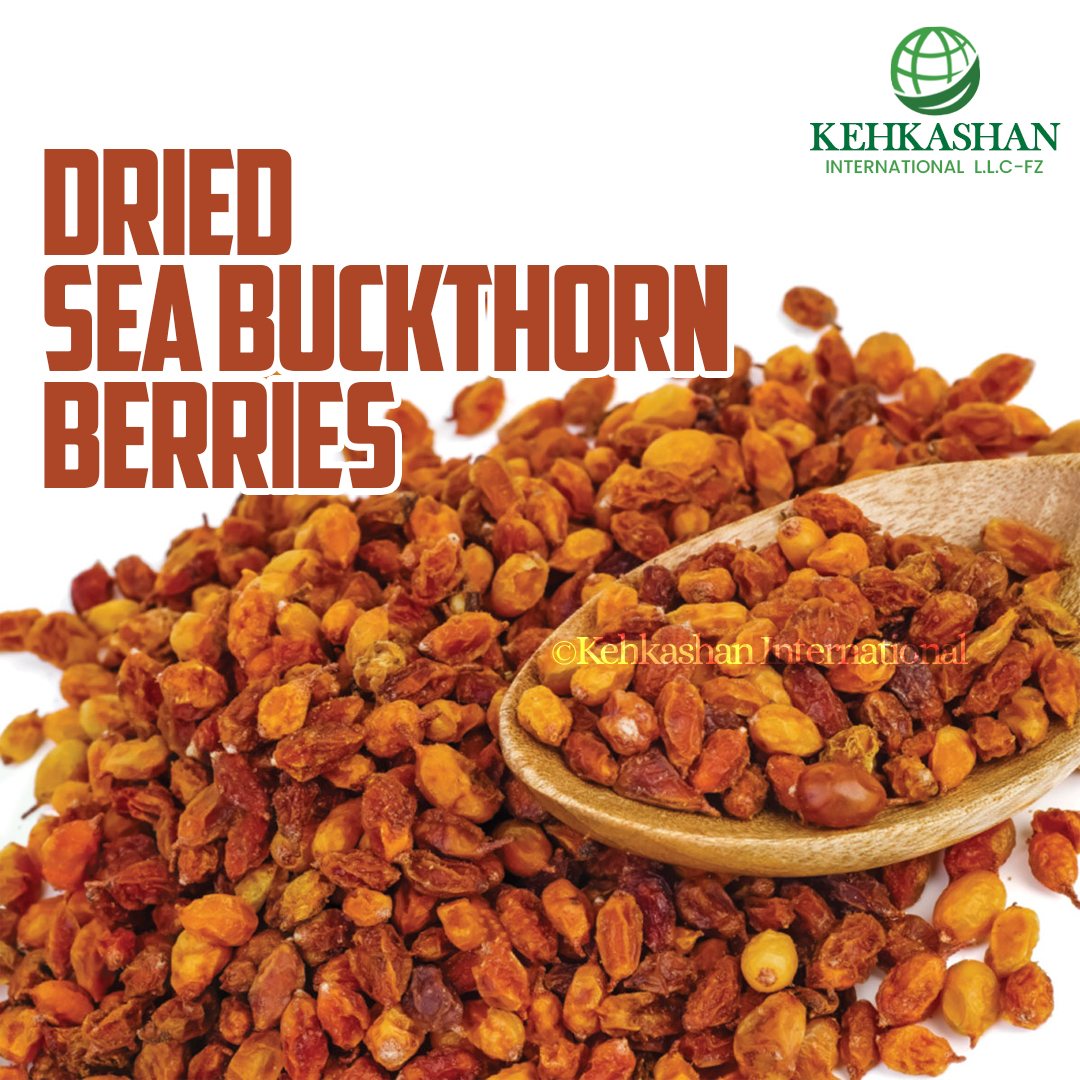
Reference image. Sample lots and product-specific photography available on RFQ.
| Tier | Quantity | Note |
|---|---|---|
| Trial | 100 kg LCL | — |
| Commercial | 500 kg–2 MT LCL | — |
| Grade | Indicative range |
|---|---|
| Pakistan-Hunza / Ladakh (sun-dried) | RFQ — mid tier |
| Mongolian / Russian Altai (sun-dried) | RFQ — mid tier |
| Freeze-dried (premium) | RFQ — top tier |
| Wild-harvest organic-certified | RFQ — top tier |
| Discharge port | Transit | Incoterm |
|---|---|---|
| Karachi (Pakistan, FOB) | 0 days | FOB |
| Jebel Ali (UAE) | 4–6 days | CFR / CIF |
| Jeddah Islamic Port (KSA) | 8–12 days | CFR / CIF |
| Dammam (KSA) | 7–10 days | CFR / CIF |
| Mombasa (Kenya) | 14–20 days | CFR / CIF |
Every container leaves UAE Free Zone with the document pack below. Additional certificates (Halal, SASO conformity, BRC, organic, FairWild, etc.) are added on request before vessel loading.
Wild Hippophae rhamnoides is picked in Hunza and Skardu valleys at 2,400 to 3,800 metres, in Ladakh, in Mongolia's Khovd and Selenge provinces, and in Russian Altai plantations. European nutraceutical extractors favour Hunza and Altai lots for titration. Korean and Japanese tea blenders take Mongolian sun-dried. German clean-label brands pay for EU-organic Mecklenburg fruit.
Hunza and Ladakh fruit is subspecies turkestanica, a small acidic berry with the highest vitamin C. Mongolian and Altai material is subspecies mongolica, including Russian cultivars Chuyskaya and Altaiskaya bred for larger fruit and oil. Chinese Inner Mongolia grows subspecies sinensis. German plantations run subspecies rhamnoides cultivars Leikora, Hergo, and Askola, milder but EU-organic.
Alongside vitamin C in milligrams per 100 grams and omega-7 percent in seed and pulp oil, the COA states format, moisture below 14 percent, foreign matter below 0.2 percent for nutraceutical grade, and beta-carotene at 80 to 200 milligrams per 100 grams. Lead, cadmium, aflatoxin, ochratoxin A, and an LC-MS pesticide scan complete it.
Nutraceutical extractors in Germany, Finland, and Poland press dried berries for seed oil capsules and immune powders. Cosmetic formulators specify pulp-oil omega-7 for serums and balms. Tea blenders in Korea and Japan cut sun-dried berries into fruit infusions. Functional beverage start-ups buy 500 to 2,000 kilograms; equine and canine joint supplements take bulk grade.
Hunza berries truck to Karachi and reach Jebel Ali in 4 to 6 days. From Jebel Ali, Jeddah is 5 to 8 days, Hamburg 21 to 28 days, Busan 21 to 28 days, and New York 28 to 35 days. Dried whole berries ship ambient with desiccant; freeze-dried and oils move reefer or nitrogen-flushed.
Dried sea buckthorn is quoted against an RFQ as FOB Karachi, FOB Jebel Ali, CFR, or CIF destination. Price moves on vitamin C band, sun-dried versus freeze-dried process, organic certification, origin, and carton count. Contracts fixed in November after the August-to-October harvest price below spring spot; custom-titration blends carry extra lab and lot-management cost.
A 250 gram to 1 kilogram sample ships with a draft COA and the cooperative's collection-valley record. Buyers confirm vitamin C and omega-7 at Eurofins, SGS, or Intertek. Lots below the contracted titration are rejected at origin. Proforma follows approval, settled by LC at sight or TT, and stuffing is photographed with seal numbers.
Dried sea buckthorn cubes out early. A 20-foot FCL takes 10 to 12 metric tonnes of sun-dried berries in 25 kilogram cartons, or 6 to 8 tonnes of freeze-dried fruit in 5 kilogram vacuum pouches. A 40-foot high-cube reaches 18 to 20 tonnes. Most orders move LCL from 300 kilograms via Jebel Ali.
Dried berries enter the EU under HS 0813.40 with EC 1881/2006 contaminant limits, pesticide MRL compliance, and a fumigation certificate; whole berries have traditional food history, so no Novel Food dossier is needed. United States importers hold FSVP records and file FDA prior notice. Korea's MFDS tests residues at Busan on each consignment.
Answers to the questions buyers ask us most often during RFQ and trial-shipment evaluation.
Long-form guides written by the Kehkashan trade desk for buyers and procurement teams scoping origin trade-offs, variety codes, and documentation flows.
trade brief
Trade-desk reference for sea buckthorn importers: Pakistani Gilgit-Baltistan vs Chinese origin economics, oil yield, omega-7 content, EU food compliance.
Top destinations
Related products
From the trade desk
RFQ response within 24 hours. FOB Jebel Ali, CFR, CIF, or DAP. LC at sight, TT, or DP.
Dispatch from Jebel Ali. Lead time 14–21 days. RFQ within 24h.