MOQ tiers
| Tier | Quantity | Note |
|---|---|---|
| Trial | 5 MT LCL | — |
| Standard FCL | 1 × 20'FCL ≈ 24 MT | — |
| Programme | 20–100 × 20'FCL / year | — |
Kehkashan exports sesame (Sesamum indicum) seeds from origin partners in Sudan, Ethiopia, Nigeria, India, and Pakistan — supplied in bulk FCL or LCL with FOB Jebel Ali, CFR, or CIF terms to tahini, bakery, and oil-extraction buyers across 80+ destinations.
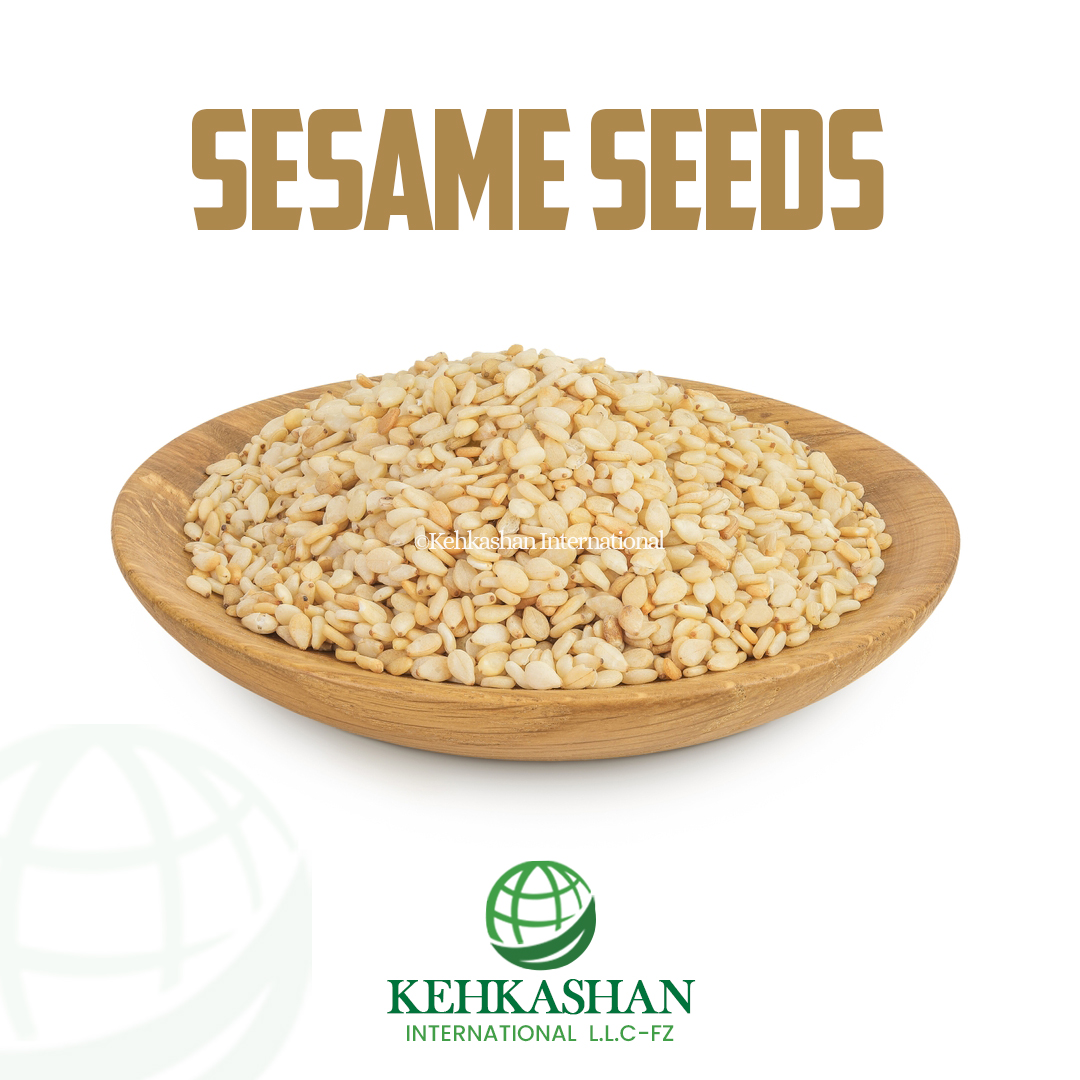
Reference image. Sample lots and product-specific photography available on RFQ.
| Tier | Quantity | Note |
|---|---|---|
| Trial | 5 MT LCL | — |
| Standard FCL | 1 × 20'FCL ≈ 24 MT | — |
| Programme | 20–100 × 20'FCL / year | — |
| Grade | Indicative range |
|---|---|
| Sortex 99% white (commercial bakery) | RFQ — entry tier |
| Sortex 99.5% white (premium tahini) | RFQ — mid tier |
| Sortex 99.95% AA (Japan / Korea premium) | RFQ — top tier |
| Hulled (oil-extraction grade) | RFQ — variable |
| Discharge port | Transit | Incoterm |
|---|---|---|
| Karachi / Mundra (FOB) | 0 days | FOB |
| Jebel Ali (UAE) | 4–6 days | CFR / CIF |
| Mersin (Türkiye) | 14–18 days | CFR / CIF |
| Yokohama (Japan) | 28–35 days | CFR / CIF |
| Hamburg (Germany) | 21–28 days | CFR / CIF |
Every container leaves UAE Free Zone with the document pack below. Additional certificates (Halal, SASO conformity, BRC, organic, FairWild, etc.) are added on request before vessel loading.
Ethiopian Humera lots go to tahini mills in Israel, Lebanon and Türkiye and to Japanese bakery importers paying for bright white seed. Sudanese Gedaref and Pakistani Multan sesame supplies GCC tahini and halva plants out of Jeddah and Jebel Ali. Indian Saurashtra white and Madhya Pradesh black serve oil crushers and Korean roasted-oil buyers.
Hulled white 99.95 percent is the Sortex AA kernel for Japanese and Korean bun toppings and tahini. Natural white 99 percent is mechanically cleaned seed for bakery and oil extraction. The 99/1 Sortex code means 99 percent white with 1 percent tolerated off-colour, a pastry grade. Black sesame serves roasted-oil and traditional-medicine buyers.
A sesame COA declares colour, origin, hulled or natural, Sortex grade, oil content by Soxhlet at 48 to 55 percent, FFA below 2 percent, moisture below 6 percent and admixture below 0.5 percent. Aflatoxin B1 and total in ppb, heavy metals and Salmonella absent in 25 grams follow for EU, Japanese and US lots.
Tahini and halva mills across Saudi Arabia, Egypt, Jordan and Türkiye run 1,000 to 20,000 tonne annual programmes of hulled high-Sortex white. EU and US bun and bagel bakeries take natural or hulled 99 to 99.5 percent in 500 to 5,000 tonne programmes. Oil crushers accept mixed-colour lots on oil content.
Pakistani sesame sails Karachi to Jebel Ali in 4 to 6 days; Mundra lots take the same. From Jebel Ali, Jeddah is 5 to 8 days, Hamad 3 to 5, Mersin 12 to 16, Hamburg 21 to 28, Yokohama 24 to 30 and New York 28 to 35. Long-haul bookings specify humidity-controlled stowage.
We quote FOB Karachi, Mundra or Jebel Ali plus CFR and CIF destination against RFQ. Origin sets the base, Humera highest, Indian bulk lowest. Each Sortex step from 99 to 99.5 to 99.95 percent adds a margin, hulling adds yield loss, and Sudanese supply volatility since 2023 moves the whole curve.
Origin lots are tested for Salmonella, aflatoxin and moisture before offer. A 1 to 2 kilogram sample ships with a draft COA so the tahini mill can run its own Sortex count and oil assay. Signed approval opens the proforma against LC at sight or TT. Stuffing runs under our supervisor with SGS reporting.
Sesame is dense, so weight limits bind before volume. A 20-foot FCL carries 24 metric tonnes in 25 kilogram PP bags or 50 kilogram jute, and 22 tonnes in 1 tonne FIBCs. A 40-foot high-cube is capped near 26 to 27 tonnes by road-weight rules. LCL trials start at 5 tonnes via Jebel Ali.
EU entries under HS 1207.40 carry a CHED-D on TRACES, Salmonella-negative certificate, aflatoxin within EC 1881/2006, fumigation certificate and Form A where eligible. Japan applies MHLW monitoring for aflatoxin and residues, so 99.95 percent lots ship with the full panel. Saudi SFDA clearance needs the origin phytosanitary certificate and attested invoice; Halal on request.
Answers to the questions buyers ask us most often during RFQ and trial-shipment evaluation.
Long-form guides written by the Kehkashan trade desk for buyers and procurement teams scoping origin trade-offs, variety codes, and documentation flows.
trade brief
Sortex-grade sesame for US importers — Sudan, Ethiopia, Humera, India, Pakistan origins. Hulled, natural, white/brown/black. FOB pricing, reply in 1 working day.
variety guide
Glossary of optical sorting tiers with origin notes (Humera, Sudan, Nigeria, India) and a buyer-side spec template for FOB and CFR sesame contracts.
origin report
Side-by-side comparison of the four primary sesame export origins: color, sweetness, oil content, sortex grade availability, EU aflatoxin compliance, FOB pricing.
Top destinations
Related products
From the trade desk
RFQ response within 24 hours. FOB Jebel Ali, CFR, CIF, or DAP. LC at sight, TT, or DP.
Dispatch from Jebel Ali. Lead time 14–21 days. RFQ within 24h.