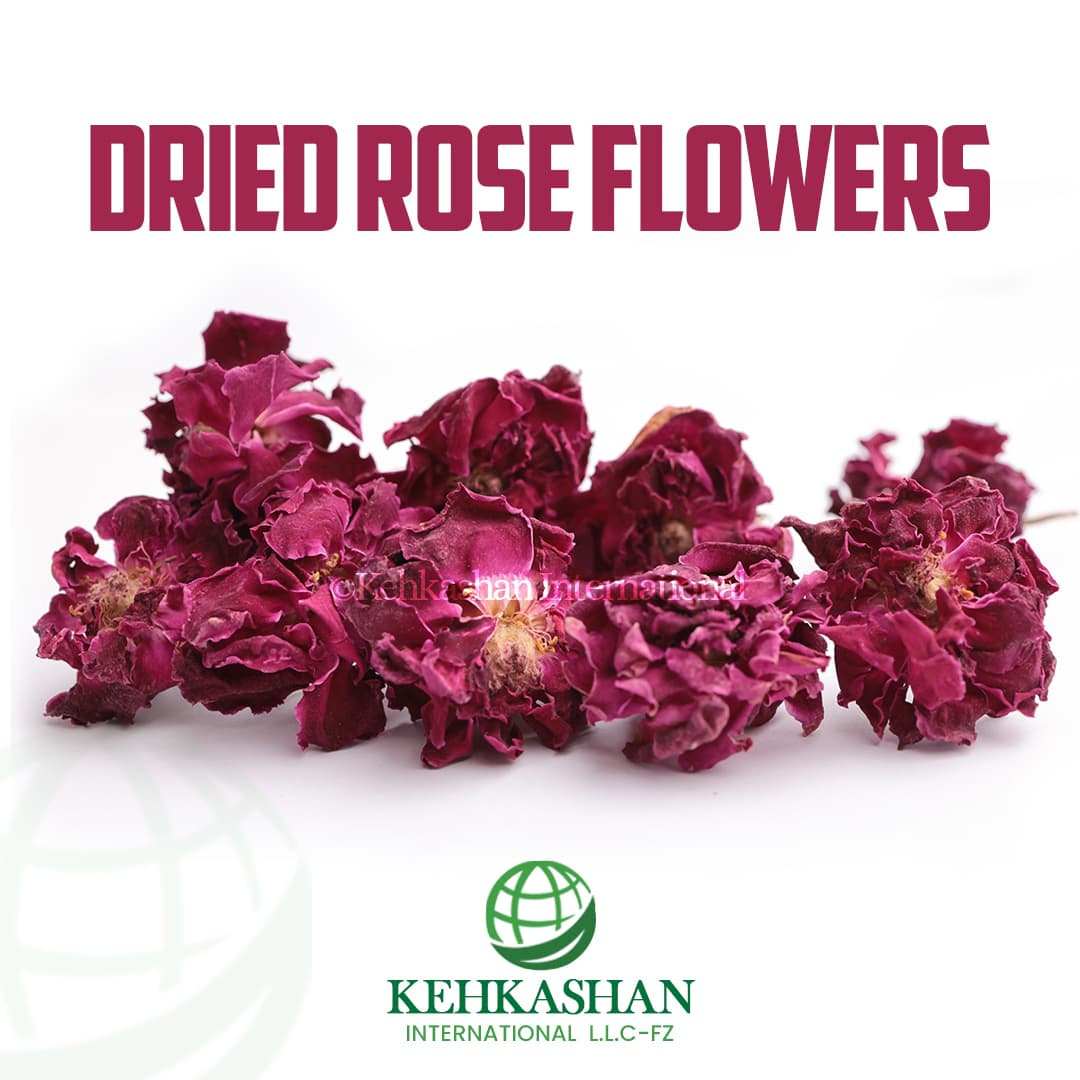
Dried rose flowers (Rosa damascena) come primarily from Pakistan, Iran, Bulgaria, Türkiye, Morocco and India. Buyers specify whole buds vs petals, oil content 0.03 to 0.05 percent, deep-pink color retention, EU pesticide compliance, and moisture below 12 percent. MOQ is one 20-foot full-container load at 8 to 10 metric tons. Lead times Karachi to Hamburg are 21 to 28 days.
Why dried rose flowers are a misunderstood category
The international rose trade splits into three distinct value chains that buyers regularly conflate on the RFQ side, paying the wrong price for the wrong material as a result. The first is the rose oil and absolute trade — perfumery and high-end cosmetic input, priced per kilogram in the four-figure range, dominated by Bulgaria's Kazanlak Valley and Iran's Ispahan Province. The second is the dried rose petal and bud trade — herbal tea, gulkand confectionery, cosmetic infusion, decorative culinary, and ayurvedic herbal blends — priced 8 to 28 USD/kg depending on origin and grade. The third is rose water and rose hydrosol, a co-product of oil distillation, sold in food and cosmetic-grade tiers.
This guide focuses on the second value chain — the dried whole-bud and dried-petal export trade — because that is where Kehkashan operates from the Pakistan supply base, and where buyer specifications are most often misaligned with what the supplier is actually shipping.
Botanical separation matters before the price negotiation
Two species cover roughly 95 percent of the commercial dried rose trade, and they are not interchangeable. Buyers writing RFQs without specifying species routinely end up with the cheaper substitute when their formulation requires the premium one.
Rosa damascena — the oil-bearing damask rose. Deep pink to magenta petals, 30 to 35 petals per flower, intense fragrance, oil content 0.03 to 0.05 percent in the dried whole bud. This is the species that drives the perfumery and premium herbal-tea trade. Pakistan, Iran, Bulgaria, Türkiye and Morocco are damascena-origin countries.
Rosa centifolia — the cabbage rose, also called rose de Mai. Light pink, ~100 petals per flower, sweeter fragrance, oil content 0.02 to 0.03 percent. France (Grasse region) is the historical home, with smaller production in Morocco and Egypt. Centifolia ships dried for cosmetic absolute extraction and decorative-grade petal blends.
A third minor species, Rosa moschata (musk rose), occasionally shows up in Indian and Persian supply for specialty herbal-tea blends but is not commercially significant for export volumes.
The price premium for confirmed Rosa damascena over generic "dried rose" is typically 25 to 40 percent, and the premium widens for guaranteed-origin material from named valleys.
Where commercial dried rose flowers come from
Pakistan (Punjab and Khyber-Pakhtunkhwa). Damascena cultivation across Lahore district, Pattoki, Sheikhupura and the Swat valley. Pakistani-origin dried rose ships out of Karachi after sun-drying or low-temperature tunnel-drying in Punjab cooperatives. Oil content runs 0.03 to 0.045 percent on Pakistani-harvest material — solid mid-band quality at competitive FOB pricing. This is Kehkashan's primary origin, with direct cooperative relationships in Pattoki and the Sheikhupura corridor.
Iran (Ispahan, Kashan, Lorestan). The largest single-origin damascena producer globally per FAOSTAT essential-oil crop data, supplying both the oil and dried-flower trades. Iranian-origin dried whole bud carries the highest oil content in the global supply at 0.04 to 0.055 percent, with deep-magenta color retention superior to most other origins. Sanctions complexity routes most Iranian-origin material through Free Zone consolidation in the UAE for buyer compliance, with mixed-origin Certificates of Origin where commercially appropriate.
Bulgaria (Kazanlak Valley). The premium oil-trade origin and EU-registered PGI "Bulgarsko rozovo maslo" production zone. Dried whole bud is a co-product of the oil-distillation harvest, with limited export volumes available outside the perfumery channel. Color retention is excellent and the heritage premium adds 30 to 60 percent over Pakistani-origin pricing for European retail tea brands.
Türkiye (Isparta). Second-largest global damascena oil producer after Bulgaria. Dried whole bud is a smaller co-product trade, ships through Mersin port. Oil content 0.035 to 0.05 percent.
Morocco (Kelaat M'Gouna, Dades Valley). Damascena cultivation at altitude in the Atlas range. Dried-flower export is small-scale relative to oil and rose-water. Mostly serves European cosmetic and clean-label retail buyers.
India (Pushkar and Aligarh). Domestic-dominated, with Pushkar damascena petals serving the Indian gulkand confectionery industry and the temple-trade market. Limited export volumes. Oil content lower at 0.025 to 0.035 percent.
The six origins together produce roughly 5,000 to 8,000 metric tons of dried-rose-equivalent annually for export, of which Kehkashan's Pakistan supply contributes a meaningful share.
Format choices and grade vocabulary on the RFQ
Dried rose ships in five primary formats, and each has its own pricing tier and end-use base:
Whole buds, A-grade. Closed bud, intact calyx, deep-magenta to deep-pink color retention, minimal stem. The premium tier — herbal tea brands, decorative culinary, gift-grade cosmetic blends. FOB Karachi 14-22 USD/kg.
Whole buds, B-grade. Slightly opened bud, minor color fade, some calyx detachment. Mid-tier — bulk herbal-tea blends, infusion-grade cosmetic. FOB Karachi 9-13 USD/kg.
Petals, sorted. Loose petals, color-graded by sorting line. Used in cosmetic infusions, bath salt blends, decorative culinary, Middle Eastern dessert garnish. FOB Karachi 8-14 USD/kg.
Petals, unsorted. Mixed-color petals from harvest waste streams. Lowest-tier — soap manufacturers, potpourri, candle inclusions. FOB Karachi 5-8 USD/kg.
Rose powder. Stone-milled or low-temperature-milled dried petals, mesh size 60 to 100. Cosmetic clay-mask blends, ayurvedic preparations, food-coloring industrial input. FOB Karachi 12-22 USD/kg.
A clean dried-rose Certificate of Analysis carries seven fields beyond format declaration:
- Botanical species — Rosa damascena, Rosa centifolia, or other (must be stated explicitly).
- Oil content — by hydrodistillation, expressed as percent of dried-flower weight.
- Moisture — below 12 percent for shelf-stable shipped grade. Bulk lots above 12 percent risk fungal degradation.
- Color grade — visual scale (deep magenta, deep pink, pink, light pink, faded) with reference photo or RGB-equivalent.
- Foreign matter — below 1 percent for tea-grade, below 2 percent for cosmetic-grade.
- Aflatoxin and ochratoxin A — below EU regulatory limits per Regulation 1881/2006 for tea-grade.
- Heavy metals and pesticide residue — EU pesticide Annex A and B compliance, lead below 3 mg/kg, cadmium below 1 mg/kg.
Pharmaceutical and cosmetic buyers add microbiological tests for total aerobic count, yeasts and molds, E. coli absence, and salmonella absence on a per-lot basis.
Container math, MOQ, and freight envelope
Dried rose is unusually low-density and freight-sensitive — the cargo is voluminous relative to its weight, and freight per kilogram FOB-equivalent can run 15 to 25 percent of FOB on long-haul EU and US shipments. A 20-foot full-container load holds:
- 8 to 10 metric tons of dried whole buds in 5 kg multi-layer kraft cartons
- 9 to 11 metric tons of dried petals in 10 kg multi-layer kraft cartons
- 12 to 14 metric tons of rose powder in 25 kg multi-layer kraft bags with food-grade liner
MOQ tiers as we run them at Kehkashan:
- 200 kg starter — minimum order for sample-to-trial transition, fits LCL consolidation
- 1,000 kg — break-even on most LCL routes
- 8,000 kg+ — full 20-foot FCL of single-grade whole bud
- 12,000 kg+ — full 40-foot FCL for high-volume tea-blend or cosmetic-extract buyers
Documentation set on every shipment
Every Rosa damascena container leaves Karachi with the standard export pack:
- Bill of lading
- Commercial invoice and packing list
- Certificate of Origin (Pakistan Chamber of Commerce)
- Phytosanitary certificate (Department of Plant Protection)
- Certificate of Analysis (botanical species, oil content, moisture, color grade, foreign matter, aflatoxin, heavy metals, pesticide residue)
- Health certificate (PSQCA equivalent)
- Form A or EUR.1 origin certificate where preferential tariff applies
- Fumigation certificate (mandatory for EU and US)
- Declaration of non-irradiation (EU clean-label retail)
EU organic-certified buyers add the EU-organic transaction certificate per shipment, plus the lot-level traceability chain back to the cooperative or farm block.
Lead times by destination port
| Destination port | Country | Ocean transit | Typical Incoterm |
|---|---|---|---|
| Hamburg | Germany | 21-28 days | CIF / DAP |
| Rotterdam | Netherlands | 21-28 days | CIF / DAP |
| Felixstowe | United Kingdom | 21-28 days | CIF / DAP |
| Marseille | France | 22-28 days | CIF |
| Genoa | Italy | 22-28 days | CIF |
| Jeddah | Saudi Arabia | 5-8 days | CFR / CIF |
| Hamad | Qatar | 3-5 days | CIF |
| Sohar | Oman | 2-4 days | CIF |
| New York | United States | 28-35 days | CIF |
| Long Beach | United States | 32-40 days | CIF |
| Tokyo | Japan | 24-30 days | CFR |
| Busan | South Korea | 21-28 days | CFR |
| Mumbai | India | 7-10 days | CFR |
Most dried-rose shipments move at standard ambient with desiccant packs and humidity-controlled stowage requirements specified on the booking note. Premium A-grade whole-bud tea-grade lots occasionally move under nitrogen-flush packaging for color-retention insurance on the longer routes.
Demand-side pulls — who buyers actually are
Five end-use segments drive global dried-rose demand, each with distinct format, grade and pricing tolerances:
Premium herbal-tea blenders. Brands like Pukka, Yogi Tea, Kusmi Tea, T2, plus a long tail of EU and North American specialty tea brands. Spec emphasis on A-grade whole-bud Rosa damascena with deep color retention and clean pesticide-residue panels. Willing to pay top-band pricing for guaranteed-origin material from named valleys.
Cosmetic and skincare formulators. Skincare brands using dried rose petal in cleansing oil infusions, clay masks, bath salts, body scrubs and fragrance-layered formulations. Weleda, Fresh, L'Occitane, Aveda, and a long tail of indie clean-beauty brands. Spec emphasis on color retention and organic certification where applicable.
Indian gulkand and Middle Eastern dessert industry. Gulkand (rose petal preserve), kheer garnish, mahalabia confectionery, and rose-water-based desserts. Bulk B-grade petal and unsorted petal pricing-band buyers. Volumes are large, specifications are looser, and pricing tolerance is the lowest in the segment.
Ayurvedic and herbal-medicine formulators. Indian Ayurvedic, Tibb-e-Unani, and traditional Chinese medicine herbal-blend manufacturers. Spec emphasis on lot consistency and pesticide-residue compliance for export to EU and North American natural-products retail.
Decorative and gift-trade. Wedding decorations, gift-box inclusions, candle inclusions, potpourri, soap manufacturer petals. Lowest-grade unsorted-petal segment by spec, but one of the largest by volume in aggregate.
Competition map — who buyers usually go to
The dried-rose export trade is fragmented at the lower-grade tiers and concentrated at the premium end. At the premium tier, named players include Bulgarian Rose Company (Kazanlak Valley vertical), Lerya (Iranian damascena), Ittar Bros (Indian gulkand industry), and Aboca (Italian premium herbal-tea sourcing). Below the premium tier sit roughly 50 to 80 mid-volume Pakistani, Iranian, Turkish, Moroccan, and Indian exporters plus a long tail of regional consolidators.
For buyers running diligence, the differentiators between credible suppliers and marketplace listings are:
- Lot traceability to the harvest valley or cooperative — a credible exporter can produce GPS coordinates or named cooperative for the lot.
- Lab certification from an internationally recognized lab (SGS, Bureau Veritas, Intertek, Eurofins) on oil content, pesticide residue, and heavy metals. In-house anonymous certificates carry minimal weight at the EU tea-grade and cosmetic tiers.
- Color-retention stability across multiple shipments — a supplier who can deliver the same color grade across four annual shipments is the supplier you want for a standardized retail blend.
We document each of these on every Kehkashan dried-rose shipment. Sample lots of 250g to 1kg are couriered free of freight to qualified buyers worldwide; the sample fee credits against the first PO on acceptance.
When to buy ahead vs spot
Damascena harvest in Pakistan-Punjab runs late April through early June. Iranian-Ispahan harvest runs May through June. Bulgarian-Kazanlak runs late May through June. Türkish-Isparta runs late May through July. Quality assessment finishes by mid-July, and the year's pricing band stabilizes by late August.
Annual contracts booked in August at fixed prices typically secure 8 to 15 percent better pricing than spot purchases through the year. For premium herbal-tea brands and EU clean-beauty cosmetic formulators running standardized retail blends against a guaranteed color and oil-content spec, the annual-contract route is the only practical option — spot supply rarely matches the specification consistency these buyers need.
For decorative-trade, Indian gulkand, and unsorted-petal industrial buyers with looser tolerance, spot purchases of 500 to 2,000 kg lots through the year work reliably.
Trade desk closing note
Dried rose is one of those commodities where the supplier's relationship with the harvest cooperative is more important than the supplier's brochure. We work with cooperatives in Pattoki and the Sheikhupura corridor in Punjab, with consolidator partnerships into Iranian Ispahan, Türkish Isparta and Bulgarian Kazanlak supply for buyers needing those origins specifically. For sanctions-sensitive buyers, our Free Zone routing reconciles Iranian-origin compliance through proper documentation and consolidation.
For a quote, send the six RFQ specs (botanical species, origin, format, grade tier, organic certification yes/no, quantity) to [email protected]. The trade desk replies within one working day with FOB Karachi, CFR your-destination-port, CIF, and DAP options.


