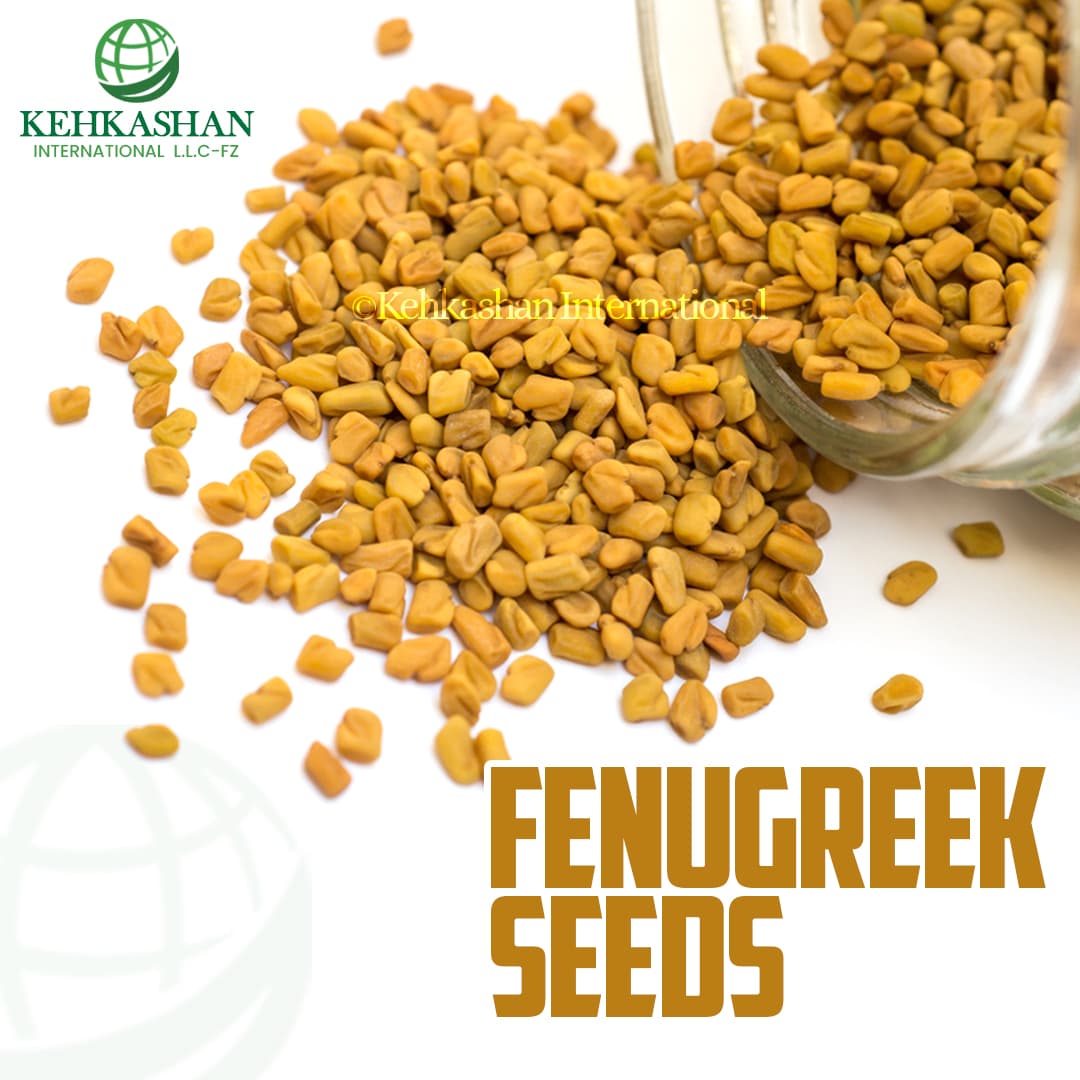
Fenugreek seeds (Trigonella foenum-graecum) come primarily from India, Pakistan, Morocco, Egypt and Iran. Buyers specify AM-1, AM-2, RMt-1 or local landraces, purity 99 percent, moisture below 10 percent, sortex-cleaned, EU pesticide-residue compliant. Standard MOQ is one 20-foot full-container load at 24 to 26 metric tons. Lead times from Karachi or Mumbai to Jeddah run 5 to 8 days.
Why fenugreek seed demand is structurally rising
Fenugreek is one of the few commodities where end-use demand grew across multiple unrelated channels at the same time. Five demand pulls overlapped in the 2018-2026 cycle and pushed global trade volume from roughly 380,000 metric tons annually to over 600,000 metric tons.
Gulf and Levant culinary demand. Saudi Arabia, the UAE, Qatar, and Kuwait import roughly 40,000 metric tons a year of clean food-grade fenugreek for traditional preparations including hilbeh, the Yemeni paste that anchors Gulf weekend breakfasts. This is the dominant pull that sets the GCC pricing band.
Indian-diaspora retail. Pakistani, Indian, Bangladeshi, and Sri Lankan diaspora populations across the UK, Canada, USA, and Australia drive consistent retail demand. Sortex 99.9 percent grade in 1-kilogram and 5-kilogram retail packs is the format.
Animal-feed industry. Forage-grade fenugreek seed is increasingly used in dairy and beef feed formulations as a galactagogue and digestion aid. Egypt and southern Europe pull large feed-grade volumes at lower spec.
Nutraceutical and pharmaceutical extraction. Fenugreek extract standardized to 50 to 70 percent saponins or 4-hydroxyisoleucine sells into the diabetes and lactation-support supplement markets — supported by EFSA reviews of Trigonella foenum-graecum botanical health claims. EU and US extract producers buy unprocessed seed in 22-ton-plus annual contracts.
Food-flavor industry. Fenugreek leaf (kasuri methi) and seed flavor compounds appear in artificial maple syrup, savory snacks, and meat seasoning. McCormick, Givaudan, and Symrise all source seed-grade material under specification.
The five pulls don't compete for the same lots. Buyers who understand the spec hierarchy gain pricing power; buyers who treat all fenugreek as fungible pay 12 to 22 percent more than they need to.
The five origin countries — what differentiates each
India. Dominant volume producer at roughly 65 percent of global supply per FAOSTAT spice production data. Concentrated in Rajasthan (Nagaur, Sikar, Jhunjhunu districts), Gujarat (around Mehsana), and Madhya Pradesh. Indian variety releases AM-1, AM-2, RMt-1, RMt-143, RMt-303, Pusa Early Bunching, and Lam Selection 1 dominate commercial trade. Indian-origin seed is harvested January-March, so spot supply firms by April and stays adequate through year-end.
Pakistan. Second-largest producer at about 12 percent of global supply. Concentrated in southern Punjab and Sindh. Pakistani local landraces are slightly larger-seeded with marginally higher saponin content than Indian commercial varieties. Karachi-FOB is the standard origin term. Pakistani-origin seed often prices 50-80 USD per metric ton below Indian-origin equivalent because of lower brand recognition in EU buyer specifications, despite comparable lab numbers.
Morocco. Roughly 6 percent of supply, with the harvest concentrated in the Saiss plain and Sous valley. Moroccan-origin commands a 8-15 percent premium over Indian for EU buyers because of the EU origin proximity (lower transit risk, faster lead time) and the historical perception of cleaner pesticide profile. Casablanca-FOB.
Egypt. About 5 percent of global supply, mostly from the Nile Delta. Egyptian-origin moves heavily into the Gulf food-flavor and feed segments. Alexandria-FOB. Egyptian fenugreek tends to spec slightly lower on color uniformity but matches India on saponin content.
Iran. Roughly 4 percent of global supply, concentrated in Khorasan. Iranian-origin material is sanctioned-routing-sensitive and most buyers source through UAE consolidators. Bandar Abbas-FOB direct, or Jebel Ali via consolidation.
The remaining 8 percent is spread across Turkey, Syria, Algeria, Tunisia, and Ethiopia. Volume from these origins is irregular and tends to fill spot shortages rather than sit on annual contracts.
Variety codes buyers should know
Five commercial varieties dominate the spec on Indian and Pakistani RFQs.
AM-1 (Ajmer Methi 1). Released by ICAR-NRCSS Ajmer (National Research Centre on Seed Spices). Mid-maturing, 130-135 day cycle, pale-yellow seed with high uniformity. Saponin content 1.4 to 1.7 percent. Most common workhorse variety on Gulf-bound food-grade contracts.
AM-2 (Ajmer Methi 2). Slightly larger seed than AM-1 with marginally higher saponin (1.6 to 1.9 percent). Preferred by extract-producer buyers.
RMt-1 (Rajasthan Methi 1). Drought-tolerant short-cycle variety from Rajasthan Agricultural University. Slightly more variable seed size; suits feed-grade contracts where uniformity matters less than tonnage.
RMt-143. Higher-yielding modern release. Trial data shows 12-18 percent yield gain over AM-1 under irrigated conditions. Available in commercial volume from 2024.
Pusa Early Bunching. Released by IARI New Delhi. Faster cycle (110 days) but lower seed-grade saponin. Mostly grown for the leafy-vegetable kasuri methi trade rather than seed export.
For Pakistani-origin seed, varieties are mostly local landraces — supplier-specific selections rather than government-released codes. The CoA names the supplier line ("Sindh Highland Local," "Bahawalpur Selection") and back-tests against AM-1/AM-2 reference samples for buyer comparability.
Grade and CoA fields buyers specify
Purity. Food-grade specifies 99 percent minimum, sortex-99 to sortex-99.5 grade. Feed-grade tolerates 97 to 98 percent. EU retail-pack grade requires 99.5 percent plus a stones-glass-metal control test.
Moisture. Below 10 percent for shipped grade. Higher moisture risks fungal degradation and aflatoxin development in transit.
Saponin content. 1.2 to 1.9 percent typical. Extract-grade buyers spec the lower bound (1.5 percent floor); food-grade buyers care less about saponin specifically.
Aflatoxin. Total below 4 micrograms per kilogram for EU compliance, B1 below 2. Saudi SFDA mirrors. Indian FSSAI tolerates up to 15 but most Indian re-exporters spec to EU-tight to keep optionality.
Pesticide residue panel. EU buyers run the full Annex B panel (chlorpyrifos, malathion, dimethoate, etc.). Indian-origin material occasionally trips chlorpyrifos limits; Moroccan and Egyptian material rarely does. Pakistani local-landrace material is variable and benefits from lab pre-clearance before booking.
Heavy metals. Lead below 3 mg/kg, cadmium below 1 mg/kg (EU), more permissive for Gulf retail.
Color. Pale yellow to amber. Darkening indicates over-storage or fungal contamination.
A clean Certificate of Analysis carries variety, harvest year, all the above lab numbers, plus a phytosanitary declaration from the origin's National Plant Protection Organisation.
Container math, MOQ, pricing tiers
A 20-foot full-container load holds 24 to 26 metric tons of fenugreek seed in 25 kilogram PP bags or 50 kilogram jute bags. A 40-foot high-cube takes 48 to 52 metric tons.
MOQ tiers as we run them at Kehkashan:
- 1,000 kg LCL — minimum starter, fits consolidation bracket
- 5,000 kg — break-even on 20-foot LCL with shared shipping
- 24,000 kg+ — full 20-foot FCL of single-grade material
- 50,000 kg+ — full 40-foot FCL or multi-container annual contract
Pricing tiers (FOB Karachi or Mumbai, indicative, 2026):
- Feed-grade, 97-98% purity: 1.10-1.30 USD/kg
- Food-grade AM-1/AM-2 sortex: 1.40-1.65 USD/kg
- EU retail-pack 99.5% sortex: 1.70-1.95 USD/kg
- Extract-grade with saponin guarantee: 1.85-2.20 USD/kg
- Moroccan-origin food-grade premium: 1.60-1.90 USD/kg
These bands shift with the harvest. India's Rajasthan harvest in January-February sets the year's price floor; a poor monsoon the prior year compresses Indian supply 15-25 percent and pushes every band up 18-30 percent.
Documentation set on every shipment
Every fenugreek seed container leaves Karachi, Mumbai, Casablanca, Alexandria, or Bandar Abbas with the standard export pack:
- Bill of lading
- Commercial invoice and packing list
- Certificate of Origin (origin Chamber of Commerce)
- Phytosanitary certificate (NPPO)
- Certificate of Analysis (lab name, ISO 17025 accreditation if applicable)
- Aflatoxin and pesticide-residue analysis reports
- Health certificate
- Form A or EUR.1 origin certificate where preferential tariff applies
- Fumigation certificate (mandatory for EU, optional for GCC)
EU shipments add a CHED-D entry on the EU TRACES system. Saudi Arabia adds attested commercial invoice through the origin embassy in Riyadh plus SASO conformity for retail-pack material.
Lead times by destination port
| Destination port | Country | Ocean transit | Typical Incoterm |
|---|---|---|---|
| Jeddah | Saudi Arabia | 5-8 days from Jebel Ali, 7-10 days from Mumbai | CFR / CIF |
| Hamad | Qatar | 3-5 days | CIF |
| Sohar | Oman | 2-4 days | CIF |
| Aqaba | Jordan | 7-10 days | CFR |
| Mombasa | Kenya | 12-18 days | CIF |
| Alexandria | Egypt | 8-12 days | CFR |
| Hamburg | Germany | 21-28 days | CIF / DAP |
| Rotterdam | Netherlands | 21-28 days | CIF / DAP |
| Felixstowe | United Kingdom | 21-28 days | CIF / DAP |
| New York | United States | 28-35 days | CIF |
| Toronto via Halifax | Canada | 30-38 days | CIF |
| Sydney | Australia | 25-32 days | CIF |
Pre-vessel production lead time is 14 to 21 days from PO confirmation; ocean transit on top.
How to run an RFQ
A clean fenugreek RFQ specifies six things:
- Origin preference (India, Pakistan, Morocco, Egypt, Iran, or any-best-price)
- Variety or grade band (AM-1, AM-2, food-grade sortex, feed-grade, extract-grade)
- Purity and saponin floor if relevant
- Quantity and pack size (25 kg PP, 50 kg jute, 1 MT FIBC)
- Destination port
- Incoterm (FOB origin, CFR destination, CIF, DAP)
Complete RFQs get same-day quote. Incomplete RFQs add 2 to 5 working days as the trade desk clarifies specs.
Trade desk closing note
Fenugreek is a commodity where origin perception lags origin reality. Indian seed dominates global volume but Moroccan and Pakistani alternatives match on lab numbers at 5 to 12 percent lower FOB price. Buyers running standardized formulations should run multi-origin parallel testing on 5-kilogram samples before locking annual contracts; the savings on a 50-ton annual program can run 6,000 to 14,000 USD by switching origin without sacrificing spec.
For a quote, send the six RFQ specs above to [email protected]. The trade desk replies within one working day with FOB origin, CFR destination, CIF, and DAP options.


