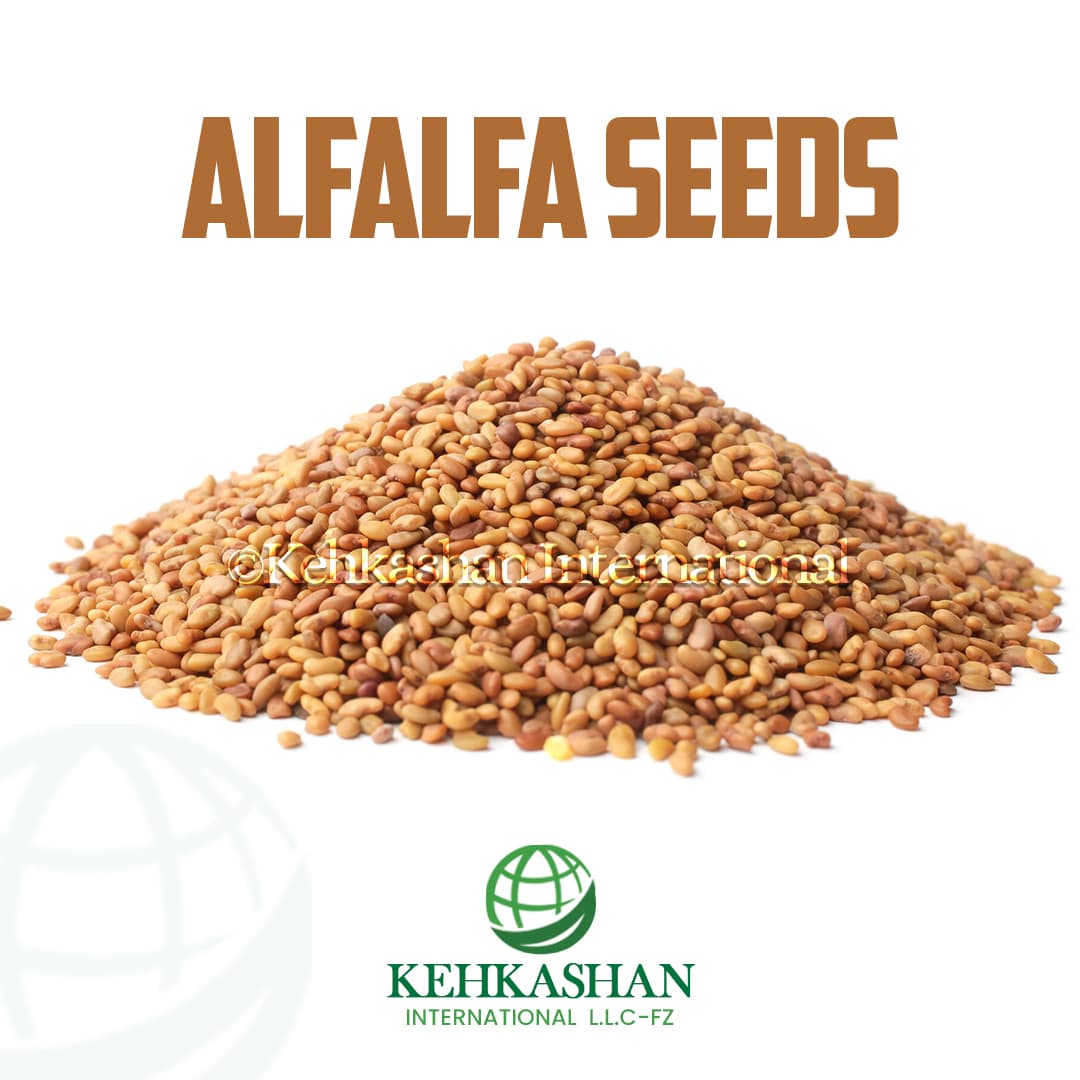
Saudi Arabia imports alfalfa seed from the United States, Australia, Argentina, Italy, and Pakistan. Buyers specify fall-dormancy 4 to 8 varieties, 99 percent purity minimum, 90 percent germination, ISTA tested, and SASO conformity. Lead times from Jebel Ali to Jeddah Islamic Port run 5 to 8 days.
Why Saudi Arabia imports alfalfa seed at scale
Saudi Arabia is the largest single-country alfalfa seed importer in the Middle East. The pull comes from three structural forces that overlap in the Kingdom's central pivots and dairy belt around Al-Kharj, Hail, and the Wadi Ad-Dawasir basin: Vision 2030 food-security targets, dairy expansion led by Almarai, Nadec, and Al-Safi, and a hot-arid climate where on-farm forage yields collapse without irrigated lucerne stands.
Domestic alfalfa hay production was deliberately curtailed under the 2018 phasing-out of green-fodder cultivation on non-renewable aquifer water under MEWA's National Water Strategy, so dairy operators now run a mixed strategy: import compressed alfalfa hay in bales, and import certified seed for the remaining domestic forage area on treated wastewater and pivot-recycled brackish water. That second leg — the seed leg — is what sustains roughly 35,000 to 45,000 hectares of Saudi pivot alfalfa, and it ships almost entirely through Jebel Ali under multi-origin consolidation.
Top origins ranked by spec, price, and lead time
The Saudi buyer's origin shortlist is narrow. Five countries cover almost the entire shipped tonnage, and the choice between them turns on fall-dormancy fit, regulatory acceptance of the Roundup Ready (RR) trait, and FOB price per kilogram.
United States — AmeriStand and HarvXtra. AmeriStand 403T (fall-dormancy 4, traffic-tolerant, conventional) and AmeriStand 480 HarvXtra (FD 4, reduced-lignin, Roundup Ready) are the dominant US releases sold into Saudi Arabia. WL 525HQ and CW 5050 also ship in volume. US-origin lots carry the OECD seed-scheme tag plus an ISTA-format Certificate of Analysis, with purity 99.5 to 99.9 percent and germination 90 percent minimum. FOB Pacific North-West to Jebel Ali transit is 28 to 35 days; production lead time after PO confirmation is 21 to 28 days. Genetically-modified RR varieties require pre-clearance under SFDA and SASO rules.
Australia — WL 525HQ, Sequel HR, Genesis. Australian alfalfa is non-GM, ships ex-Adelaide or Melbourne, and matches FD 5 to 7 — well-suited to Saudi Arabia's warmer southern pivots. Purity runs 99.0 to 99.7 percent, germination 90 percent. Production lead time is 21 to 28 days; ocean transit to Jebel Ali is roughly 21 days.
Argentina — CW 5050, CW 50027. Argentinian seed is FD 5 to 7 and price-competitive, with purity 99.0 to 99.5 percent and germination 90 percent. Lead time end-to-end is 28 to 35 days from Buenos Aires through to Jeddah. Common in second-tier Saudi specifications and in mixed origin LCs that blend US and Argentinian volume in a single 20-foot container.
Italy — Equipe, Garisenda, Pomposa. Italian Po-Valley material is FD 4 to 5, ISTA-certified, and shorter-leadtime than New World origins (14 to 21 days production). Italian releases are popular in Northern Saudi pivots seeking dormancy 4. Phytosanitary chain runs through MIPAAF (Italian Ministry of Agriculture).
Pakistan — Sargodha local and multi-cut hybrids. Pakistani alfalfa is FD 7 to 9, lower-priced, and indicated where Saudi importers want a budget multi-cut option for short-rotation hay paddocks. Purity 98.5 to 99.0 percent, germination 85 percent minimum.
Variety guide for Saudi conditions
Saudi pivot alfalfa is grown across two thermal bands. The northern band (Hail, Qassim, central Riyadh) suits fall-dormancy 4 to 5 varieties; the southern band (Wadi Ad-Dawasir, Najran) suits fall-dormancy 6 to 8. Buyers who specify the wrong dormancy class lose stand longevity within two cutting seasons.
Roundup Ready alfalfa is permitted under SFDA and SASO rules subject to import-batch authorisation. RR varieties do not deliver the same yield uplift in Saudi conditions that they do in the US Pacific North-West, because weed pressure under desert pivot is naturally low; the trait's value is operational simplicity rather than yield. Many Saudi buyers therefore continue to specify conventional traffic-tolerant cultivars over RR, simply on cost grounds.
The reduced-lignin HarvXtra trait is more interesting to Saudi dairy buyers than to hay-export buyers. HarvXtra extends the harvest window by 7 to 10 days without sacrificing relative-feed-value (RFV), which translates directly into milk yield consistency. AmeriStand 480 HarvXtra is the canonical request from Almarai-network growers.
Logistics — Jebel Ali to Jeddah Islamic Port
The default routing is FOB Jebel Ali to CFR Jeddah Islamic Port. Standard ocean transit is 5 to 8 days under regular Maersk, MSC, or CMA-CGM service. Inland from Jeddah to Al-Kharj is 1,150 km by road, 18 to 24 hours under bonded transport.
For Eastern Province deliveries, the more efficient route is Jebel Ali to King Abdul Aziz Port (Dammam), 3 to 5 days transit, with inland haul to Al-Hofuf or central Riyadh at 350 to 700 km. Many Saudi importers split the PO across both ports to balance inland trucking against vessel availability.
Common Incoterms used by Saudi buyers, in descending order of frequency: CFR Jeddah, CIF Jeddah, CFR Dammam, FOB Jebel Ali, DAP buyer-warehouse. DAP is increasingly common where the seller carries inland trucking risk, and is priced on a sliding scale based on diesel benchmarks at time of dispatch.
Documentation set
A complete Saudi alfalfa import documentation set comprises seven items, each with its own validity window and signing authority:
- Phytosanitary certificate — issued at origin by the national plant-protection authority (USDA APHIS for US, DAFF for Australia, SENASA for Argentina, MIPAAF for Italy, DPP for Pakistan). Validity 14 days from issue.
- Certificate of origin (COO) — chamber-of-commerce attested, mandatory for SASO conformity.
- ISTA-format Certificate of Analysis (COA) — purity, germination, other-seed count, dodder presence, weed-seed identification per ISTA Rules 2024 chapter 5. Lot-traceable to the production field.
- OECD seed-scheme certificate — applicable for US, Australian, and EU origins. Adds a redundant origin-trace layer above ISTA.
- SASO conformity certificate — issued by SASO-approved conformity-assessment body before shipment. Without it, the cargo will not clear at Jeddah.
- Commercial invoice and packing list — must show variety code, fall-dormancy class, lot numbers, pack size, gross/net weight per pallet.
- Bill of lading — multimodal where Jebel Ali consolidates multiple origins into one container.
For Roundup Ready varieties specifically, an additional GMO authorisation letter from SFDA is required. Buyers should secure that letter before issuing the LC, not after.
Payment terms typical for KSA buyers
Saudi alfalfa importers settle predominantly on Letter of Credit at sight, USD-denominated, drawn on Saudi National Bank, Al Rajhi Bank, or Riyad Bank. EUR-denominated LCs are seen for Italian-origin lots where the seller invoices in euros; in those cases Kehkashan's UAE Free Zone status accommodates either currency without re-invoicing.
Documentary collection (D/P) and TT against shipping documents are used by long-relationship buyers, typically after three or more clean transactions. Open account is rare in this corridor and only seen with the largest dairy groups.
LC clauses frequently negotiated: latest shipment date allowing for production lead time plus 7-day buffer; partial shipment allowed where the PO covers more than 25 MT; transhipment allowed at Jebel Ali (essential for multi-origin consolidation); third-party documents acceptable (so a Kehkashan-issued multi-origin commercial invoice clears under a US-origin or Italian-origin phyto certificate). Each clause matters; buyers should not accept a template LC without redlining for these.
FAQ
What is the typical MOQ for alfalfa seed shipped to Saudi Arabia?
One 20-foot full-container load is the practical floor — approximately 24 to 25 MT depending on pack size. Pack-size options include 10 kg PP bag, 25 kg PP bag, 50 kg jute bag, and 1 MT FIBC. Smaller orders are quoted as LCL but are uncommon because the freight-per-kg penalty is severe.
Which fall-dormancy class fits Saudi central pivots?
Fall-dormancy 4 to 5 is correct for Hail, Qassim, and central Riyadh pivots; fall-dormancy 6 to 8 is correct for southern pivots in Wadi Ad-Dawasir and Najran. AmeriStand 480 HarvXtra (FD 4) is the canonical Almarai-network specification.
How long does it take to ship alfalfa from Jebel Ali to Jeddah?
Ocean transit is 5 to 8 days under regular service. Add production lead time at origin — typically 21 to 28 days from PO confirmation for US and Australian releases, 14 to 21 days for Italian releases — plus 5 to 7 days for Jebel Ali consolidation when blending origins.
What is SASO conformity and how is it obtained?
SASO conformity is a Saudi Standards, Metrology and Quality Organization certificate issued by an approved conformity-assessment body (Bureau Veritas, SGS, Intertek) verifying that the lot meets SASO-mandated specifications. The certificate is issued at origin or at Jebel Ali before shipment, and must accompany the cargo through Jeddah customs.
Are Roundup Ready alfalfa varieties allowed in Saudi Arabia?
Yes, Roundup Ready alfalfa is permitted subject to SFDA pre-import authorisation per consignment. The authorisation letter must be issued before the LC is opened. Conventional non-GM varieties remain the larger share of Saudi alfalfa imports.
Can multiple origins be blended on one Saudi alfalfa PO?
Yes — Kehkashan consolidates US, Italian, Australian, and Argentinian alfalfa lots at Jebel Ali into a single multi-origin 20-foot container, under one Letter of Credit and one bill of lading. The LC must permit transhipment at Jebel Ali and third-party documents.


