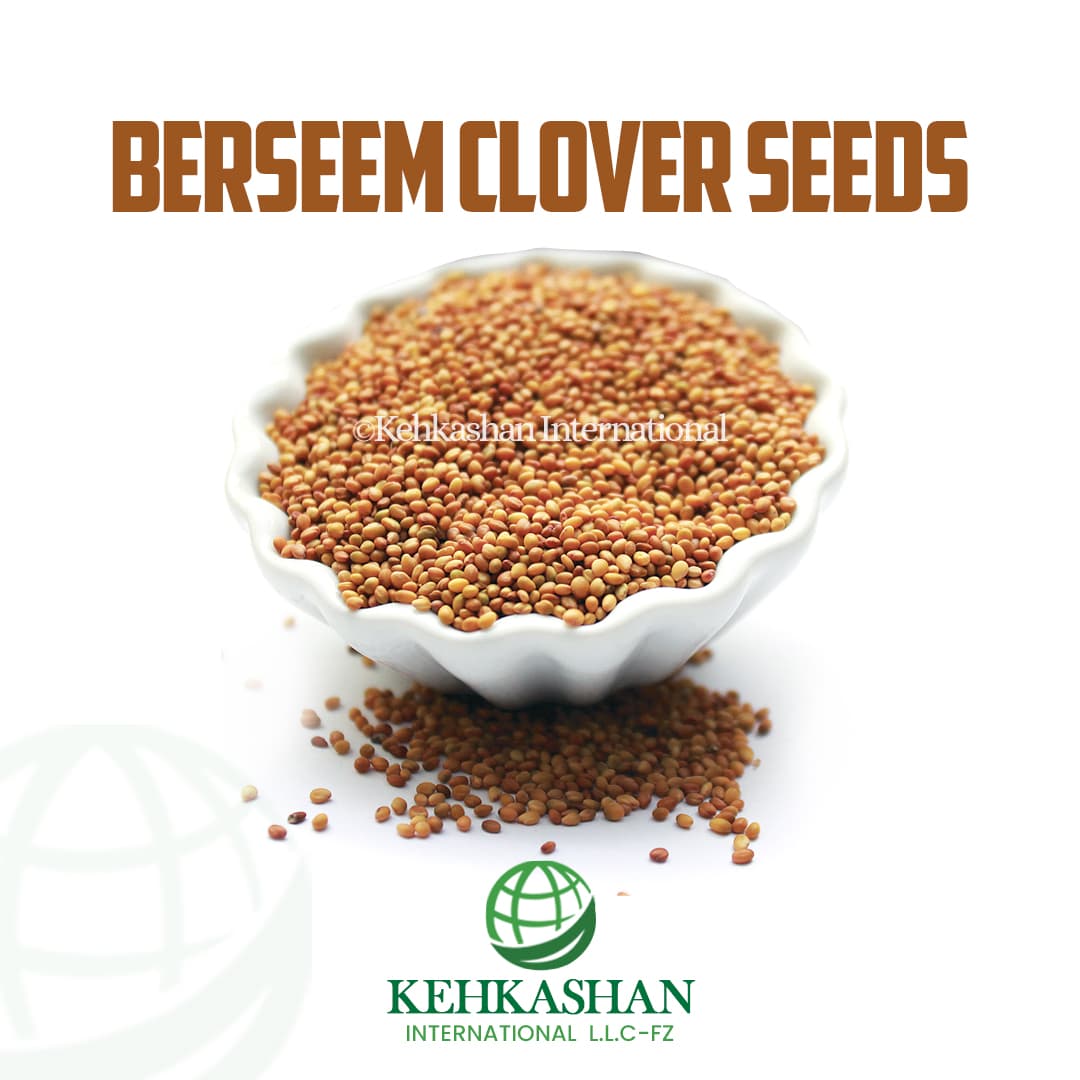
Egyptian berseem clover (Trifolium alexandrinum) is harvested October to March, exported through Alexandria and Damietta, consolidated at Jebel Ali, and re-shipped to Saudi, Gulf, East African, and Central Asian buyers under a single neutral-jurisdiction Letter of Credit.
Why Egypt is the global hub for berseem
Berseem clover (Trifolium alexandrinum) — also called Egyptian clover — is the world's most-traded annual forage legume, and Egypt is the dominant origin per FAO forage crop assessments. Egyptian berseem accounts for the majority of internationally-shipped seed in the species, with smaller but important supply from Pakistan, India, and Italy.
Three structural reasons hold the Egyptian position. First, Nile Delta soils and winter-growing conditions match the species' agronomy almost perfectly: berseem is a cool-season annual that suits 15 to 25 degree Celsius daytime temperatures and short photoperiods. Second, Egyptian seed multiplication is concentrated in the Sharqia, Beheira, and Kafr El-Sheikh governorates with multi-generational cooperative seed growers under the Egyptian Ministry of Agriculture and Land Reclamation registration regime. Third, the post-harvest cleaning and dodder-removal infrastructure in Egypt is mature; ISTA-grade lots routinely come off the cleaning line at 99.0 to 99.5 percent purity with dodder-free certificates that satisfy Gulf phyto requirements.
Variety guide — Mescavi, Saidi, Balady
Three named varieties cover almost all internationally-traded Egyptian berseem.
Mescavi (Miskavi) — the multi-cut variety. Yields 4 to 6 cuttings per growing season under good water. Stem is finer and the regrowth after each cutting is faster than Saidi or Balady. Mescavi is the default request from Saudi, UAE, and Pakistani dairy buyers because its cumulative dry-matter yield over the season is the highest among the three.
Saidi — the single-cut variety from Upper Egypt. Saidi is a tall, large-leafed type producing one heavy cut at flowering. It is used where buyers want maximum standing biomass for hay-making rather than rotational grazing. Saidi has a smaller export footprint than Mescavi but is specifically requested by some Sudanese and Yemeni buyers.
Balady — the local landrace, intermediate between Saidi and Mescavi in cutting count. Balady is grown widely on Egyptian farmer-saved seed but its export volume is small because the formal certified-seed production is concentrated in Mescavi. Balady requests usually come from Egyptian-diaspora buyers in East Africa.
For an export contract, the variety must be specified by name on the commercial invoice and on the ISTA certificate. A "berseem clover" line item without variety designation is insufficient and will be queried by Saudi or UAE phyto inspection.
Egyptian export season
Egyptian berseem seed harvest is May to July; cleaning, conditioning, and lot-formation is July to September; container loading runs September through March of the following year. Buyers in the Northern Hemisphere sow berseem in the cool autumn-winter window, so the bulk of vessel activity is October to March.
Out-of-season requests (April to August) are quoted from carryover stock at a 5 to 12 percent price premium over fresh-season material, and buyers should accept that germination decay is a real risk on carryover lots. The standard mitigation is a freshly-pulled ISTA test issued within 30 days of shipment, regardless of when the lot was originally produced.
Re-export through Dubai — the Free Zone case
A material share of Egyptian berseem ships not directly from Alexandria to the buyer's port but through Jebel Ali under a neutral-jurisdiction re-export structure. The reason is documentary and financial, not geographic.
Egyptian banking and LC handling can be slow for Saudi, UAE, and Central Asian buyers, particularly where the buyer's bank requires confirmed-LC handling at a UAE-resident correspondent. By routing through a Kehkashan trade-desk LC drawn on Emirates NBD or HSBC UAE, the buyer settles in a neutral-currency, neutral-jurisdiction structure: USD or EUR LC, UAE Free Zone seller, multi-origin commercial invoice, original Egyptian phytosanitary and ISTA certificates accompanying the cargo end-to-end.
Operationally, the Egyptian seed is loaded ex-Damietta or ex-Alexandria, transhipped at Jebel Ali for 24 to 72 hours, and re-loaded into a multi-origin container that may also carry alfalfa, sorghum-sudan, or pearl millet seed for the same buyer. One PO replaces three. One LC replaces three. One bill of lading covers the consolidated container.
Spec language buyers should request
Egyptian berseem export specs should be written in ISTA-aligned language. The minimum acceptable specification for international buyers is:
- Purity: 99.0 percent minimum, with the percentage of "other crop seeds" disclosed line-by-line.
- Germination: 90 percent minimum at 7 days, ISTA Rules 2024 chapter 5.
- Dodder: dodder-free certificate. Dodder (Cuscuta spp.) contamination is the single biggest reason that berseem lots are rejected at destination phyto inspection. Insist on a dodder-free certificate signed by the cleaning facility.
- Other weed seeds: Striga, Sinapis arvensis, Avena fatua counts disclosed.
- Moisture: 9 to 11 percent at packing.
- Pack size: 25 kg PP woven bag is standard; 50 kg jute is requested for some African buyers; 1 MT FIBC for bulk dairy operators.
Saudi buyers in particular will reject any lot lacking a dodder-free certificate, regardless of overall purity, because dodder establishment in Saudi pivots is catastrophic and irreversible.
Logistics and documentation
Origin ports are Alexandria for the Mediterranean route and Damietta for direct Gulf service. Transit Alexandria to Jebel Ali via Suez Canal is 7 to 10 days. Transit Damietta to Jebel Ali is 8 to 11 days. Onward Jebel Ali to Jeddah is 5 to 8 days; Jebel Ali to Mombasa is 12 to 18 days; Jebel Ali to Aktau (for Central Asian re-export) is 18 to 25 days via Bandar Abbas trans-Iran or via Black Sea.
Required documents at origin: phytosanitary certificate from Egyptian Plant Quarantine, dodder-free certificate, ISTA Certificate of Analysis, certificate of origin attested by the Egyptian Chamber of Commerce, commercial invoice, and packing list. For re-export at Jebel Ali, the UAE Federal Customs adds the re-export endorsement to the original documents — the buyer receives the full original chain.
FAQ
What's the difference between Mescavi and Saidi berseem?
Mescavi is the multi-cut Egyptian variety yielding 4 to 6 cuttings per season; it is the default international export variety. Saidi is the single-cut Upper-Egypt variety used where buyers want one heavy biomass harvest at flowering for hay production.
When is Egyptian berseem in season for export?
Harvest May to July; lot conditioning July to September; export shipment season October through March. Out-of-season requests are quoted on carryover stock with a fresh germination test.
What is a dodder-free certificate?
A dodder-free certificate is a separate document attesting that the cleaning line removed Cuscuta spp. seed contamination from the lot. It is issued by the seed cleaning facility and counter-signed by the Egyptian phytosanitary authority. Saudi and UAE buyers reject berseem without it.
Can Egyptian berseem be re-exported through Dubai under a single LC?
Yes. Kehkashan loads Egyptian berseem ex-Alexandria or ex-Damietta, transhipping at Jebel Ali, and issues a UAE Free Zone commercial invoice against a USD or EUR LC drawn on a UAE-resident bank. The original Egyptian phyto and ISTA documents accompany the cargo end-to-end.
What pack sizes ship for berseem clover?
Standard pack is 25 kg PP woven bag. 50 kg jute bag is used for African buyers; 1 MT FIBC is used for bulk dairy operators. MOQ for international export is one 20-foot FCL, approximately 24 MT.
Pricing structure and the FOB negotiation
Berseem prices move on three axes: variety (Mescavi commands a premium of 8 to 15 percent over Saidi or Balady at FOB), purity tier (lots above 99.5 percent purity carry a 4 to 7 percent uplift over 99.0 percent material), and crop-year freshness (current-season material trades 5 to 12 percent above carryover). On a typical FOB Damietta quote, a buyer requesting Mescavi at 99.5 percent purity, 90 percent germination, current crop, dodder-free, will see roughly the top of the Egyptian export band; the same buyer requesting Saidi at 99.0 percent on carryover stock will see something closer to the bottom of the band.
Saudi and UAE buyers usually negotiate on a CFR basis to Jeddah or Jebel Ali rather than FOB — meaning the seller carries the ocean freight risk to the destination port. This shifts the responsibility for vessel availability and freight-rate volatility onto the trade-desk side and is one of the reasons that consolidation through Jebel Ali makes sense: by aggregating multiple buyer requirements into a single 20-foot or 40-foot container, the trade desk reduces freight-rate exposure per buyer and can hold price stability across a 30 to 60 day quote validity.
For Letter-of-Credit terms, Saudi and UAE buyers most commonly settle berseem on LC at sight USD-denominated, drawn on Saudi National Bank, Al Rajhi Bank, Emirates NBD, or HSBC UAE. Documentary collection (D/P) is used by repeat buyers; TT against shipping documents is occasional but limited to long-relationship counterparties. Open account is rare in this corridor.
Quality-assurance chain — what to verify before opening the LC
Before opening a Letter of Credit on an Egyptian berseem contract, the buyer's quality team should verify five specific items independently of the seller's representations. First, the production-field traceability — the lot number on the COA must trace back to a named field or set of fields in Sharqia, Beheira, Kafr El-Sheikh, or another known production governorate. Generic "Egypt" provenance without governorate specificity is a yellow flag.
Second, the cleaning-line identification on the dodder-free certificate. Egyptian berseem cleaning is concentrated in a known set of facilities; the certificate should name the facility and its operator. Third, the ISTA tag or ISTA-format certificate should be issued within 90 days of the production date — not within 90 days of the shipment date. Older ISTA certificates indicate that the lot has been in storage longer than the buyer was told.
Fourth, the moisture content at packing. Egyptian berseem stored in PP woven bags above 11 percent moisture in summer climate is at risk of fungal-load increase; specifications below 9 percent are aspirational and rarely seen on real lots. The realistic acceptable range is 9 to 11 percent at packing. Fifth, the country-of-destination phyto-conformity statement. Saudi imports require explicit declaration that the lot is free of Cuscuta spp., Striga spp., Avena fatua, and Sinapis arvensis; the Egyptian phyto certificate must carry that declaration line, not a generic "free of harmful pests" boilerplate.


