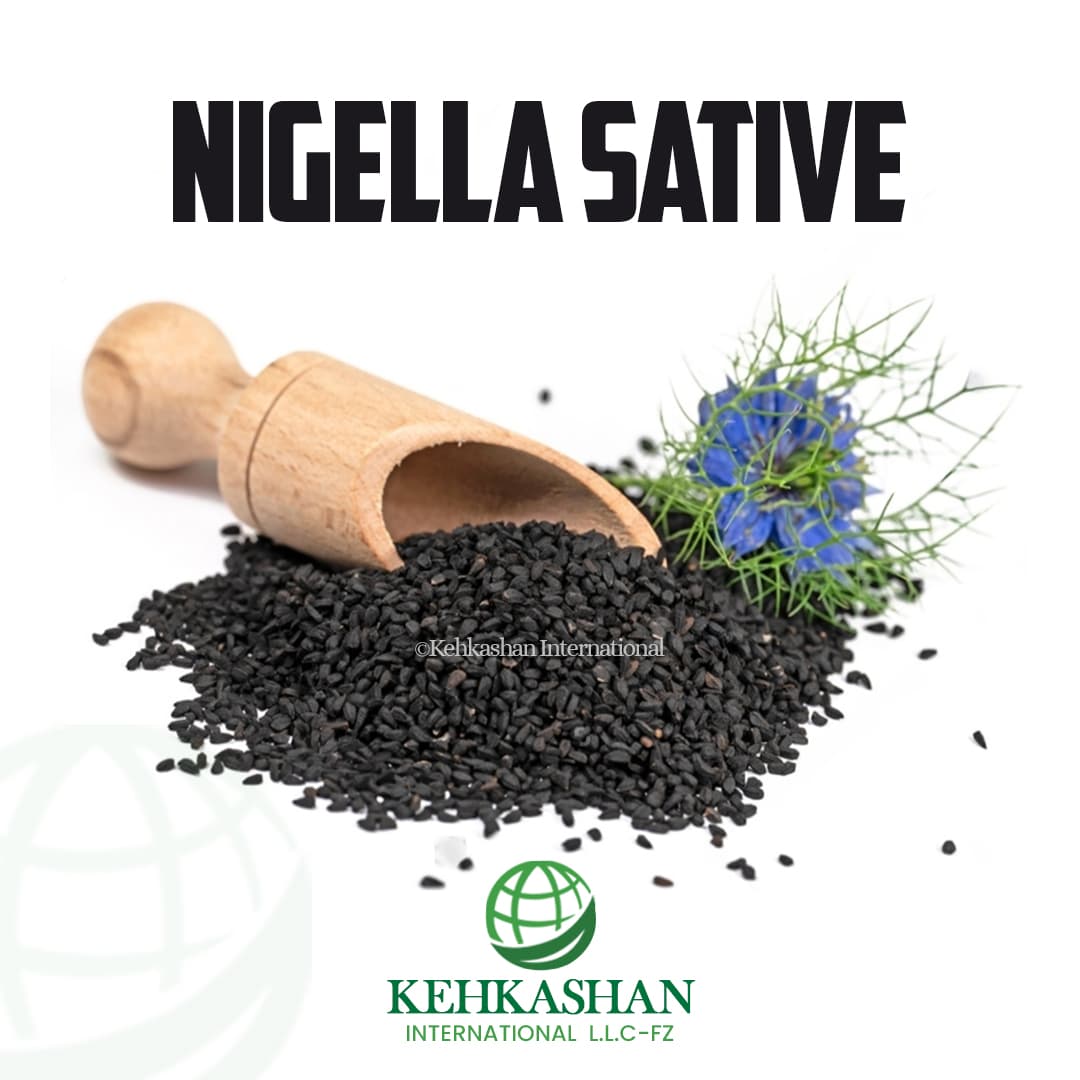
Black seed (Nigella sativa) comes primarily from Pakistan, India, Egypt, Türkiye, Ethiopia and Syria. Buyers specify thymoquinone content 0.5 to 2.5 percent, fixed-oil yield 32 to 40 percent, EU pesticide compliance, and moisture below 8 percent. MOQ is one 20-foot full-container load at 22 to 24 metric tons whole seed. Lead times Karachi to Jeddah are 5 to 8 days.
Why black seed is the highest-margin oilseed in our 2026 export book
Nigella sativa sits in an unusual category. It is botanically a small annual herb of the Ranunculaceae family, but commercially it behaves like three separate trade items packaged in one seed: a culinary spice (whole seed for breads, curries, and Middle Eastern bakery), a traditional-medicine input (whole seed and powder for Tibb-e-Nabawi, Ayurvedic, and Unani formulations), and a premium nutraceutical and cosmetic raw material (cold-pressed oil with thymoquinone titration as the active ingredient). The pricing spread across these three channels is wide — from 1.80 USD/kg for industrial-grade whole seed all the way to 80 USD/kg for clinical-grade cold-pressed oil with guaranteed thymoquinone content.
The single compositional lever that drives most of the pricing variance is thymoquinone, the volatile compound that delivers most of the documented anti-inflammatory, antioxidant, and antimicrobial properties Nigella sativa is sold on (catalogued in the PubChem entry for thymoquinone). Origin, processing temperature, and storage all affect thymoquinone retention — and most marketplace listings provide no documentation of it whatsoever.
This guide walks through the six origin countries, the thymoquinone and oil-yield titration bands that drive pricing, the format spread (whole seed, powder, cold-pressed oil, capsules), and the documentation set we run on every Kehkashan container.
Where commercial black seed comes from
Pakistan. Cultivation across Punjab (Bahawalpur, Multan, Rahim Yar Khan), Sindh (Khairpur, Larkana), and Khyber-Pakhtunkhwa (Mardan). Pakistani-origin black seed runs a thymoquinone titration of 0.6 to 1.4 percent on standard commercial lots, with selected lots from the Bahawalpur corridor reaching 1.8 to 2.2 percent. Fixed-oil yield 33 to 38 percent of dried-seed weight. Pakistani black seed ships out of Karachi. This is Kehkashan's primary origin — direct cooperative relationships in the Bahawalpur and Rahim Yar Khan corridors.
India. Cultivation across Madhya Pradesh, Rajasthan, Punjab, Haryana, and Himachal Pradesh. Indian black seed runs 0.5 to 1.2 percent thymoquinone, fixed-oil yield 32 to 36 percent. Major export volume but at the lower-titration end of the global market.
Egypt. Concentrated in the Nile Delta and Upper Egypt regions per Egyptian Ministry of Agriculture cultivation maps. Egyptian black seed historically commanded a premium for thymoquinone titration (often 1.5 to 2.5 percent) and remains the reference origin in Tibb-e-Nabawi traditional-medicine markets. Ships from Alexandria. Volumes have declined as Egyptian agricultural conversion to higher-margin export crops has reduced black-seed acreage.
Türkiye. Cultivation in the Konya, Burdur, Çorum, and Eskişehir provinces per Turkish Ministry of Agriculture and Forestry crop statistics. Türkish black seed runs 1.0 to 2.0 percent thymoquinone with strong essential-oil distillation industry. Ships from Mersin and Izmir.
Ethiopia. Smaller producer, mostly serving regional African and Middle Eastern markets. Thymoquinone titration 0.6 to 1.4 percent. Ships from Djibouti.
Syria. Historically a premium-tier producer with very high thymoquinone titration (often 2.0 to 2.8 percent), but commercial export volumes have collapsed since 2011. Limited supply remains through Lebanese and Türkish consolidators for buyers specifically seeking Syrian-origin material.
The six origins together produce roughly 80,000 to 120,000 metric tons of whole-seed equivalent annually for export, with maybe 60 to 70 percent reaching international markets after domestic culinary and traditional-medicine absorption.
Thymoquinone titration — the price driver buyers should specify
Buyers paying premium prices for Nigella sativa are paying for thymoquinone retention, not just raw weight. The compound is volatile, heat-sensitive, and degrades during long-term storage at ambient warehouse temperatures. The supplier's harvest, drying, and storage discipline determines how much of the field-fresh thymoquinone reaches the buyer's formulation.
Thymoquinone titration bands and applications:
- Below 0.5 percent. Industrial-grade whole seed for low-value culinary and animal-feed inclusions. Lowest FOB pricing. Indian and Ethiopian harvest lots often land here.
- 0.5 to 0.8 percent. Standard culinary and traditional-medicine grade. Bulk Indian, Pakistani and Ethiopian export lots typically land here. GCC traditional-medicine retail buys in this band.
- 0.8 to 1.4 percent. Premium culinary and standard nutraceutical-input grade. EU and North American retail-brand spice and supplement buyers buy in this band. Pakistani Bahawalpur-corridor and Türkish lots typically land here.
- 1.4 to 2.0 percent. Premium nutraceutical and clinical-input grade. EU supplement brands and Indian Ayurvedic pharma running standardized formulations buy in this band. Pakistani selected-lot, Egyptian and Türkish lots reach here.
- 2.0 percent and above. Specialty pharmaceutical and clinical-trial grade. Carries 30 to 60 percent FOB premium over standard nutraceutical band. Egyptian and Syrian-consolidator material historically supplied this tier.
For cold-pressed oil, the thymoquinone in the oil is typically 1.0 to 4.0 percent depending on seed quality and pressing temperature — premium cold-pressed oil from high-titration seed reaches 3.5 to 4.0 percent thymoquinone in the bottled product.
Custom titration is available — when a buyer needs a specific band, the supplier blends harvest lots and tests for thymoquinone retention. This costs more in lab work and lot management but is routinely done for buyers running standardized formulations.
Format choices on the RFQ
Black seed is sold in four primary formats:
Whole seed. Shelf-stable, the format most-shipped at volume. FOB Karachi 1.80 to 4.50 USD/kg depending on titration band.
Powder (stone-milled or low-temperature-milled). Mesh size 40 to 80. Used in capsule formulations, food-color industrial input, ayurvedic blend ingredient. Note that thymoquinone degrades faster in powder form than in whole seed — buyers running standardized capsule fills should specify recent-mill date and request post-mill thymoquinone re-test. FOB Karachi 3.00 to 6.50 USD/kg.
Cold-pressed oil. Premium nutraceutical and cosmetic format. Yield 28 to 35 percent of seed weight (lower than the seed's total fixed-oil content because cold-pressing leaves residue oil). FOB Karachi 18 to 80 USD/kg depending on thymoquinone titration in the bottled oil and origin certification.
Solvent-extracted oil. Higher yield (36 to 40 percent of seed weight) but the solvent residue and some thermal degradation reduces the thymoquinone content — typically 1.0 to 2.5 percent thymoquinone in the bottled oil. FOB Karachi 12 to 28 USD/kg.
Grade vocabulary on the Certificate of Analysis
A clean black seed CoA carries seven fields beyond thymoquinone titration:
- Format and origin — whole seed, powder, cold-pressed oil, solvent-extracted oil; harvest origin region.
- Fixed-oil content — by Soxhlet extraction, expressed as percent of dried-seed weight. Standard 32 to 40 percent.
- Moisture — below 8 percent for shelf-stable shipped grade. Lower (below 5 percent) for powder.
- Foreign matter — below 1 percent for food-grade, below 0.5 percent for nutraceutical-grade.
- Aflatoxin and ochratoxin A — below EU regulatory limits per Regulation 1881/2006.
- Heavy metals and pesticide residue — EU pesticide Annex A and B compliance, lead below 3 mg/kg, cadmium below 1 mg/kg.
- Volatile-oil content — minimum 0.5 percent of seed weight (premium lots reach 1.0 to 1.5 percent).
Pharmaceutical and cosmetic buyers add microbiological tests for total aerobic count, yeasts and molds, E. coli absence, and salmonella absence. EU clean-beauty cosmetic buyers running cold-pressed oil require valid IFRA and COSMOS certifications where applicable.
Container math, MOQ, and pricing
Black seed is small (1,000-seed weight ~2.5 to 3.0 grams) and high-density. A 20-foot full-container load holds:
- 22 to 24 metric tons of whole seed in 25 kg or 50 kg multi-layer kraft bags
- 22 to 24 metric tons of powder in 25 kg multi-layer kraft bags with food-grade liner
- 18 to 22 metric tons of cold-pressed or solvent-extracted oil in 200 kg HDPE drums
MOQ tiers as we run them at Kehkashan:
- 200 kg starter — minimum order, fits LCL consolidation
- 1,000 kg — break-even on most LCL routes
- 22,000 kg+ — full 20-foot FCL of single-grade whole seed
- 26,000 kg+ — full 40-foot FCL for high-volume nutraceutical-input buyers
Pricing tiers (FOB Karachi, indicative, 2026):
- Industrial-grade whole seed (below 0.5 percent thymoquinone): 1.80-2.20 USD/kg
- Standard culinary whole seed (0.5 to 0.8 percent thymoquinone): 2.20-2.80 USD/kg
- Premium culinary and standard nutraceutical (0.8 to 1.4 percent): 2.80-3.80 USD/kg
- Premium nutraceutical (1.4 to 2.0 percent): 3.80-4.80 USD/kg
- Specialty pharmaceutical (2.0 percent+): 4.80-6.50 USD/kg
- Cold-pressed oil, standard: 18-32 USD/kg
- Cold-pressed oil, premium thymoquinone-titrated: 35-80 USD/kg
Documentation set on every shipment
Every Nigella sativa container leaves Karachi with the standard export pack:
- Bill of lading
- Commercial invoice and packing list
- Certificate of Origin (Pakistan Chamber of Commerce)
- Phytosanitary certificate (Department of Plant Protection)
- Certificate of Analysis (thymoquinone titration, fixed-oil content, moisture, foreign matter, aflatoxin, heavy metals, pesticide residue)
- Health certificate (PSQCA equivalent)
- Form A or EUR.1 origin certificate where preferential tariff applies
- Fumigation certificate (mandatory for EU and US, optional for GCC)
- Steam-sterilization certificate (where buyer has specified treated material for retail packaging)
- Cold-chain temperature logger record (mandatory for cold-pressed oil shipments)
EU pharmaceutical-grade buyers may require a Certificate of Suitability to the European Pharmacopoeia (CEP) on the cold-pressed oil grades. EU clean-beauty cosmetic buyers add IFRA and COSMOS certifications where applicable.
Lead times by destination port
| Destination port | Country | Ocean transit | Typical Incoterm |
|---|---|---|---|
| Jeddah | Saudi Arabia | 5-8 days | CFR / CIF |
| Hamad | Qatar | 3-5 days | CIF |
| Sohar | Oman | 2-4 days | CIF |
| Mombasa | Kenya | 12-18 days | CIF |
| Hamburg | Germany | 21-28 days | CIF / DAP |
| Rotterdam | Netherlands | 21-28 days | CIF / DAP |
| Felixstowe | United Kingdom | 21-28 days | CIF / DAP |
| New York | United States | 28-35 days | CIF |
| Long Beach | United States | 32-40 days | CIF |
| Toronto (via Montreal) | Canada | 30-37 days | CIF |
| Mumbai | India | 7-10 days | CFR |
| Tokyo | Japan | 24-30 days | CFR |
| Kuala Lumpur | Malaysia | 14-20 days | CFR |
Whole seed shipments move at standard ambient. Cold-pressed oil shipments require refrigerated container service throughout the route — temperature logger records become part of the documentation set, and some EU and North American buyers require post-arrival thymoquinone re-test on landed product to confirm degradation has not exceeded specified tolerance.
Demand-side pulls — who buyers actually are
Five end-use segments drive global Nigella sativa demand:
Gulf and Middle Eastern Tibb-e-Nabawi traditional-medicine retail. Saudi Arabia, UAE, Qatar, Kuwait, Egypt, Jordan, Morocco. Whole seed and powder for traditional-medicine retail and the strong consumer-belief market behind black seed's documented health properties (the Hadith reference is well-known in this consumer segment). Standard culinary and premium-culinary tiers, large volume. Buyers run 200 to 5,000 ton annual programs.
Global retail spice and Indian-diaspora retail. UK, USA, Canada, Australia, EU spice retail through national distribution chains. Whole seed and powder as standalone retail SKU plus inclusion in spice blends. Volumes 100 to 2,000 ton annual programs.
Nutraceutical capsule and supplement brands. EU, North American, and Indian Ayurvedic pharma. Premium-titration whole seed, powder, and cold-pressed oil for capsule and tincture formulations. Spec emphasis on thymoquinone titration with guaranteed labelled-claim accuracy. Buyers run 20 to 500 ton annual programs.
Clean-beauty cosmetic formulators. EU, North American, and Korean cosmetic brands using cold-pressed Nigella sativa oil for skincare formulations (anti-inflammatory, sebum-regulating, scalp-care positioning). Spec emphasis on thymoquinone in the oil, organic certification where applicable, and IFRA/COSMOS compliance. Buyers run 5 to 100 ton annual programs.
Premium herbal-tea and wellness brands. Specialty herbal-tea brands running digestive-aid, immune-support, and traditional-medicine-positioning blends. Whole seed and powder in tea-blend recipes. Smaller volume per buyer, but premium pricing.
Competition map — who buyers usually go to
The Nigella sativa export trade is concentrated at the premium nutraceutical end and fragmented at the bulk culinary end. Notable players: Hemani Group (Pakistan, large vertical from seed to retail brand), Marnys (Spain, premium nutraceutical), Heera Foods (UK, retail-brand vertical), Healthy Origins (US, supplement-brand vertical), Sunny Isle (US, cold-pressed oil specialty), El Tahhan (Egypt, traditional-medicine and pharmaceutical-grade), and Origins Healthcare (Pakistan, B2B pharma supply). Below this top tier sit roughly 80 to 120 mid-volume Pakistani, Indian, Egyptian, Türkish, and Ethiopian exporters.
For buyers running diligence, the differentiators between credible suppliers and marketplace listings are:
- Thymoquinone titration documentation — a credible exporter can produce a third-party gas-chromatography test for thymoquinone on the lot being offered, ideally from an internationally recognized lab (SGS, Bureau Veritas, Intertek, Eurofins).
- Storage discipline — ambient warehouse storage degrades thymoquinone over time. Suppliers shipping seed harvested 12+ months prior should be expected to provide a re-test of current titration, not just the harvest-time test.
- Cold-chain integrity for oil shipments — the temperature logger record at destination is the proof point for cold-pressed oil shipments.
- Heat-treatment disclosure — some suppliers heat-treat black seed for shelf-life extension, which destroys thymoquinone. Premium buyers need explicit disclosure of any thermal treatment applied.
We document each of these on every Kehkashan Nigella sativa shipment. Sample lots of 250g to 1kg are couriered free of freight to qualified buyers worldwide; the sample fee credits against the first PO on acceptance.
When to buy ahead vs spot
Pakistani Nigella sativa harvest runs March through May. Indian harvest runs February through April. Egyptian harvest runs April through June. Quality assessment finishes by July, and the year's pricing band stabilizes by August.
Annual contracts booked in August at fixed prices typically secure 6 to 12 percent better pricing than spot purchases through the year, plus guaranteed availability of the specified thymoquinone band. For nutraceutical, clean-beauty cosmetic, and premium retail-brand buyers running standardized formulations against a guaranteed thymoquinone spec, the annual-contract route is the only practical option — spot supply rarely matches the spec consistency these buyers need.
For traditional-medicine retail and bulk culinary buyers with looser tolerance, spot purchases of 5 to 20 ton lots through the year work reliably.
Trade desk closing note
Nigella sativa is one of those crops where the supplier's harvest, drying, and storage discipline directly determines the value the buyer gets in the formulated end-product. The difference between a 0.7 percent thymoquinone lot and a 1.6 percent thymoquinone lot is real money in the supplement bottle, and it shows up at the consumer-facing claim level. We work with cooperatives in the Bahawalpur and Rahim Yar Khan corridors of Punjab, plus consolidator partnerships into Egyptian Beni Suef and Türkish Konya supply for buyers needing those origins specifically.
For a quote, send the six RFQ specs (format, origin preference, thymoquinone band, organic certification yes/no, cold-pressed vs solvent-extracted for oil, quantity) to [email protected]. The trade desk replies within one working day with FOB Karachi, CFR your-destination-port, CIF, and DAP options.


