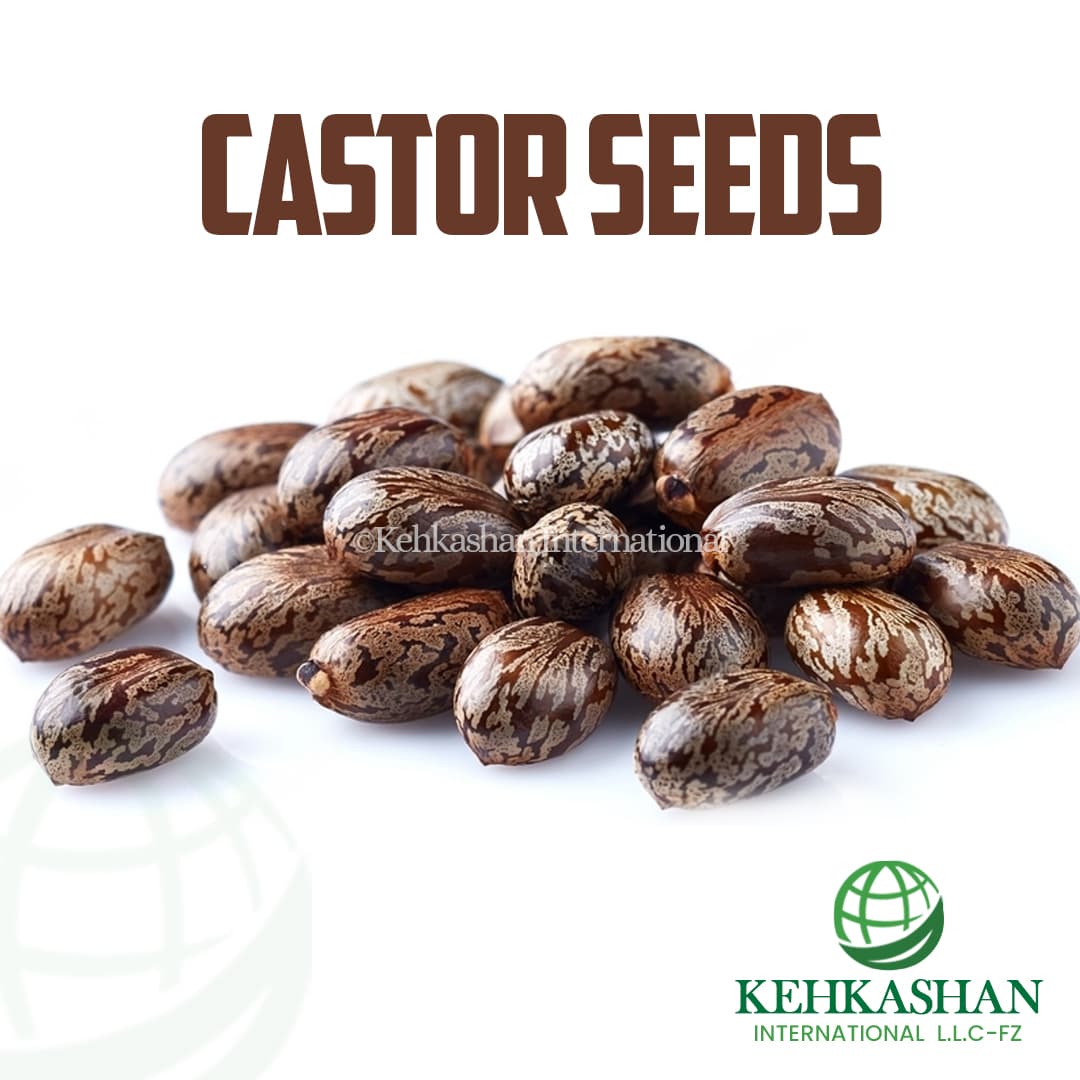
Castor seeds (Ricinus communis) come primarily from India, Brazil, Mozambique, China and Ethiopia. Buyers specify oil content 48 to 52 percent, ricinoleic acid 87 to 91 percent of oil, free fatty acid below 2 percent, moisture below 6 percent. MOQ is one 20-foot full-container load at 22 to 24 metric tons. Lead times Karachi to Hamburg are 21 to 28 days.
Why castor is the industrial-chemicals crop most commodity buyers underestimate
Castor (Ricinus communis) sits in an unusual category. Unlike most of the oilseeds in the global export trade, the demand pull is almost entirely industrial — castor oil and its derivatives (sebacic acid, undecylenic acid, hydrogenated castor oil, ricinoleic acid, polyols for polyurethane production) are critical inputs to a wide range of industrial value chains, from synthetic lubricants and aviation hydraulic fluids to pharmaceutical excipients, cosmetic surfactants, biopolymer feedstocks, and ricin-resistant industrial coatings. The downstream industrial buyers care about specific oil-composition properties (ricinoleic acid percentage, hydroxyl value, iodine value) that are unique to castor among commercial oilseeds, and they pay accordingly for spec-consistent supply.
The supply side is dominated by India — roughly 85 percent of global commercial castor production by volume per FAOSTAT castor oilseed production data — with significant production in Brazil, Mozambique, China, and Ethiopia. Pakistan's castor cultivation is small relative to Indian production, but Kehkashan operates re-export and consolidation channels into Indian Gujarat supply for buyers who want a Free Zone routed delivery rather than direct-from-Mumbai shipment.
This guide walks through the global supply matrix, the oil-composition specifications that drive industrial pricing, the variety-code library (with deep-dive cross-link to our companion castor-variety-codes pillar), and the documentation set we run on every Kehkashan container. For the deep-dive on Indian castor variety codes (GCH-7, DCH-32, TMV-5, etc.), see /insights/castor-seed-variety-codes-explained.
Where commercial castor comes from
India. The dominant origin, with roughly 85 percent of global production by volume per APEDA castor seed export data. Concentrated in Gujarat (Banaskantha, Mehsana, Sabarkantha, Patan districts), with smaller production in Rajasthan, Andhra Pradesh, Telangana and Karnataka. Indian castor is mostly hybrid-variety with oil content 48 to 52 percent and ricinoleic acid 87 to 90 percent of oil. Ships from Mumbai (Nhava Sheva), Mundra and Kandla. The Gujarat castor crushing-and-extraction industry processes the bulk of Indian production into crude castor oil for export to industrial buyers.
Brazil. Concentrated in the Bahia, Minas Gerais and Ceará states. Brazilian castor is mostly cultivated by smallholder farmers under government-supported sustainable-agriculture programs. Oil content 47 to 50 percent. Ships from Salvador and Santos. Brazilian production has declined since 2010 as cotton and soybean production has expanded into former castor zones.
Mozambique. Concentrated in the Tete, Manica, Sofala and Zambézia provinces. Mozambican castor is wild-collected and small-plot cultivated, with oil content 46 to 49 percent. Ships from Beira and Maputo. Smaller volume but a growing share of global supply.
China. Concentrated in Inner Mongolia, Liaoning, Henan, Shandong, and Sichuan provinces. Chinese castor production serves the substantial domestic crushing-and-extraction industry, with limited but growing export volume. Ships from Tianjin and Shanghai.
Ethiopia. Concentrated in the Wollega, Tigray, Amhara and SNNPR regions. Ethiopian castor is wild-collected and small-plot cultivated, with oil content 47 to 50 percent. Ships from Djibouti.
The five origins together produce roughly 1.6 to 2.0 million metric tons of castor seed annually, with maybe 30 to 40 percent reaching international export markets after domestic crushing absorption.
Oil composition specifications drive industrial pricing
Industrial castor oil buyers care about four oil-composition properties more than any other variable on the RFQ:
- Oil content of seed — by Soxhlet extraction, expressed as percent of dried-seed weight. Standard commercial range 47 to 52 percent. Premium hybrid varieties from Indian Gujarat reach 50 to 52 percent.
- Ricinoleic acid content of oil — by gas chromatography, expressed as percent of total fatty acid composition. Standard 87 to 90 percent. Premium hybrids and well-managed harvests reach 90 to 91 percent. Below 87 percent the oil is suboptimal for the major industrial derivatization pathways as defined in Codex Alimentarius CXS 210-1999 for specified vegetable oils.
- Hydroxyl value — measure of the hydroxyl groups available for chemical derivatization. Standard 160 to 168 mg KOH/g for crude castor oil.
- Iodine value — measure of unsaturation. Standard 82 to 90 g I/100g for crude castor oil.
Additional secondary specifications include free fatty acid (FFA, below 2 percent for premium grade), color (Gardner scale, lower numbers indicate clearer oil), unsaponifiable matter (below 0.8 percent), moisture, and acid value.
For whole-seed buyers (industrial crushing operations doing their own extraction), the oil-content specification is the primary driver. For crude-oil and refined-oil buyers, the full oil-composition panel becomes the price-determining factor.
Variety-code vocabulary on the Certificate of Variety
The Indian castor variety library includes both hybrid F1 varieties (the dominant commercial tier) and open-pollinated cultivars. Notable codes include GCH-7, GCH-5, DCH-32, TMV-5, TMV-6, TMV-Ch-1, GAUCH-1, and several private-sector hybrid releases. For a complete decoding of the variety codes and their oil-content and yield characteristics, see our companion pillar at /insights/castor-seed-variety-codes-explained.
For most industrial castor oil buyers, the hybrid-vs-open-pollinated and the specific origin (Gujarat vs other Indian states vs Brazilian vs Mozambican) matter more than the specific variety code, because the oil-composition specification is what the downstream chemistry depends on.
Container math, MOQ, and pricing
Castor seed is medium-density. A 20-foot full-container load holds:
- 22 to 24 metric tons of whole castor seed in 25 kg or 50 kg PP woven bags
- 18 to 22 metric tons of crude castor oil in 200 kg HDPE drums
- 18 to 22 metric tons of refined castor oil in 200 kg HDPE drums
MOQ tiers as we run them at Kehkashan (consolidating from Indian Gujarat supply through Free Zone routing):
- 500 kg starter — minimum order for whole seed, fits LCL consolidation
- 5,000 kg — break-even on a 20-foot LCL with consolidated shipping
- 22,000 kg+ — full 20-foot FCL of single-grade whole seed
- 200 kg starter for crude oil in single drums
- 18,000 kg+ — full 20-foot FCL of crude or refined oil
Pricing tiers (FOB Free Zone consolidation or Mumbai, indicative, 2026):
- Whole castor seed (Indian standard hybrid, 48-50% oil): 0.80-1.10 USD/kg
- Whole castor seed (premium hybrid, 50-52% oil): 1.05-1.40 USD/kg
- Whole castor seed (Brazilian, Mozambican, Ethiopian): 0.95-1.30 USD/kg
- Crude castor oil (BSS grade, free fatty acid below 2%): 1.30-1.80 USD/kg
- Refined castor oil (RSS grade, food and pharma input): 1.80-2.50 USD/kg
- Hydrogenated castor oil (12-HSA precursor): 2.50-3.40 USD/kg
- First-grade castor oil (premium pharma/cosmetic): 2.20-3.00 USD/kg
Documentation set on every shipment
Every Ricinus communis container leaves Free Zone consolidation or Mumbai with the standard export pack:
- Bill of lading
- Commercial invoice and packing list
- Certificate of Origin (Pakistan Chamber of Commerce for Free Zone routing, Indian Chamber for direct Mumbai shipment)
- Phytosanitary certificate
- Certificate of Analysis (oil content, ricinoleic acid, hydroxyl value, iodine value, FFA, moisture, color, unsaponifiable matter)
- Health certificate (PSQCA equivalent for whole seed; food-grade health certificate for refined oil)
- Form A or EUR.1 origin certificate where preferential tariff applies
- Fumigation certificate (mandatory for EU and US)
- MSDS (Material Safety Data Sheet) for crude and refined oil shipments
- Hazardous-classification declaration (castor seed contains residual ricin and is regulated as a hazardous bulk cargo on certain routes — MSDS and shipping declarations must reflect this)
EU pharmaceutical-grade buyers may require a Certificate of Suitability to the European Pharmacopoeia (CEP) on refined castor oil and hydrogenated castor oil grades.
Lead times by destination port
| Destination port | Country | Ocean transit | Typical Incoterm |
|---|---|---|---|
| Hamburg | Germany | 21-28 days | CIF / DAP |
| Rotterdam | Netherlands | 21-28 days | CIF / DAP |
| Antwerp | Belgium | 22-28 days | CIF / DAP |
| Felixstowe | United Kingdom | 21-28 days | CIF / DAP |
| Marseille | France | 22-28 days | CIF |
| Genoa | Italy | 22-28 days | CIF |
| New York | United States | 28-35 days | CIF |
| Long Beach | United States | 32-40 days | CIF |
| Houston | United States | 32-38 days | CIF |
| Tokyo | Japan | 24-30 days | CFR |
| Busan | South Korea | 21-28 days | CFR |
| Shanghai | China | 18-24 days | CFR |
| Santos | Brazil | 28-35 days | CIF |
Whole castor seed shipments require explicit hazardous-cargo handling on certain routes due to residual ricin in the seed coat — the IMDG (International Maritime Dangerous Goods) classification applies and shipping booking must reflect this. Refined castor oil shipments do not carry the same hazardous-cargo restriction. EU buyers running pharmaceutical-grade refined castor oil specify temperature-controlled stowage to preserve hydroxyl-value spec consistency.
Demand-side pulls — who buyers actually are
Six end-use segments drive global castor demand, each with distinct oil-composition specs and pricing tolerances:
Industrial chemical derivatization (sebacic acid, undecylenic acid, polyols). US, EU, China, India industrial-chemical manufacturers running castor-oil-based derivative production. Spec emphasis on ricinoleic acid percentage and hydroxyl value. Volumes 5,000 to 50,000 ton annual programs per plant. Largest single demand pull globally.
Synthetic lubricant and aviation hydraulic fluid manufacturers. US, EU, Russian, and Chinese specialty-lubricant manufacturers using hydrogenated castor oil and ricinoleic acid derivatives in high-temperature aviation hydraulic fluids and racing-engine lubricants. Spec emphasis on free fatty acid, hydroxyl value consistency, and color. Volumes 500 to 5,000 ton annual programs.
Pharmaceutical excipient and laxative industry. US, EU, Indian pharmaceutical manufacturers using refined castor oil in pharmacopoeia-grade laxative formulations and excipient applications. Spec emphasis on EP/USP/JP-compliant refining and CEP certification.
Cosmetic and personal-care surfactant manufacturers. EU, US, Korean, and Japanese cosmetic manufacturers using castor-oil derivatives (PEG-castor oil, hydrogenated castor oil, ricinoleate) in shampoo, cleanser, lipstick, mascara, and skincare formulations. Volumes 500 to 5,000 ton annual programs.
Biopolymer and bioplastic feedstock manufacturers. EU, US, and Asian bioplastic-feedstock manufacturers using castor-oil polyols in bio-based polyurethane production. Growing segment with 5- to 10-percent annual demand growth rate.
Animal-feed industrial buyers (dehulled castor cake). Decorticated and detoxified castor cake (after oil extraction and ricin inactivation) as a high-protein animal feed input. Smaller volume but stable demand from Indian and African feed-mill operations.
Competition map — who buyers usually go to
The castor export trade is concentrated. Notable named players:
- Jayant Agro-Organics (Indian Mumbai-based, world's largest castor-derivatives manufacturer)
- Adani Wilmar (Indian, large multi-oilseed trader)
- Gokul Refoils (Indian Gujarat, large castor crushing capacity)
- Royal Industries (Indian, castor derivative chemistry)
- Ittehad Chemicals (Pakistan, castor-derivative manufacturing)
- NK Industries (Indian, castor crushing and derivatives)
- Vegetable Vitamin Foods (Indian, castor and other oilseeds)
- Itochu Corporation (Japan, large multi-origin trader)
- Cargill and Bunge (multi-origin, multi-oilseed)
For buyers running diligence, the differentiators between credible suppliers and marketplace listings are:
- Oil-composition transparency — a credible exporter can produce a full gas-chromatography analysis of the oil composition (ricinoleic acid, hydroxyl value, iodine value, color, FFA) from an internationally recognized lab on the lot or shipment offered.
- Hazardous-cargo compliance — for whole-seed shipments, the supplier must run the IMDG documentation and hazardous-cargo booking discipline. Marketplace listings that ignore this are not viable for compliant buyers.
- Refining-process disclosure — for refined-oil buyers, the refining-process chemistry and quality-control records must be available. EP/USP-grade material requires specific refining and bleaching disciplines that not all suppliers can deliver consistently.
- Lot consistency across multiple shipments — for industrial-derivative manufacturers running standardized chemistry, oil-composition consistency across multiple shipments is the paramount specification.
We document each of these on every Kehkashan castor shipment. Sample lots of 1 to 5 kg (whole seed) or 250 ml (oil) are couriered to qualified buyers; the sample fee credits against the first PO on acceptance.
When to buy ahead vs spot
Indian castor harvest runs January through April. Brazilian harvest runs August through November. Mozambican and Ethiopian harvests run September through December. Quality assessment finishes 60 days post-harvest, and the year's pricing band stabilizes by June for Indian-origin and by February for Southern Hemisphere origins.
Annual contracts booked in May-June at fixed prices typically secure 8 to 15 percent better pricing than spot purchases through the year, plus guaranteed availability of the specified oil-composition spec. For industrial-derivative manufacturers running standardized chemistry against guaranteed ricinoleic-acid percentage, the annual-contract route is essentially mandatory — spot supply rarely matches the spec consistency these buyers need.
For lubricant, cosmetic surfactant, and pharmaceutical buyers running smaller programs, mid-year purchases of 500 to 2,000 ton lots through the year work reliably, particularly for refined-oil grades.
Trade desk closing note
Castor is one of those crops where the supplier's relationship with the crushing-and-refining infrastructure is more important than the supplier's brochure. The difference between a generic crude castor oil at 1.40 USD/kg and a pharmaceutical-grade refined castor oil at 2.50 USD/kg is mostly in the refining discipline and the lot-level oil-composition documentation. We work with consolidator partnerships into Indian Gujarat crushing-and-refining capacity, plus alternate supply into Brazilian Bahia and Mozambican Tete origins for buyers needing those specifically.
For a quote, send the six RFQ specs (whole seed or oil grade, oil-composition spec preferences, origin preference, MSDS and hazardous-cargo requirements, organic certification yes/no, quantity) to [email protected]. The trade desk replies within one working day with FOB Free Zone or Mumbai, CFR your-destination-port, CIF, and DAP options. For the deep dive on Indian castor variety codes, see /insights/castor-seed-variety-codes-explained.


