Paliers MOQ
| Palier | Quantité | Note |
|---|---|---|
| Trial | 1,000 kg LCL | — |
| Standard FCL | 1 × 20'FCL ≈ 22–24 MT | — |
| Mixed FCL | Mescavi + Balady + Fahl on one BL | — |
| Programme | 10–25 × 20'FCL / season | — |
Kehkashan exports berseem (Egyptian) clover (Trifolium alexandrinum) seeds from origin partners in Egypt, Pakistan, and India — supplied in bulk FCL or LCL with FOB Jebel Ali, CFR, or CIF terms to irrigated-lowland forage and dairy buyers across MENA, Africa, and South Asia in 80+ destinations.
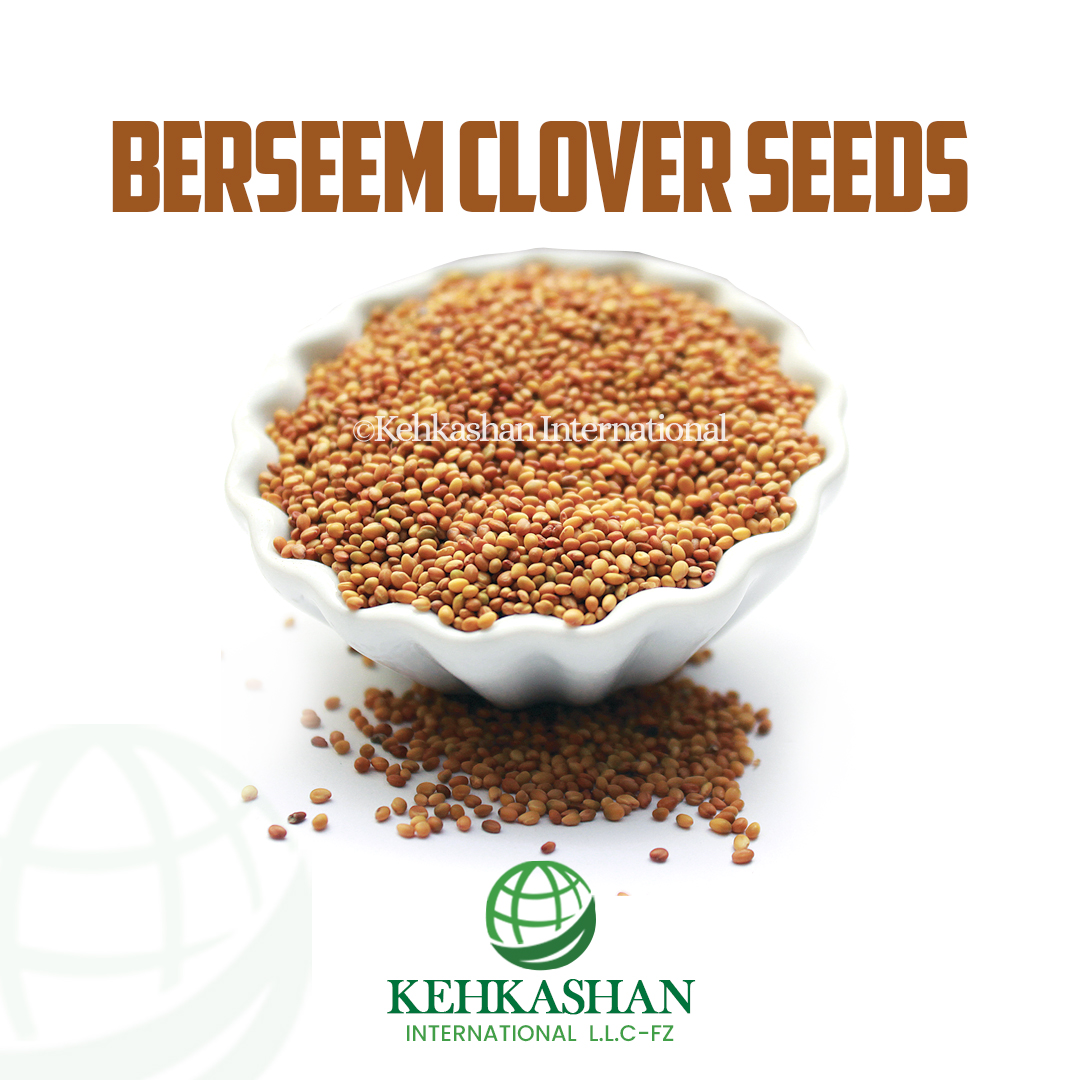
Reference image. Sample lots and product-specific photography available on RFQ.
| Palier | Quantité | Note |
|---|---|---|
| Trial | 1,000 kg LCL | — |
| Standard FCL | 1 × 20'FCL ≈ 22–24 MT | — |
| Mixed FCL | Mescavi + Balady + Fahl on one BL | — |
| Programme | 10–25 × 20'FCL / season | — |
| Grade | Fourchette indicative |
|---|---|
| Egyptian Mescavi (multi-cut) | RFQ — premium tier |
| Egyptian Balady (single-cut) | RFQ — entry tier |
| Egyptian Fahl (winter cover) | RFQ — mid tier |
| Pakistani / Indian re-multiplied | RFQ — value tier |
| Port de déchargement | Transit | Incoterm |
|---|---|---|
| Alexandria (Egypt, FOB) | 0 days | FOB |
| Jebel Ali (UAE) | 8–12 days | CFR / CIF |
| Jeddah Islamic Port (KSA) | 12–18 days | CFR / CIF |
| Mombasa (Kenya) | 20–28 days | CFR / CIF |
| Karachi (Pakistan) | 14–20 days | CFR / CIF |
Chaque conteneur quitte la zone franche des EAU avec le pack documentaire ci-dessous. Des certificats supplémentaires (Halal, SASO, BRC, bio, FairWild, etc.) sont ajoutés sur demande avant le chargement.
Certified Egyptian berseem is multiplied in Sharqia, Beheira, and Kafr El-Sheikh governorates and loads at Alexandria or Damietta. Saudi and Emirati dairy pivots specify Egyptian Mescavi. Sudanese and Yemeni hay growers ask for single-cut Saidi. Price-led programmes in Kenya, Iraq, and Central Asia take re-multiplied Sindh or Indian Punjab lots consolidated at Jebel Ali.
Egyptian certificates spell the multi-cut type Mescavi, Meskawi, or Miskawi; all refer to the same basally branching variety. Saidi and Balady are the single-cut Upper Egypt and landrace types with apical branching. Fahl is the winter-cover type. Bigbee and Frosty are Mississippi and cold-tolerant United States releases; Sonora is the Mediterranean multi-cut line.
An Egyptian berseem COA lists variety by name, purity at 98 to 99 percent, germination at 85 percent minimum on a seven-day count, and 9 to 11 percent moisture. Weed seed is itemised: Cuscuta, Striga, Sinapis arvensis, and Avena fatua declared absent. The ISTA date falls within 90 days of production, not shipment.
Saudi and Emirati pivot dairies run Mescavi from October to April for four to six green-chop cuts. Pakistani Sindh and Indian Punjab growers sow berseem into rice fallow for nitrogen and winter fodder. Iraqi feedlots in Diyala and Najaf chop it for beef finishing. Sudanese hay traders bale Saidi for Khartoum markets.
Egyptian berseem sails Alexandria or Damietta to Jebel Ali in 8 to 12 days via Suez. Direct Alexandria to Jeddah runs 12 to 18 days, to Mombasa 20 to 28 days. Transhipment at Jebel Ali takes 24 to 72 hours, then Umm Qasr is 4 to 6 days and Dammam 7 to 10 days.
Berseem is quoted against an RFQ as FOB Damietta, FOB Jebel Ali, CFR, or CIF destination. Price moves on variety (Mescavi above Saidi and Balady), purity above 99.5 percent, current-crop versus carryover after May-to-July harvest, and container count per programme. Gulf buyers negotiate CFR Jeddah or Dammam with 30 to 60 day validity.
The lot number traces to named fields in Sharqia or Beheira, and the dodder-free certificate names the cleaning facility. A 1 to 2 kilogram sample goes for buyer germination testing. After approval the proforma opens against LC at sight, and container stuffing at Alexandria or Jebel Ali is photographed with seal numbers recorded.
A 20-foot FCL carries 22 to 24 metric tonnes of berseem in 25 kilogram PP bags, or 20 tonnes in 50 kilogram jute. A 40-foot high-cube reaches 26 to 27 tonnes. Mescavi, Balady, and Fahl share one container and bill of lading. FIBC bulk bags suit pivot dairies; LCL trials start at 1,000 kilograms.
Saudi Arabia requires a MEWA seed-import permit and rejects any berseem lot lacking a dodder-free certificate, whatever the purity figure. Kenya issues a KEPHIS plant import permit and tests germination at Mombasa. Pakistan's Department of Plant Protection inspects at Karachi and requires an Egyptian phytosanitary certificate plus fumigation.
Réponses aux questions les plus fréquentes posées par les acheteurs lors d'un RFQ ou d'une évaluation d'expédition d'essai.
Guides détaillés rédigés par le bureau commercial Kehkashan pour les acheteurs et les équipes achats — arbitrages d'origine, codes variétés et flux documentaires.
trade brief
How Egyptian berseem (Trifolium alexandrinum) moves via Mediterranean ports, consolidates at Jebel Ali, and re-ships to Gulf, African and Central Asian buyers.
trade brief
Trade-desk reference for clover seed importers: Persian, Berseem, Red, White, Crimson — Pakistani and European origin economics, ISTA bands, dodder-freedom.
Principales destinations
Produits associés
Du bureau commercial
Réponse au RFQ sous 24 heures. FOB Jebel Ali, CFR, CIF ou DAP. LC at sight, TT ou DP.
Expédition depuis Jebel Ali. Délai 14–21 jours. RFQ sous 24 h.