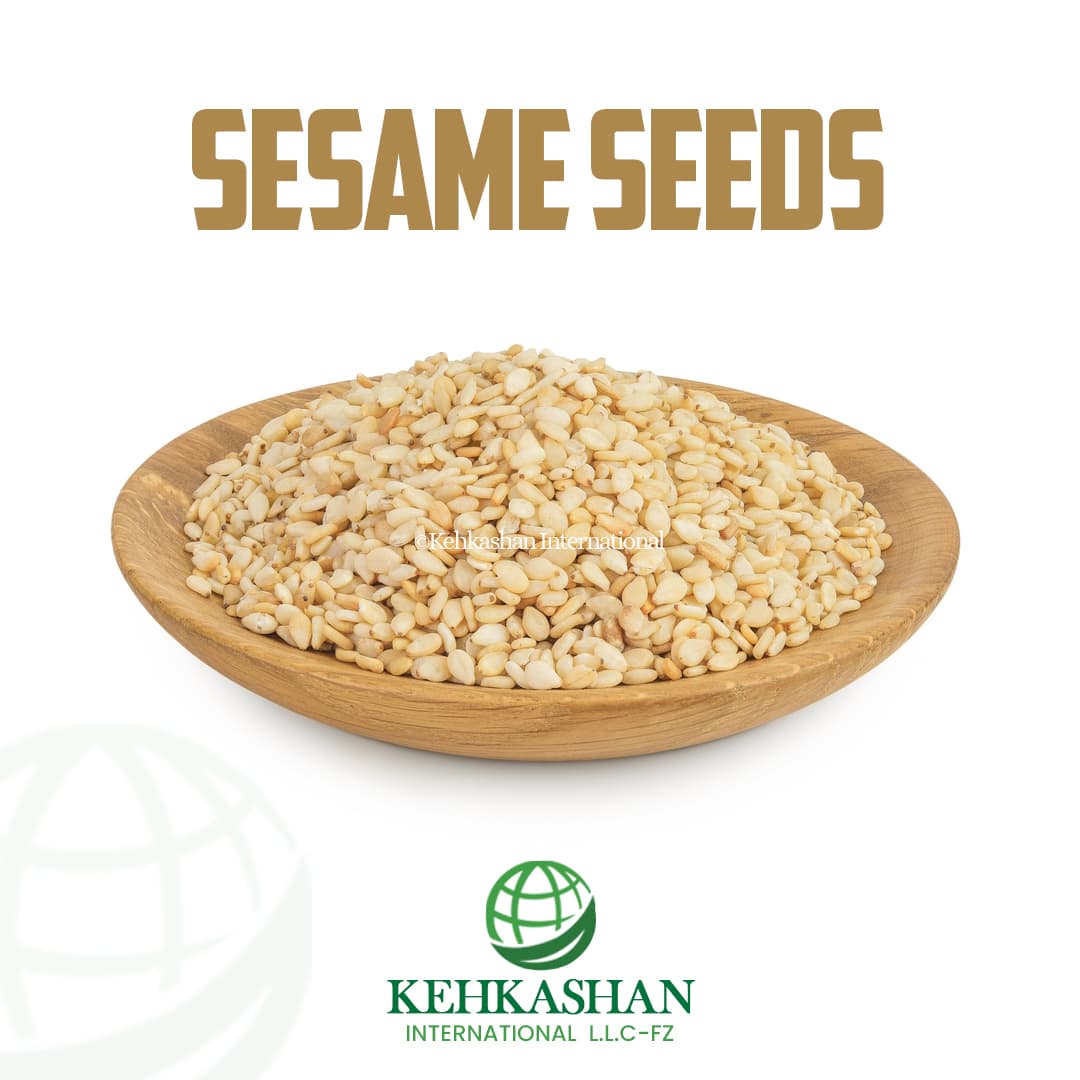
Sesame seeds (Sesamum indicum) come primarily from Sudan, Ethiopia, Nigeria, India, Pakistan, Türkiye and Mexico. Buyers specify color (white, brown, black), hulled vs natural, oil content 48 to 55 percent, sortex grade, EU aflatoxin compliance, and moisture below 6 percent. MOQ is one 20-foot full-container load at 22 to 24 metric tons. Lead times Karachi to Hamburg are 21 to 28 days.
Why sesame is the largest oilseed export trade most buyers misprice
Sesame is the third-largest oilseed in the global export trade by value (after soybean and palm), and it is also the most consistently mispriced category on B2B marketplace listings. The reason is that sesame is sold across at least eight separate value chains — bakery seed, hulled sesame, tahini-grade, sesame oil industrial extraction, Korean and Japanese premium roasted-oil tier, Mexican confectionery, Turkish helva industry, and Chinese black-seed traditional medicine — and each chain has its own specification language, color preference, sortex grade tolerance, and pricing band. A "sesame seed FOB Karachi 1.40 USD/kg" quote can be a perfectly reasonable bakery-grade price or a wildly incorrect tahini-grade price depending on which chain the buyer operates in.
This guide walks through the seven origin countries that dominate the global export trade, the color and grade vocabulary that drives pricing, and the documentation set we run on every Kehkashan container. For the deep-dive on optical sortex grading specifically, see our companion pillar at /insights/sortex-grade-sesame-seeds-margin-impact.
Where commercial sesame comes from
Sudan. Historically the largest single-origin producer globally, with cultivation across the Gedaref, Kassala, Blue Nile, Sennar and White Nile states. Sudanese sesame is mostly white-natural, with high oil content (52 to 55 percent) and excellent flavor profile for tahini. Ships from Port Sudan. Volumes have been disrupted by conflict and supply-chain dislocations since 2023, with substantial pricing volatility.
Ethiopia. Concentrated in the Humera and Wollega regions of Tigray and Western Ethiopia. Humera sesame commands the global premium tier — bright white seed, intensely sweet flavor profile, oil content 53 to 56 percent. The reference origin for premium tahini and Japanese bakery buyers paying top-band pricing. Ships from Djibouti.
Nigeria. Concentrated in the Benue, Nasarawa, Jigawa and Kano states. Nigerian sesame runs both white and brown varieties, with oil content 49 to 53 percent. Ships from Lagos (Apapa and Tin Can).
India. Cultivation across Gujarat, Madhya Pradesh, Rajasthan, Andhra Pradesh, Tamil Nadu, and Karnataka. Indian sesame produces all three color types (white, brown, black). White sesame from Saurashtra (Gujarat) is the major Indian export tier. Black sesame from Madhya Pradesh and Tamil Nadu serves Korean and Japanese premium-oil buyers. Ships from Mumbai (Nhava Sheva), Mundra, Kandla, and Tuticorin.
Pakistan. Cultivation across Punjab (Multan, Bahawalpur, Rahim Yar Khan, Khanewal) and Sindh. Pakistani sesame is mostly white-natural with oil content 50 to 53 percent and a flavor profile suited to Middle Eastern tahini and EU bakery markets. Ships from Karachi — TDAP publishes annual sesame export volumes by HS-1207.40. This is Kehkashan's primary origin — direct cooperative relationships in the Multan and Bahawalpur corridors.
Türkiye. Smaller producer than the African and Indian origins, but a major sesame-processing and re-export hub. Concentrated in the Şanlıurfa and Antalya provinces. Turkish helva industry absorbs much of the domestic and imported supply. Ships from Mersin and Izmir.
Mexico. Smallest of the major commercial origins. Concentrated in Sinaloa, Sonora, Michoacán and Oaxaca. Mexican sesame serves Mexican confectionery and US-southwest specialty markets. Ships from Manzanillo and Veracruz.
The seven origins together produce roughly 6 to 7 million metric tons of sesame annually per FAOSTAT HS-1207.40 production data, with maybe 40 to 50 percent reaching international export markets after domestic oil and confectionery absorption.
Color and variety separation — the spec that drives everything
Sesame ships in three primary color types, and they are not interchangeable across most end-use channels.
White sesame. The largest commercial color by volume. Used in bakery (US bagels, EU sesame buns, Japanese pastry), tahini and halva manufacturing, sesame oil industrial extraction, and confectionery. Ethiopian Humera, Sudanese white-natural, and Indian Saurashtra are the premium tiers. Pakistani, Nigerian, and Mexican white sesame serves the cost-competitive bakery and oil-extraction tiers.
Brown sesame. A distinct commercial color (not unhulled white sesame) with darker pigmentation in the seed coat. Used in Indian and Pakistani culinary applications, North African baked goods, and some Mediterranean confectionery. Smaller volume than white globally.
Black sesame. Used in Korean and Japanese premium roasted-oil applications, Chinese traditional-medicine herbal preparations, US and EU specialty bakery (sesame-noodle dressing, black-sesame ice cream, decorative culinary inclusion), and Indian Ayurvedic preparations. Indian Madhya Pradesh and Tamil Nadu, plus Chinese-origin material, dominate the global supply. Premium pricing applies — black sesame typically commands 20 to 50 percent over white sesame at equivalent grades.
Mixed-color sesame is sold for industrial oil extraction and lower-value applications where color specification is irrelevant.
Hulled vs natural — the second specification that drives everything
The other primary specification axis is whether the seed is hulled (seed coat removed) or natural (seed coat intact).
Hulled sesame. Mechanically dehulled to remove the seed coat, leaving the bright white inner kernel. Used in bakery, tahini, halva, confectionery, and sesame-oil applications where the seed coat would impart bitterness or color contamination. Hulling reduces yield by roughly 22 to 28 percent of the natural seed weight (the discarded hull becomes a separate animal-feed by-product), so hulled sesame FOB pricing runs 25 to 40 percent over equivalent natural-grade pricing.
Natural sesame. Seed coat intact. Used where the slight bitterness and color contribution of the seed coat is desired or where downstream processing (oil extraction, full-seed bakery applications) does not require hulling.
Within both hulled and natural categories, sortex grade further divides the trade — see our companion pillar for the optical-sortex grading deep-dive.
Grade vocabulary on the Certificate of Analysis
A clean sesame CoA carries seven fields beyond color and hulled/natural declaration:
- Color and variety — white, brown, black; specific origin variety where applicable (Ethiopian Humera, Indian Saurashtra, Sudanese Gedaref, etc.).
- Hulled or natural — explicit declaration with hulling-method declaration (mechanical, water-bath, chemical).
- Sortex grade — typically 99 percent, 99.5 percent, 99.95 percent (premium tahini and Japanese bakery tier).
- Oil content — by Soxhlet extraction, expressed as percent of dried-seed weight. Standard 48 to 55 percent.
- Free fatty acid (FFA) — below 2 percent for food-grade. Older or improperly stored seed develops higher FFA and reduced oil yield in extraction.
- Moisture — below 6 percent for shipped grade. Bulk lots above 6 percent risk fungal degradation and oxidation.
- Aflatoxin and ochratoxin A — below EU regulatory limits per Regulation 1881/2006 on contaminants in foodstuffs. Aflatoxin is a particularly common rejection cause for sesame at EU and Japanese ports — RASFF notification records for sesame show recurring port-level interceptions on this commodity.
Buyers add heavy metals testing (lead, cadmium, mercury, arsenic), pesticide residue panels (EU Annex A and B), salmonella testing for food-grade, and in some pharmaceutical applications a Certificate of Suitability to the European Pharmacopoeia.
Container math, MOQ, and pricing
Sesame is small (1,000-seed weight ~3 to 4 grams) and very high-density. A 20-foot full-container load holds 22 to 26 metric tons in 25 kg or 50 kg multi-layer kraft bags or PP woven bags with food-grade liner.
MOQ tiers as we run them at Kehkashan:
- 500 kg starter — minimum order, fits LCL consolidation
- 5,000 kg — break-even on a 20-foot LCL with consolidated shipping
- 22,000 kg+ — full 20-foot FCL of single-grade material
- 26,000 kg+ — full 40-foot FCL for high-volume bakery, tahini, or oil-extraction buyers
Pricing tiers (FOB Karachi, indicative, 2026):
- Natural sesame, mixed-color industrial-extraction grade: 1.20-1.50 USD/kg
- Natural sesame, white 99% sortex (Pakistani standard): 1.40-1.80 USD/kg
- Natural sesame, white 99.5% sortex (premium bakery): 1.70-2.20 USD/kg
- Natural sesame, white 99.95% sortex (premium tahini, Japanese bakery): 2.10-2.80 USD/kg
- Natural sesame, Ethiopian Humera premium: 2.30-3.10 USD/kg
- Hulled sesame, white 99% sortex: 1.90-2.40 USD/kg
- Hulled sesame, white 99.95% sortex (premium tahini, Japanese): 2.60-3.50 USD/kg
- Black sesame, Indian premium: 2.10-2.90 USD/kg
- Brown sesame, Indian and Pakistani: 1.50-2.00 USD/kg
- Organic-certified premium: add 0.40-0.80 USD/kg over standard tier
Documentation set on every shipment
Every Sesamum indicum container leaves Karachi with the standard export pack:
- Bill of lading
- Commercial invoice and packing list
- Certificate of Origin (Pakistan Chamber of Commerce)
- Phytosanitary certificate (Department of Plant Protection)
- Certificate of Analysis (color, variety, hulled/natural, sortex grade, oil content, FFA, moisture, aflatoxin, heavy metals, pesticide residue)
- Health certificate (PSQCA equivalent)
- Form A or EUR.1 origin certificate where preferential tariff applies
- Fumigation certificate (mandatory for EU and US, optional for GCC)
- Salmonella absence certificate (mandatory for EU food-grade and Japanese bakery destinations)
- Hulling-process declaration (mechanical, water-bath, chemical) where applicable
EU pharmaceutical buyers may require a Certificate of Suitability to the European Pharmacopoeia (CEP). EU organic-certified buyers add the EU-organic transaction certificate per shipment.
Lead times by destination port
| Destination port | Country | Ocean transit | Typical Incoterm |
|---|---|---|---|
| Hamburg | Germany | 21-28 days | CIF / DAP |
| Rotterdam | Netherlands | 21-28 days | CIF / DAP |
| Felixstowe | United Kingdom | 21-28 days | CIF / DAP |
| Marseille | France | 22-28 days | CIF |
| Genoa | Italy | 22-28 days | CIF |
| Mersin | Türkiye | 12-16 days | CFR / CIF |
| Jeddah | Saudi Arabia | 5-8 days | CFR / CIF |
| Hamad | Qatar | 3-5 days | CIF |
| New York | United States | 28-35 days | CIF |
| Long Beach | United States | 32-40 days | CIF |
| Tokyo | Japan | 24-30 days | CFR |
| Yokohama | Japan | 24-30 days | CFR |
| Busan | South Korea | 21-28 days | CFR |
| Manzanillo | Mexico | 32-40 days | CIF |
| Mumbai | India | 7-10 days | CFR |
Most sesame shipments move at standard ambient with humidity-controlled stowage requirements specified on the booking note. Hulled sesame and high-sortex-grade premium lots use nitrogen-flush packaging on the long-haul Japanese and US-West-Coast routes for color-retention insurance.
Demand-side pulls — who buyers actually are
Six end-use segments drive global sesame demand, each with distinct color, grade and pricing tolerances:
Middle Eastern tahini and halva industry. Saudi Arabia, UAE, Egypt, Jordan, Lebanon, Türkiye, Israel, Greece. White-hulled high-sortex-grade sesame for tahini and halva manufacturing. Buyers run 1,000 to 20,000 ton annual programs through national food-input distributors and direct supplier relationships.
EU and US bakery industry. Sesame-bun and sesame-bagel manufacturers, plus general bakery and confectionery using sesame inclusions. Spec emphasis on white-natural or hulled sesame at standard 99 to 99.5 percent sortex grade. Volumes 500 to 5,000 ton annual programs.
Japanese and Korean premium bakery and oil industry. Highest-grade tier globally. Spec emphasis on white 99.95 percent sortex Ethiopian Humera or Indian premium plus black sesame for premium roasted-oil applications. Volumes are smaller but pricing premium is substantial.
US and EU sesame-oil industrial extraction. Industrial oil-extraction plants buying natural sesame at the lower-grade tier for bulk oil production. Volumes are large (5,000 to 50,000 ton annual programs per plant) but pricing tolerance is tight.
Mexican confectionery industry. Mexican palanqueta and dulce confectionery using natural and hulled sesame. Volumes 1,000 to 5,000 ton annual programs through Mexican confectionery distributors.
Indian and Asian Ayurvedic and traditional-medicine. Black sesame for Ayurvedic, traditional Chinese medicine, and Korean herbal preparations. Volumes are fragmented across many smaller buyers.
Competition map — who buyers usually go to
The sesame export trade is concentrated at the African origin level (Sudan, Ethiopia, Nigeria) and fragmented at the Asian origin level (India, Pakistan, Türkiye). Notable named players: ETG (Export Trading Group, large multi-origin trader), AgriCom (Switzerland-based, large multi-origin), Olam International (Singapore), Cargill, Alfred C. Toepfer International, plus regional Pakistani and Indian exporters and Turkish processors.
For buyers running diligence, the differentiators between credible suppliers and marketplace listings are:
- Color and variety transparency — a credible exporter declares the specific origin variety (Humera, Saurashtra, Sudanese-natural, etc.) plus the harvest cooperative or village-level origin where possible.
- Sortex-grade verification — the optical-sortex grade should be verified by the supplier with a third-party-lab certificate, not just declared on the supplier's CoA.
- Aflatoxin testing per lot — sesame's aflatoxin risk is real and lot-variable. Suppliers running lot-level aflatoxin testing from internationally recognized labs (SGS, Bureau Veritas, Intertek, Eurofins) are materially safer than suppliers offering generic origin certificates.
- Hulling-process disclosure — water-bath hulling can leave residual moisture that drives oxidation and reduces shelf life. Mechanical hulling is the premium method for premium tahini and Japanese bakery tiers.
We document each of these on every Kehkashan sesame shipment. Sample lots of 1 to 2 kg are couriered free of freight to qualified buyers worldwide; the sample fee credits against the first PO on acceptance.
When to buy ahead vs spot
African sesame harvest (Sudan, Ethiopia, Nigeria) runs October through January. Indian and Pakistani harvest runs October through December. Turkish harvest runs August through October. Mexican harvest runs October through December. Quality assessment finishes by late February, and the year's pricing band stabilizes by April.
Annual contracts booked in March-April at fixed prices typically secure 8 to 15 percent better pricing than spot purchases through the year, plus guaranteed availability of the specified color and sortex grade. For tahini, halva, and Japanese bakery brands running standardized retail product against guaranteed grade consistency, the annual-contract route is essentially mandatory.
For industrial oil-extraction and bulk-bakery buyers with looser tolerance, spot purchases of 100 to 500 ton lots through the year work reliably.
Trade desk closing note
Sesame is the highest-volume premium oilseed in the global export trade, and the supplier's color-discipline and sortex-grade-discipline are the primary differentiators between cost-tier marketplace listings and the supplier you want for a standardized retail or food-industrial program. We work with cooperatives in the Multan and Bahawalpur corridors of Punjab, plus consolidator partnerships into Ethiopian Humera, Sudanese-natural, Indian Saurashtra, and Indian-premium black-sesame supply for buyers needing those origins specifically.
For a quote, send the seven RFQ specs (color, hulled/natural, origin preference, sortex grade tier, organic certification yes/no, aflatoxin tolerance, quantity) to [email protected]. The trade desk replies within one working day with FOB Karachi, CFR your-destination-port, CIF, and DAP options. For the deep dive on sortex grading, see /insights/sortex-grade-sesame-seeds-margin-impact.


