Aller au contenu
Kehkashan

Alkanet Roots Exporter & Wholesale Supplier — 35+ Origins, 80+ Destinations

Kehkashan exports alkanet (Alkanna tinctoria) roots from origin partners in Türkiye, Iran, and Pakistan — supplied in bulk FCL or LCL with FOB Jebel Ali, CFR, or CIF terms to natural-dye houses and cosmetic formulators across 80+ destinations.
  • 35+ origins
  • 80+ destinations
  • ISTA / OECD certified
  • LC at sight (USD/EUR)
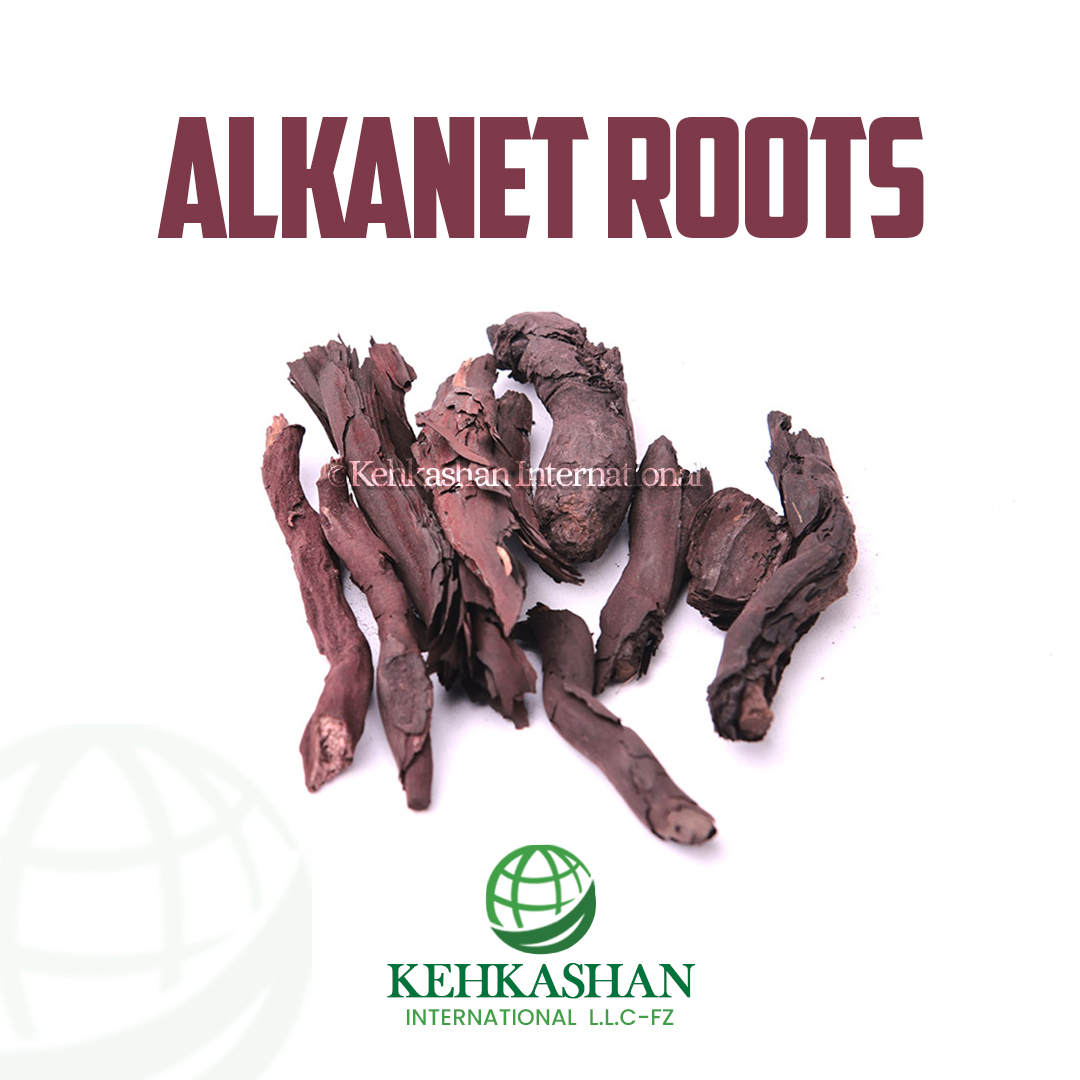
Alkanet Roots — photo du produit Kehkashan International

Reference image. Sample lots and product-specific photography available on RFQ.

Quick facts

Scientific name
Alkanna tinctoria
HS code
1211.90
Common varieties
Origins available
Pakistan, Iran, Turkey, Egypt, India, AF
MOQ
500 kg starter, FCL volumes available
Pack sizes
20 kg PP bag, 25 kg cartons (food / cosmetic grade), 50 kg jute bag
Specs
Color: Deep crimson to maroon, Moisture: < 10%, Grade: Whole roots · Cut · Powdered, Foreign matter: < 1%, End uses: Cosmetic · Culinary · Ayurvedic
Lead time
14–28 days from PO confirmation
Incoterms
FOB Jebel Ali · CFR · CIF · DAP
Payment terms
LC at sight · TT · DP

Spécifications et calcul du conteneur

Paliers MOQ

PalierQuantitéNote
Trial100 kg LCL
Commercial500 kg–2 MT LCL

Bandes de prix FOB (sur demande)

GradeFourchette indicative
Whole roots (cosmetic / dye)RFQ — mid tier
Cut / shredded (extraction)RFQ — entry tier
Powdered (formulators)RFQ — premium tier

Délais — principales destinations

Port de déchargementTransitIncoterm
Karachi (Pakistan, FOB)0 daysFOB
Jebel Ali (UAE)4–6 daysCFR / CIF
Jeddah Islamic Port (KSA)8–12 daysCFR / CIF
Dammam (KSA)7–10 daysCFR / CIF
Mombasa (Kenya)14–20 daysCFR / CIF
Formats d'emballage
20 kg PP bag · 25 kg cartons (cosmetic grade) · 50 kg jute
Capacité du conteneur
LCL typical; FCL on programme

Jeu documentaire par expédition

Chaque conteneur quitte la zone franche des EAU avec le pack documentaire ci-dessous. Des certificats supplémentaires (Halal, SASO, BRC, bio, FairWild, etc.) sont ajoutés sur demande avant le chargement.

  1. Bill of Lading (BL) — original 3/3 set
  2. Commercial Invoice — UAE Free Zone issued
  3. Packing List with lot codes
  4. Certificate of Origin (CoO) — Dubai Chamber attested
  5. Phytosanitary Certificate — origin NPPO
  6. EU Mycotoxin / Aflatoxin test report (per EU 1881/2006)
  7. Heavy-metals test report (Pb, Cd, As, Hg)
  8. Microbiological test (Salmonella, E. coli, total plate count)
  9. Fumigation Certificate
  10. Form A (GSP) where applicable

Origin × spec comparison

Alkanet Roots origin comparison: variety options, fall dormancy, purity, germination, lead time, FOB Jebel Ali price.
OriginVariety optionsFall dormancyPurity %Germination %Lead time to Jebel AliFOB Jebel Ali
PakistanSargodha local · multi-cut hybrid7–998.5–99.0%85% min10–18 daysRFQ
Iran14–28 daysRFQ
Turkey14–28 daysRFQ
EgyptMulti-cut Egyptian · CUF 1018–1098.5–99.0%85% min10–18 daysRFQ
India14–28 daysRFQ
AF14–28 daysRFQ

Indicative figures. Prices and lead times are confirmed at the time of RFQ.

What buyers ask us most

  • Do you supply HarvXtra alfalfa to Saudi Arabia?

    Yes — USA-origin AmeriStand 480 HarvXtra, fall-dormancy 4, ISTA-tested.

  • Can you mix Italian and Australian alfalfa on one PO?

    Yes — multi-origin consolidation at Jebel Ali is our default.

  • What's your germination guarantee?

    90 percent minimum, ISTA-tested COA per shipment.

  • Do you handle phytosanitary, COO, and fumigation?

    Yes — included in CFR, CIF, and DAP terms.

  • What's the MOQ for alfalfa seed versus alfalfa hay?

    Seed MOQ is 1 × 20'FCL (~25 MT). Hay is quoted on inquiry.

Origins we draw alfalfa from, and which buyer prefers which

Saudi Arabia dairy buyers tend to ask for USA-origin AmeriStand 480 HarvXtra and 455TQ Roundup Ready, fall-dormancy 4 to 5. Kenyan smallholder farmers and East African cooperatives prefer Italian and Argentinian fall-dormancy 6 to 8 lots. Russian feed mills source Pakistani and Argentinian alfalfa at lower entry pricing per metric tonne shipped.

What the variety codes actually mean for your field

AmeriStand 403T carries traffic-tolerance traits at fall-dormancy 4. AmeriStand 480 HarvXtra is the reduced-lignin Roundup Ready release for higher-quality dairy hay. WL 525HQ is a fall-dormancy 5 selection from the Forage Genetics International program. CW 5050 is a conventional dormancy-5 line widely used in Italy and Argentina across pivot fields.

Spec language on every alfalfa COA we ship

Every shipment carries an ISTA-format Certificate of Analysis with purity 99.0 to 99.9 percent, germination 90 percent minimum, and a dodder-free declaration. Origin lots from the United States and Australia are OECD-scheme tagged. Sortex cleaning is applied at the packing line where field admixture exceeds 0.5 percent. Hard-seed counts are reported on request.

Fall dormancy ratings 4 to 10 and how to pick the right one

Fall-dormancy 4 to 5 fits temperate Saudi central pivots, Algerian pivot circles, and southern European multi-cut systems. Fall-dormancy 6 to 7 suits Egyptian Delta rotations, Moroccan irrigated valleys, and most Kenyan smallholder programs. Fall-dormancy 8 to 10 is for year-round equatorial dairy operations in East Africa, Sudan, and tropical Latin America.

Use cases: dairy, beef, sheep, and equine forage

Saudi dairy and Gulf dairy operations use HarvXtra reduced-lignin alfalfa for higher relative-feed-value hay. Kenyan and Tanzanian smallholder beef and sheep programs run conventional fall-dormancy 6 to 8 alfalfa in mixed-rotation paddocks. Equestrian buyers in Qatar, Kuwait, and the UAE specify low-dust, double-cleaned WL series lots for stable feed.

Logistics from Jebel Ali to your discharge port

From Jebel Ali, transit to Jeddah and Dammam runs 5 to 8 days. To Mombasa via the Indian Ocean it is 12 to 18 days. Aqaba is 7 to 10 days. Doha and Kuwait are 3 to 5 days. Karachi is 4 to 6 days. Beirut is 10 to 14 days. We consolidate multi-origin alfalfa lots inside one 20 foot or 40 foot container at Jebel Ali before sailing.

Pricing structure: FOB versus CFR versus CIF deltas

We quote FOB Jebel Ali, CFR destination, CIF destination, and DAP door-step on the same RFQ. The FOB-to-CFR delta covers ocean freight only. The CFR-to-CIF delta adds marine insurance at roughly 0.15 percent of invoice plus 10 percent. DAP additionally covers destination port handling, inland trucking, and customs broker handover at your door.

Quality assurance: sample, COA, buyer approval, ship

We courier a one to two kilogram alfalfa sample with a draft Certificate of Analysis. The buyer runs lab confirmation or visual inspection. After signed approval we open the proforma invoice against an LC at sight or TT advance. Container loading happens under our supervisor. Documents are released through your bank.

Buying alfalfa in 20-foot FCL versus 40-foot HC versus LCL

One 20 foot full-container load fits about 24 to 25 metric tonnes of alfalfa seed packed in 25 kilogram PP bags or 50 kilogram jute bags. A 40 foot high-cube takes 26 to 28 metric tonnes. Less-than-container shipments are accepted for trial orders down to roughly 5 metric tonnes consolidated with our Jebel Ali warehouse partner before ocean dispatch.

Documentation set we release per alfalfa shipment

A standard alfalfa export pack includes the ISTA Certificate of Analysis, Certificate of Origin issued by the Dubai Chamber, a phytosanitary certificate from the UAE Ministry of Climate Change and Environment, the bill of lading, the commercial invoice and packing list, and where the destination requires it a fumigation certificate and Form A.

Sanctions, payment, and trade-finance from a UAE Free Zone

Russian feed mills and Iranian buyers benefit from neutral-jurisdiction USD or EUR LC at sight issued from our UAE Free Zone account. We screen each PO against UN, EU, US, and UK sanctions lists before confirming. TT advance and DP collection are accepted for repeat buyers. Saudi importers usually open LC through SABB or Riyad Bank.

Risk and rejection: how we handle a failed COA at destination

If a destination lab reports germination below 90 percent or purity below 99 percent, we accept a counter-sample drawn under SGS or Bureau Veritas supervision. Confirmed off-spec lots are replaced from a sister origin or refunded against the LC. We log every deviation and route the lot back through Sortex re-cleaning before any resale.

Saudi Arabia, Egypt, and Jordan import compliance for alfalfa

Saudi importers must clear SFDA and the Ministry of Environment, Water and Agriculture seed-import permit. Egypt requires phytosanitary inspection at Alexandria or Port Said and a CASC certificate. Jordan accepts ISTA-tagged lots through Aqaba with an MoA seed-quality clearance. We pre-stage compliance documents before container dispatch.

What changes when you order Roundup Ready alfalfa

Roundup Ready alfalfa carries a Monsanto-Forage-Genetics technology fee priced into the seed cost. Buyers sign a stewardship agreement governing replant rights and isolation distance. RR alfalfa is not permitted into the European Union or the GCC organic-certified channels. Conventional WL series and CW 5050 are the substitute lines for those buyers.

Questions des équipes achats

Réponses aux questions les plus fréquentes posées par les acheteurs lors d'un RFQ ou d'une évaluation d'expédition d'essai.

What end-uses drive alkanet demand?
Three main streams: (1) Natural-color cosmetic — lipsticks, lip balms, soap-making (deep crimson to maroon dye); (2) Ayurvedic / Unani medicine — wound-healing topical preparations; (3) Culinary garnish — Kashmiri rogan-josh red color (alkanet root steeped in oil). Buyers in cosmetic-formulator and natural-dye houses are the high-tier segment.
Is alkanet sustainable / ethical?
Alkanet (Alkanna tinctoria) grows wild across the Mediterranean basin, Iran, Pakistan, and Turkey. Most commercial supply is wild-harvest; over-harvest pressure exists in Turkish and Iranian populations. We source from cooperative wild-harvest programmes practicing seasonal rotation and provide sustainability declaration on shipments. FairWild certification is not yet available for alkanet but ECOCERT-track is.
How is alkanet color extracted by formulators?
The active dye (alkannin / shikonin) is fat-soluble. Cosmetic formulators infuse alkanet roots into a carrier oil (jojoba, sweet almond, coconut) for 2–6 weeks at 30–40 °C, then filter. Ayurvedic preparations infuse in mustard or sesame oil. Specify root format: whole roots for slow infusion, cut for medium-speed, powder for fastest extraction (but harder to filter).
What is the difference between alkanet and ratanjot in Indian retail?
Indian retail "ratanjot" is sometimes Alkanna tinctoria (Mediterranean alkanet) and sometimes Onosma echioides (Indian alkanet). Different active compounds; different colour intensity. We supply Alkanna tinctoria specifically and label the Latin binomial on every shipment. Buyers wanting Onosma echioides need to specify clearly.
How do I evaluate alkanet quality on receipt?
Sensory: deep crimson to maroon when freshly cut; greying or yellowing indicates aged or sun-bleached stock. Test: infuse 1 g into 50 mL almond oil at 35 °C for 24 hours — colour should reach deep ruby-red. Lab: HPLC for shikonin / alkannin content (typically 1–3% in wild-harvest). We provide a colour-density panel and HPLC report on programme volumes.

Guides détaillés rédigés par le bureau commercial Kehkashan pour les acheteurs et les équipes achats — arbitrages d'origine, codes variétés et flux documentaires.

Quote a 20'FCL of alfalfa today

RFQ response within 24 hours. FOB Jebel Ali, CFR, CIF, or DAP. LC at sight, TT, or DP.

Demander un devisWhatsApp

Dispatch from Jebel Ali. Lead time 14–21 days. RFQ within 24h.